


By: Ralf Ellspermann
25-Year, Multi-Awarded BPO Veteran
Published: 24 November 2024
Updated: March 9, 2026
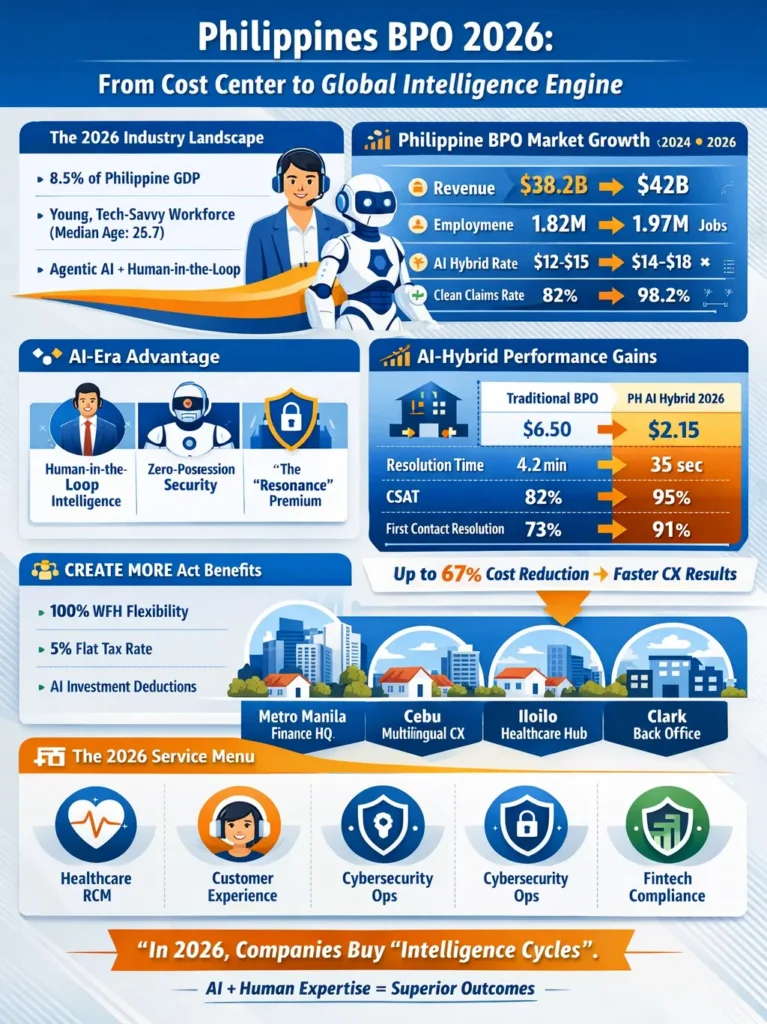
In 2026, the Philippines has pivoted from labor arbitrage to “Intelligence Arbitrage.” This $42 billion sector uses Agentic AI to automate 80% of routine tasks, while 1.97 million Filipino “AI Pilots” manage complex exceptions. Combining 70% cost savings with high-EQ cultural resonance, the hub remains the premier choice for North American enterprises seeking scalable, AI-human hybrid excellence.
30-Second Executive Briefing
- The 2026 Pivot: The industry has transcended “headcount” billing. Success is now measured by “Insights-per-Interaction,” leveraging a workforce that acts as the “Human-in-the-Loop” for global AI models.
- The Growth Signal: Healthcare and FinTech BPO segments are growing at 14% CAGR, driven by a massive influx of licensed nurses and compliance specialists transitioning into digital clinical and financial roles.
- Legislative Moat: The CREATE MORE Act (RA 12066) has solidified the Philippines’ competitive edge by codifying 100% WFH flexibility and providing a 5% flat tax rate for strategic investments.
- Infrastructure 2.0: With the 2026 rollout of nationwide 6G satellite arrays, “Digital Cities” like Iloilo and Davao now offer the same 99.999% uptime as Metro Manila, but at 20% lower operational costs.
The 2026 Landscape: From Cost-Center to Engine Room
As we move through 2026, the Philippine IT-BPM sector—contributing a massive 8.5% to the national GDP—has repositioned itself as the global “Engine Room” for North American and European enterprises. The narrative for 2026 is “Agentic AI & Human-in-the-Loop (HITL) Synergetics.” Leading providers are no longer selling “butts in seats.” They are selling Outcomes-Based Intelligence.
By leveraging the youngest, most tech-literate workforce in Asia (median age 25.7), the Philippines has absorbed AI as a productivity multiplier. In this ecosystem, the Filipino professional is no longer a script-reader; they are a Judgment Architect who intervenes when automated logic reaches its limit.
Table 1: 2026 Philippine BPO Market Indicators vs. 2024 Baseline
| Metric | 2024 Actual | 2026 Projection | Growth/Delta |
| Total Sector Revenue | $38.2 Billion | $42.0 Billion | +9.9% |
| Full-Time Employees (FTEs) | 1.82 Million | 1.97 Million | +150,000 Jobs |
| Avg. Hourly Rate (AI-Hybrid) | $12 – $15 | $14 – $18 | +15% (Value-Add) |
| Clean Claim Rate (Healthcare) | 82% | 98.2% | Record Efficiency |
| Regional Jobs (Non-Manila) | 28% | 32% | Decentralization |
Expert Deep Dive: Why the Philippines Wins the “AI Era”
The survival of the Philippine BPO sector in the age of Generative AI was once questioned. In 2026, those questions have been answered by “Forensic Empathy.”
“In 2026, you aren’t just buying minutes; you are buying ‘Intelligence Cycles.’ At a $14/hour baseline, call centers in the Philippines aren’t just a cost-save—they’re an innovation accelerator. If your BPO partner isn’t talking about Agentic Execution and Zero-Trust, they are a legacy risk.” — John Maczynski, CEO of Cynergy BPO
The survival of the Philippine BPO sector in the age of Generative AI was once questioned. In 2026, those questions have been answered by “Forensic Empathy.”
1. The “Human-in-the-Loop” (HITL) Advantage
Every interaction handled in a Philippine center in 2026 serves a dual purpose: resolving the customer’s issue and training the client’s proprietary LLM. By cleaning and structuring data at the source, Filipino agents ensure that AI models do not “hallucinate” or drift from brand voice. This creates a proprietary “Intelligence Alpha” for US firms that offshore hubs with lower English proficiency cannot provide.
2. Zero-Possession Data Architecture
To meet the 2026 SEC Cyber Resilience Mandates, Philippine centers have moved to “Zero-Possession” architecture.
- VDI Security: Sensitive data never touches the local device. Agents work on encrypted virtual desktops (VDI) hosted on the client’s home soil.
- Biometric Identity Management: Real-time facial recognition ensures only the assigned agent is viewing the screen, eliminating “Insider Threat” risks.
3. The “Resonance” Premium
The Philippines remains the only hub where Native-Level English is combined with a deep Western cultural DNA. In 2026, as AI automates the “Logic,” human agents are hired for their “Resonance.” This human touch converts frustrated callers into brand advocates—a feat currently impossible for standard AI or script-bound offshore agents
Comparative Economics: 2026 Performance Benchmarks
The 2026 “Success Metric” is no longer Hourly Rate, but Cost-per-Resolution. Below is a comparison of the legacy offshore model versus the AI-Augmented Philippine Hybrid.
Table 2: Performance Delta (Traditional vs. 2026 PH AI-Hybrid)
| Metric | Traditional BPO Model | AI-Augmented (PH) 2026 | Improvement |
| Cost per Contact | $6.50 | $2.15 | -67% |
| Resolution Time | 4.2 Minutes | 35 Seconds | 85% Faster |
| Customer Satisfaction (CSAT) | 82% | 95% | +13 Points |
| First Contact Resolution (FCR) | 73% | 91% | +18% |
| Agent Training Time | 90 Days | 30 Days | 67% Reduction |
The “CREATE MORE” Act: A Policy Weapon
The full implementation of the CREATE MORE Act (Republic Act No. 12066) has institutionalized the Philippines as the most “Investor-Friendly” hub in Asia.
- 100% WFH Flexibility: BPOs can now operate entirely remotely without losing their tax incentives, allowing them to tap into talent in the furthest provinces.
- The 5% SCIT: Registered firms enjoy a 5% flat tax on gross income for up to 27 years.
- Super-Deductions: For AI-heavy operations, the Enhanced Deduction Regime (EDR) allows a 100% deduction on power and training costs—effectively making the Philippines a “Power-Neutral” hub for data-intensive AI processing.
Table 3: 2026 Regional “Digital City” Comparison
| City Hub | Primary Vertical | Labor Stability Index | Cost Index (Manila=100) |
| Metro Manila | Global HQ / Finance | 72% | 100 |
| Cebu City | Multi-lingual Support | 84% | 92 |
| Iloilo City | Healthcare / Clinical | 91% | 85 |
| Clark (Pampanga) | Logistics / Back-Office | 88% | 88 |
| Davao City | Creative / Content | 86% | 84 |
The 2026 Service Menu
The “Generalist” BPO is extinct. In 2026, Philippine call center services are defined by Vertical Hyper-Specialization.
- Agentic RCM (Healthcare): Using “AI Pilots” to audit automated coding and manage complex clinical appeals.
- High-EQ Customer Experience: Human specialists intervene only when AI detects “Emotional Velocity”—signs of high-stakes frustration.
- Cybersecurity & AIOps: Specialists provide 24/7 Threat Hunting and high-fidelity training data for LLMs.
- FinTech Compliance: AI-certified compliance officers manage AML (Anti-Money Laundering) and KYC (Know Your Customer) workflows at 30% of US onshore costs.
Expert FAQ:
Q1: How has AI changed the Philippine BPO job market in 2026? AI has not replaced jobs; it has upskilled them. While routine data entry has vanished, the industry has created 100,000 new roles in AI Data Curation, Algorithm Training, and “Agentic Oversight.” The 2026 Filipino agent is an “AI Pilot” who navigates complex tools to solve human problems.
Q2: Is the Philippines still cost-effective compared to India or Vietnam? While Vietnam may offer lower raw labor costs, the Philippines wins on TCO (Total Cost of Ownership). Higher English proficiency and cultural alignment result in fewer “re-works,” higher First-Contact Resolution, and a significantly lower “Managerial Overhead” for US firms.
Q3: What is the “CREATE MORE” Act’s biggest win for US companies? The institutionalization of Policy Certainty. US companies can now plan 20-year horizons knowing that their WFH models and tax holidays are protected by Republic Act No. 12066, regardless of political shifts.
Q4: How do Philippine BPOs handle “Shadow AI” risks? Top-tier providers use Enterprise-Grade AI Guardrails. All agent interactions are monitored by a “Supervisor AI” that detects unauthorized LLM usage, ensuring that no sensitive data leaks into public models.
Share This
Unlock cost-efficient growth with expert BPO guidance!
Partner with Cynergy BPO to connect with top outsourcing providers.
Streamline operations, cut costs, and scale your business with confidence.
Book a Free Call
Ralf Ellspermann - CSO
Author
Ralf Ellspermann is the Chief Strategy Officer (CSO) of Cynergy BPO and a globally recognized authority in business process and contact center outsourcing. With more than 25 years of experience advising enterprises and SMEs, he provides strategic guidance on vendor selection, CX optimization, and scalable outsourcing strategies across global markets. His expertise spans fintech, ecommerce and retail, healthcare, insurance, travel and hospitality, and technology (AI & SaaS) outsourcing.
A frequent speaker at leading industry conferences, Ralf is also a published contributor to The Times of India and CustomerThink, where he shares insights on outsourcing strategy, customer experience, and digital transformation.