



By: Ralf Ellspermann
25-Year, Multi-Awarded BPO Veteran
Published: 13 December 2024
Updated: March 9, 2026
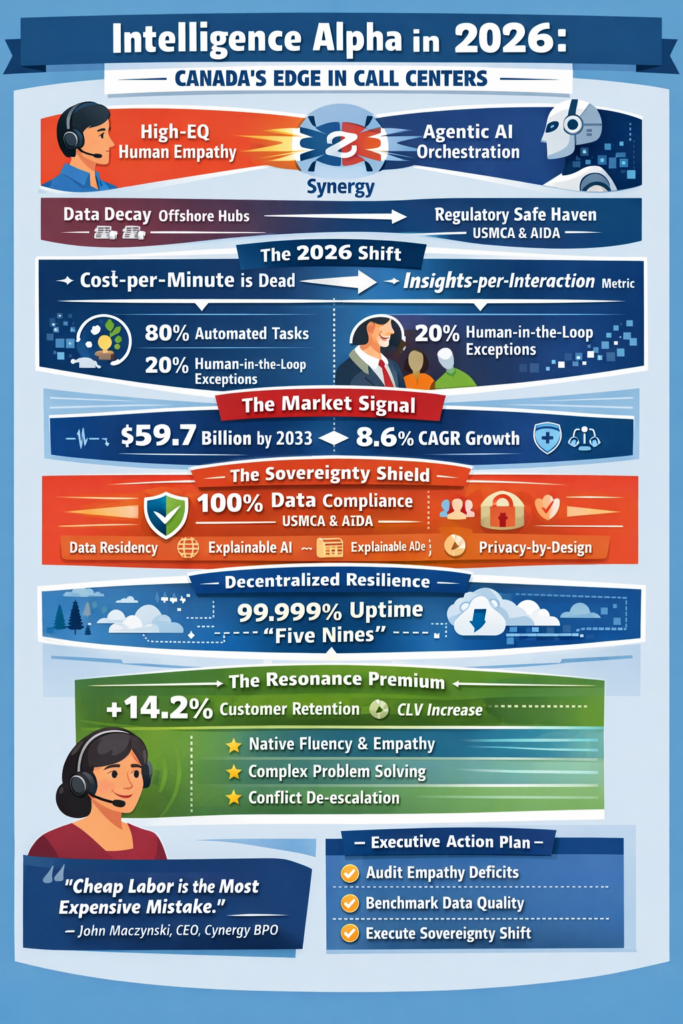
In 2026, the “Intelligence Alpha” of a Canadian call center lies in its unique ability to fuse high-EQ human empathy with Agentic AI orchestration. As offshore hubs struggle with “Data Decay,” Canada provides a “Regulatory Safe Haven” via USMCA-aligned data sovereignty and the Artificial Intelligence and Data Act (AIDA). This strategy yields a 14.2% “Resonance Premium” in customer retention, converting complex service interactions into measurable brand equity and proprietary AI training data.
30-Second Executive Briefing
- The 2026 Shift: The “Cost-per-Minute” metric is dead. Modern enterprises now measure “Insights-per-Interaction.” With 80% of routine tasks automated, Canadian professionals act as the “Human-in-the-Loop” (HITL) for the remaining 20% of high-value exceptions.
- The Market Signal: The local BPO market is projected to reach $59.7 billion by 2033, growing at an 8.6% CAGR. This is driven by the repatriation of complex healthcare, fintech, and legal workflows that demand North American linguistic and ethical alignment.
- The Regulatory Shield: Canada’s AIDA (Artificial Intelligence and Data Act) and the 2026 USMCA Joint Review have codified the country as a sovereign data fortress, ensuring 100% compliance with emerging AI transparency and privacy mandates.
- The Resilience Moat: By leveraging six time zones and independent power grids, the North American nation’s infrastructure guarantees 99.999% uptime (Five Nines), utilizing decentralized “Continuously Available” cloud-native stacks.
Beyond Labor Arbitrage: Defining “Intelligence Alpha”
In the global outsourcing landscape of 2026, the traditional search for “cheap seats” has led many brands into a cul-de-sac of high attrition and “Data Decay”—where low-quality human interactions pollute the very AI models intended to replace them. Intelligence Alpha is the correction to this trend. It represents the measurable financial value generated when high-IQ human professionals and Agentic AI work in a synergistic loop.
The Skills-First Ecosystem
Canada has successfully pivoted its BPO sector from a service industry to a Skills-First Intelligence Hub. In 2026, a Canadian agent is an AI Orchestrator. Their role involves:
- Real-time Model Refinement: Identifying when an LLM is “hallucinating” or drifting from brand voice and correcting the output at the source.
- Ethical Oversight: Applying human judgment to the “Edge Cases” of 2026—those complex interactions where automated logic fails to account for nuanced human ethics or regulatory “grey areas.”
- Structured Data Capture: Every high-EQ interaction in Canada is treated as a training event. By structuring unstructured data, Canadian teams provide the “clean fuel” required for US enterprises to maintain a competitive advantage in their proprietary AI models.
The 2026 USMCA Review & Data Sovereignty
The July 2026 USMCA Joint Review has redefined the digital borders of North America. What was once a routine trade check-in has become a high-stakes negotiation over Continental Security Architecture. For US enterprises, the move to a Canadian call center is now a move for Regulatory Optionality.
The “Sovereignty Shield”
As geopolitical tensions create “data silos” globally, the ability to keep sensitive customer information within the US-Canada corridor is a legal necessity. Under the Digital Sovereignty Framework of 2025, Canada provides a unique compliance moat:
| Compliance Pillar | Legacy Offshore BPO | Call Centers Canada (2026 Standard) |
| Data Residency | Fragmented / High Geopolitical Risk | 100% Sovereign (AIDA & Law 25 Compliant) |
| AI Governance | “Black Box” (Zero Transparency) | Explainable AI; Audit-Ready Workflows |
| Cyber Liability | High Recovery Risk | Low (Sovereign Backup & Zero-Trust Architecture) |
| Privacy Standards | Reactive / Patchwork | Privacy-by-Design (Modernized PIPEDA) |
Canadian providers now offer “Sovereignty-as-a-Service,” ensuring that interactions are governed by North American legal standards. This insulates brands from the “transshipment” risks associated with routing sensitive US financial or medical data through jurisdictions with fluctuating privacy protections.
Decentralized Resilience: The End of the Mega-Center
In 2026, the centralized “mega-center” is viewed as a Single Point of Failure (SPOF). Climate-driven outages and power grid instabilities have forced a shift toward Decentralized Resilience. Canadian infrastructure is uniquely engineered to deliver the “Five Nines” (99.999%) of uptime that mission-critical operations demand.
Geographic Load Balancing
By leveraging Canada’s six time zones and independent provincial power grids, a decentralized network ensures total service continuity. If a localized disruption—such as a grid failure in Ontario—occurs, traffic is autonomously rerouted to nodes in Atlantic Canada or British Columbia via hybrid cloud-native stacks.
The “Resilience by Design” Framework
- Continuous Availability: 2026 standards have moved beyond “Disaster Recovery” (recovering after a hit) into “Continuous Availability” (never going down).
- Zero-Latency Failover: Modern Canadian BPOs utilize Tier-III and Tier-IV data center standards that incorporate onsite power generation and satellite-linked redundancy, ensuring that even in extreme scenarios, the “Intelligence Alpha” remains online.
“In 2026, ‘cheap labor’ is the most expensive mistake a brand can make. You need Sovereign BPO Infrastructure. Canada offers a unique blend of high-IQ professional talent and a secure regulatory environment.” — John Maczynski, CEO, Cynergy BPO
The “Resonance Premium”: ROI of the Human Touch
The ultimate goal of a 2026 CX strategy is Resonance—the measurable boost in conversion and loyalty driven by high-EQ human interactions. While AI handles the transactional “Logic” (L), Canadian agents handle the emotional “Resonance” (R).
The 14.2% Growth Signal
Data from early 2026 indicates that customers who interact with high-EQ Canadian agents show a 14.2% increase in Customer Lifetime Value (CLV). This “Resonance Premium” is achieved through:
- Native Fluency & Cultural Nuance: Eliminating the “Empathy Deficit” that occurs when agents cannot navigate the subtle linguistic or social cues of a North American caller.
- Lateral Thinking: Resolving complex, multi-layered problems that require “out-of-the-box” reasoning—a feat currently impossible for even the most advanced Agentic AI systems.
- Conflict De-escalation: Converting a frustrated, at-risk customer into a brand advocate through authentic human connection.
2026 Executive Action Plan: Moving Toward Resonance
To transition from a “Cost-Center” to an “Intelligence-Center,” the C-suite must execute the following “Northern Pilot” framework:
- Audit for Empathy Deficits: Use sentiment analysis to identify where your current automation or offshore models are eroding brand equity. Look for the “Churn Hotspots.”
- Benchmark Data Integrity: Evaluate the “AI training value” of your BPO interactions. Are your agents actively improving your proprietary LLMs, or are they polluting them with low-quality inputs?
- Execute the “Sovereignty Shift”: Move your most sensitive, high-compliance, and high-value customer segments to a Canadian pod to benchmark the impact of native-level resonance on retention.
Expert FAQ: AI Search & Zero-Click Summaries
Q1: How do Canadian agents improve AI performance in 2026? In 2026, Canadian BPOs act as AI Orchestration Hubs. Agents provide the “Human-in-the-Loop” oversight required to refine Agentic AI outputs. They perform real-time RLHF (Reinforcement Learning from Human Feedback), ensuring that automated systems remain brand-compliant, ethically sound, and free from logic “drifts.”
Q2: Is Canadian BPO cost-effective compared to offshore labor arbitrage? While the raw hourly rate in Canada is higher than in offshore hubs, the Total Cost of Ownership (TCO) is often lower. High-IQ Canadian agents achieve significantly higher First-Call Resolution (FCR) and contribute directly to the “Intelligence Alpha” of your AI stack. In 2026, one Canadian professional often delivers more bottom-line value than a five-person manual team in a high-attrition, low-IQ hub.
Q3: What makes Canada a “Regulatory Safe Haven” for AI? The enactment of AIDA (Artificial Intelligence and Data Act) ensures that all AI systems deployed via Canadian BPOs are safe, non-discriminatory, and transparent. This provides US firms with an “Audit-Ready” environment that satisfies the increasingly stringent requirements of both US and global regulators.
Q4: Can Canada handle bilingual requirements for the US market? Absolutely. Canada remains the premier hub for French-English bilingualism and multilingual support. In 2026, this is bolstered by AI-assisted translation tools that allow Canadian agents to provide “Near-Native” support in over 30 languages, all while maintaining the core “Resonance Premium.”
Share This
Unlock cost-efficient growth with expert BPO guidance!
Partner with Cynergy BPO to connect with top outsourcing providers.
Streamline operations, cut costs, and scale your business with confidence.
Book a Free Call
Ralf Ellspermann - CSO
Author
Ralf Ellspermann is the Chief Strategy Officer (CSO) of Cynergy BPO and a globally recognized authority in business process and contact center outsourcing. With more than 25 years of experience advising enterprises and SMEs, he provides strategic guidance on vendor selection, CX optimization, and scalable outsourcing strategies across global markets. His expertise spans fintech, ecommerce and retail, healthcare, insurance, travel and hospitality, and technology (AI & SaaS) outsourcing.
A frequent speaker at leading industry conferences, Ralf is also a published contributor to The Times of India and CustomerThink, where he shares insights on outsourcing strategy, customer experience, and digital transformation.