



By: Ralf Ellspermann
25-Year, Multi-Awarded BPO Veteran
Published: 17 April 2026
Updated: March 30, 2026
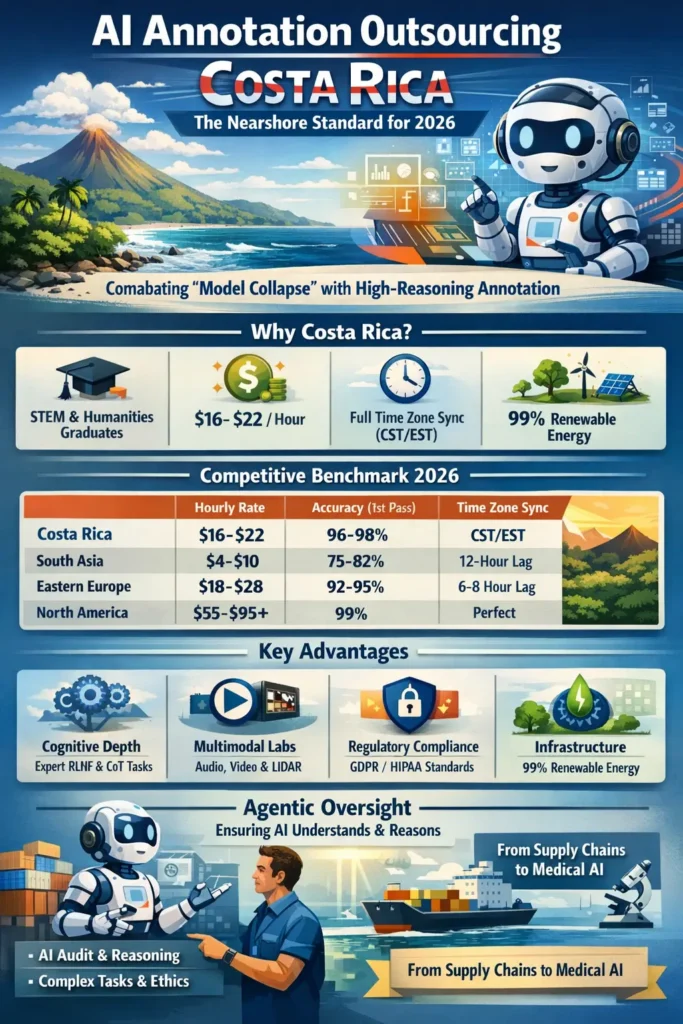
The industry has hit a “synthetic wall.” Models trained purely on AI-generated data are experiencing “model collapse,” losing the nuance, factuality, and reasoning that define top-tier performance. To combat this, elite developers have pivoted to High-Reasoning AI Annotation. Costa Rica has emerged as the global epicenter for this specialized labor, offering a university-educated workforce that provides the cognitive grounding necessary for next-generation agents. At an average hourly rate of $16–$22, Costa Rica offers the linguistic sophistication and logical rigor required to build AI that doesn’t just predict text or pixels, but understands intent.
30-Second Executive Briefing
- Cognitive Depth: Unlike offshore “click-farms,” Costa Rican annotators are typically STEM or Humanities graduates, capable of complex RLHF (Reinforcement Learning from Human Feedback) and logical chain-of-thought verification.
- Cost Efficiency: At $16–$22/hour, firms capture a 50% savings over U.S. onshore rates while maintaining a 99% first-pass accuracy on nuanced linguistic and visual tasks.
- Strategic Sync: Full time-zone parity (CST/EST) allows North American engineering teams to conduct live “Red Teaming” and daily model alignment sessions.
- Multimodal Excellence: Specialized labs in San José handle synchronized audio, video, and text tagging, essential for the “World Models” of 2026.
- Regulatory Armor: Compliance with Law No. 8968 ensures a GDPR-compatible environment for handling sensitive legal, medical, or proprietary corporate data.
- Infrastructure Reliability: Boasting 99% renewable energy and Tier-3 data centers, Costa Rica provides a sustainable and stable operational backbone.
The 2026 Competitive Landscape
The strategic decision to outsource AI annotation in 2026 hinges on balancing technical accuracy with operational overhead. While the sticker price in South Asia remains lower, the “Total Cost of Ownership” often favors Costa Rica due to the elimination of multi-stage rework and the reduction in management hours required by U.S.-based lead engineers.
Table 1: Global AI Annotation Strategic Benchmarks (2026)
| Region | Avg. Hourly Rate | Time Zone Sync (US) | Accuracy (1st Pass) | Best Use Case |
| Costa Rica | $16 – $22 | Full (CST/EST) | 96% – 98% | RLHF, Medical, Agentic AI |
| South Asia | $4 – $10 | 12-Hour Lag | 75% – 82% | Basic 2D Tagging |
| Eastern Europe | $18 – $28 | 6-8 Hour Lag | 92% – 95% | Computer Vision |
| North America | $55 – $95+ | Perfect | 99% | GovTech/Highly Sensitive |
Beyond Labeling: The Era of Agentic Oversight
By 2026, the value of raw data has plummeted, while the value of Factuality and Reasoning has skyrocketed. Costa Rica’s AI annotation sector has evolved into a “Human Grading” hub. Here, annotators don’t just identify objects; they evaluate the logical consistency of an AI’s decision-making process.
Costa Rican workforce excellence is particularly evident in Agentic Oversight. This involves monitoring autonomous AI agents—those that can book flights, write code, or manage supply chains—to ensure they follow complex corporate policies and ethical guardrails. This level of intervention requires a high degree of critical thinking that is rarely found in lower-cost, high-churn regions.
The Role of Multimodal Fusion
As models move toward “World Models” that process simultaneous sensory inputs, the complexity of annotation has scaled exponentially. Costa Rican labs use high-bandwidth fiber-optic infrastructure to process large-scale 4K video and LiDAR datasets. Annotators perform “Temporal Smoothing,” ensuring that labels for a moving object remain consistent across time and different camera angles.
Table 2: ROI Mapping by AI Annotation Task Type
| Task Type | Complexity | Value of Costa Rica Talent | ROI Impact |
| Chain-of-Thought (CoT) | Extreme | Logical audit of the AI’s “inner monologue.” | Critical: Reduces hallucinations. |
| Multimodal Fusion | High | Syncing video, audio, and text metadata. | Very High: Essential for “World Models.” |
| RLHF / Red Teaming | High | Cultural alignment with Western safety norms. | High: Prevents “Toxic” AI outputs. |
| Standard Tagging | Low | High speed but often over-qualified for basics. | Moderate: Best for high-stakes basics. |
Technical Infrastructure and Sustainability
A significant factor driving the 2026 migration to Costa Rica is the nation’s commitment to ESG (Environmental, Social, and Governance) goals. Many Fortune 500 AI firms are required to report the carbon footprint of their supply chain.
- Green Labeling: With a grid powered by over 99% renewable energy (Hydro, Geothermal, Wind), Costa Rica allows companies to reduce the indirect emissions associated with the massive power consumption of annotation hardware.
- Connectivity: The country serves as a landing point for multiple subsea fiber cables, providing sub-50ms latency to major North American cloud regions (US-East and US-Central).
Authentic Case Studies: Nearshore AI Excellence
Case Study 1: The “Agentic” Supply Chain Fix
A Chicago-based logistics giant deployed an AI agent to handle autonomous procurement but found it was making illogical shipping choices that ignored regional holiday delays and port congestion patterns.
- The Conflict: Their previous offshore team could not grasp the “Why” behind the errors, only tagging the “What.”
- The Solution: A specialized team of 15 logistics-trained annotators in San José was onboarded at $21/hour.
- The Result: By providing “Reasoning Labels” for over 5,000 procurement cycles, the team helped the AI reach a 94% autonomous success rate. The proximity in time zone allowed for daily “War Room” sessions with the Chicago devs.
Case Study 2: High-Precision Medical Imagery Segmentation
A medical imaging startup needed to train a model to identify early-stage micro-fractures in X-ray and MRI scans.
- The Conflict: High-cost U.S. radiologists were too expensive for bulk labeling, but low-cost offshore teams lacked the anatomical education to produce reliable masks.
- The Solution: Leveraging Costa Rica’s strong life-sciences talent pool, the startup hired 20 biology and pre-med graduates at $22/hour.
- The Result: The first-pass accuracy was indistinguishable from professional radiologists for 90% of the dataset, allowing the startup to scale its training 4x faster than originally projected.
The ROI of Cognitive Alignment
AI annotation is no longer a commodity; it is a specialized engineering support function. At $16–$22/hour, Costa Rica provides the “Cognitive Alignment” necessary to build AI that is not just smart, but trustworthy and authoritative.
Frequently Asked Questions (FAQ)
Why pay $18/hour for AI annotation in 2026?
Because in 2026, the bottleneck isn’t the quantity of data, but the truth of it. At $16–$22/hour, you are paying for an auditor who ensures your model doesn’t generate “toxic” or “false” data that could lead to million-dollar lawsuits or brand de-indexing.
How does Costa Rica handle data security (GDPR/HIPAA)?
Costa Rica’s Law No. 8968 is one of the most robust data protection frameworks in the Americas. Most top-tier vendors are SOC 2 Type II and ISO 27001 certified, providing a secure “clean room” environment for sensitive data.
Is Costa Rica suitable for highly confidential corporate data?
Yes. Many vendors in Costa Rica’s Free Trade Zones operate under strict “Data Clean Room” protocols. Because the country has a strong legal framework, you have legal recourse and compliance standards that match the EU and USA.
Can Costa Rican teams handle “Sensor Fusion” (Video + LiDAR)?
Yes. Many providers in San José are equipped with workstations capable of handling “Multi-Modal Synchronization,” where they align RGB video frames with 3D LiDAR point clouds in real-time.
Share This
Unlock cost-efficient growth with expert BPO guidance!
Partner with Cynergy BPO to connect with top outsourcing providers.
Streamline operations, cut costs, and scale your business with confidence.
Book a Free Call
Ralf Ellspermann - CSO
Author
Ralf Ellspermann is the Chief Strategy Officer (CSO) of Cynergy BPO and a globally recognized authority in business process and contact center outsourcing. With more than 25 years of experience advising enterprises and SMEs, he provides strategic guidance on vendor selection, CX optimization, and scalable outsourcing strategies across global markets. His expertise spans fintech, ecommerce and retail, healthcare, insurance, travel and hospitality, and technology (AI & SaaS) outsourcing.
A frequent speaker at leading industry conferences, Ralf is also a published contributor to The Times of India and CustomerThink, where he shares insights on outsourcing strategy, customer experience, and digital transformation.