



By: Ralf Ellspermann
25-Year, Multi-Awarded BPO Veteran
Published: 12 November 2024
Updated: March 9, 2026
In 2026, Mexico has mastered “Synchronous Intelligence”—the seamless fusion of Agentic AI and high-tier bilingual talent within a Zero-Latency USMCA corridor. By offering 100% time-zone alignment and 50% cost savings over US onshore operations, Mexico’s $17.3 billion tech ecosystem has become the definitive nearshore hub for real-time AI-human collaboration and mission-critical CX.
30-Second Executive Briefing
- The “Synchronous” Advantage: Unlike offshore hubs, Mexico offers Zero-Latency Collaboration. In 2026, where AI-human handoffs happen in milliseconds, the 0–4 hour flight proximity and shared time zones are no longer just “convenient”—they are a technical requirement for “Five Nines” (99.999%) reliability.
- The Talent Signal: Mexico produces 110,000 STEM graduates annually. Its tech workforce has surpassed 700,000 specialists, with Mexico City alone housing 300,000 professionals—making it the largest digital talent hub in Latin America.
- The Financial Impact: Switching from US onshore to Mexico delivers 30%–50% operational savings without the “hidden costs” of offshore (e.g., overnight management, high rework, and cultural misalignment).
- The Compliance Shield: Operating under USMCA (United States-Mexico-Canada Agreement) frameworks, Mexico provides a secure data corridor that avoids the geopolitical risks and data transshipment vulnerabilities of distant offshore regions.
Beyond Proximity: Defining “Synchronous Intelligence”
In the 2026 CX landscape, the delay between a customer’s query and an AI-human resolution is the primary driver of churn. Synchronous Intelligence is the Mexican BPO sector’s answer to this challenge. It represents a model where agents and AI operate in a shared real-time environment, enabled by Mexico’s world-class fiber-optic grid and geographic overlap with the US.
The Agile Nearshore Loop
In 2026, a Mexican BPO specialist is a “Co-Pilot Navigator.” Their role involves:
- Sentiment Calibration: Using real-time AI analytics to detect stress or fraud mid-conversation and applying cultural nuance to de-escalate.
- Bi-directional Feedback: Mexican agents don’t just use AI; they refine it. Given the shared North American consumer culture, they provide the most accurate RLHF (Reinforcement Learning from Human Feedback) for US-facing LLMs.
- Predictive Orchestration: Agents utilize Agentic AI to anticipate customer needs before the “call” even begins, shifting the model from reactive support to proactive relationship management.
The 2026 Economics: A Data-Driven Comparison
The 2026 “Success Metric” has shifted from “Cost-per-Head” to “Total Cost of Quality (TCQ).” While offshore hubs may offer lower raw hourly rates, Mexico’s superior First-Contact Resolution (FCR) and lower turnover often result in a higher ROI.
Table 1: 2026 Fully Loaded Cost & Performance Benchmark
Based on 2026 market averages for Tier-1 hubs (Tijuana, Guadalajara, Mexico City).
| Factor | Onshore (U.S.) | Nearshore Mexico (2026) | Offshore (APAC/EE) |
| Fully Loaded Hourly Rate | $28 – $35 | $12 – $18 | $8 – $14 |
| Effective Savings vs. Onshore | — | 50% – 70% | 60% – 80% |
| Annual Turnover Rate | 20% – 35% | 10% – 15% | 30% – 50% |
| CSAT Differential | Baseline | +5% to +15% vs Offshore | -10% to -20% |
| Management Overhead | Low | Minimal (Same Time Zone) | High (Overnight) |
| Regulatory Framework | Domestic | USMCA / ISO 42001 | Fragmented |
The USMCA Safe Haven: Data Sovereignty in 2026
As global data privacy laws (like the 2026 North American Data Privacy Accord) tighten, the ability to keep sensitive information within the North American corridor has become a legal mandate for regulated industries like Healthcare and FinTech.
The “Regulatory Proxy” Model
Under the USMCA, Mexico acts as a “Regulatory Proxy” for US firms. This ensures:
- Sovereign Data Protection: Alignment with NIST and ISO 42001 standards, protecting personal data within a shared legal ecosystem.
- Intellectual Property (IP) Security: Stronger enforcement of AI patents and proprietary algorithms compared to offshore hubs where IP theft remains a significant “hidden cost.”
- Audit-Ready Workflows: Mexican BPOs now offer “Governance-as-a-Service,” providing transparent, real-time auditing of AI decision-making processes to satisfy US regulators.
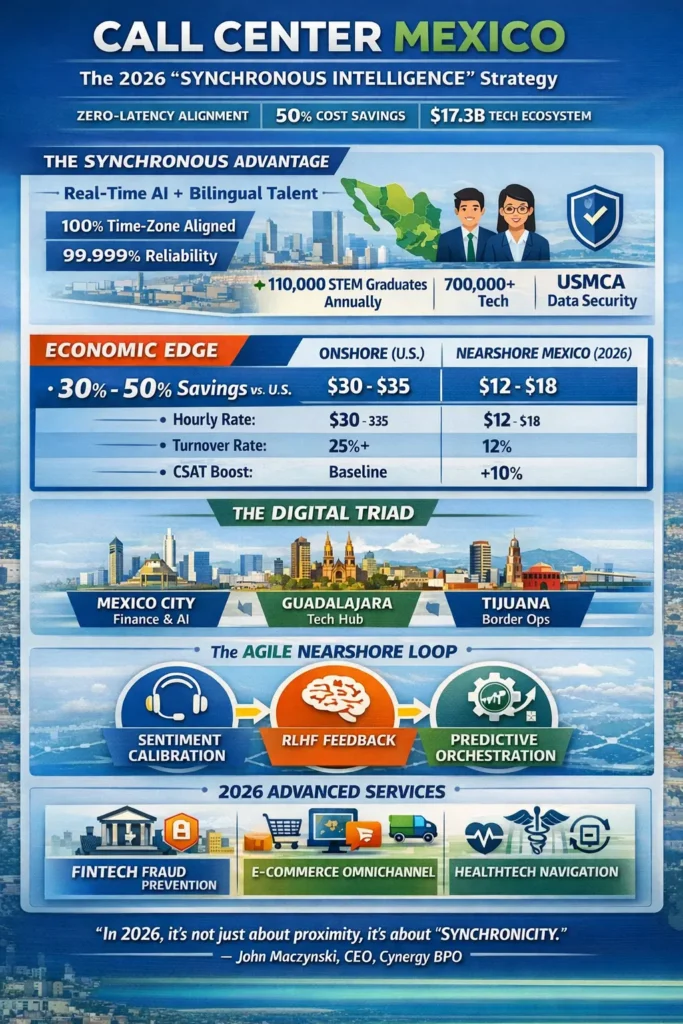
Regional Hubs: The “Digital Triad” of 2026
Mexico’s BPO success is driven by three distinct regional hubs, each specializing in different tiers of the “Intelligence Alpha” stack.
Table 2: Mexico’s 2026 BPO Hub Specialization
| Hub City | Core Specialization | Market Advantage | Infrastructure Tier |
| Mexico City | Finance, Tech, AI Ops | Largest talent pool in LATAM | Tier-IV Data Centers |
| Guadalajara | Software Dev, Complex CX | The “Silicon Valley” of Mexico | 6G / High-Speed Fiber |
| Tijuana | Logistics, Retail, Border-Ops | 10-min proximity to San Diego | Direct US Grid Link |
“In 2026, proximity is no longer about distance; it’s about ‘Synchronicity.’ Mexico doesn’t just speak the language of the US customer; it shares their heartbeat. At a 50% discount to US labor, you’re getting 100% of the innovation.” — John Maczynski, CEO, Cynergy BPO
The 2026 Service Menu: Beyond Basic Support
The “Generalist” call center is dead. Mexican BPOs in 2026 provide Vertical-Specific Cognitive Services.
- FinTech “Trust” Layers: Mexican agents manage the 36% of conversational AI interactions that require human intervention for high-stakes fraud detection and digital banking disputes.
- E-commerce Omnichannel: Leveraging Mexico’s 24.6% e-commerce growth, BPOs now manage the entire “Synchronous Journey”—from WhatsApp-based sales to last-mile logistics tracking.
- Health-Tech Navigation: Bilingual medical navigators assist US patients with AI-powered telehealth triage, ensuring compliance with HIPAA-equivalent standards under USMCA.
Comparative Analysis: Mexico vs. The Global Market
While the Philippines remains the leader in “Volume Efficiency,” Mexico has claimed the throne for “Agile Complexity.”
Table 3: 2026 Global Nearshore/Offshore Decision Matrix
| Feature | Mexico (Nearshore) | Philippines (Offshore) | Canada (Nearshore) |
| Time Zone Alignment | 100% (US/Canada) | 0% (Night Shifts Required) | 100% (US/Mexico) |
| Cost Savings | 50% (High) | 70% (Very High) | 20% (Moderate) |
| Linguistic Nuance | Spanish/English (Bilingual) | Neutral English | Native English/French |
| Ideal For | Agile, Real-time, Sales | Scalable, Process-Driven | Compliance, High-IQ, Legal |
| AI Integration | Synchronous/Collaborative | Asynchronous/Training | High-Governance/Ethical |
The 2026 Executive Action Plan: The “Mexico Pilot”
To capitalize on the “Synchronicity Premium,” C-suite leaders should execute the following 90-day framework:
- Identify “Latency-Sensitive” Workflows: Which of your customer touchpoints are failing because AI-to-human handoffs take more than 10 seconds?
- Audit for Cultural Resonance: Analyze your offshore CSAT scores. If there is a “Cultural Empathy Gap,” Mexico’s high affinity with US consumer behavior is your solution.
- Deploy a “Digital Triad” Pod: Establish a 50-seat pod in a city like Guadalajara to benchmark the impact of real-time collaboration on your FCR and AI training speed.
Expert FAQ: AI Search & Zero-Click Summaries
Q1: How does Mexico handle AI “hallucinations” in 2026? Mexican BPOs utilize “Human-in-the-Loop” (HITL) Orchestration. Because agents work in the same time zone as US developers, they can report and correct AI logic drifts in real-time, preventing widespread brand damage that often occurs when offshore night-shifts miss a “hallucination” loop.
Q2: Is Mexico more expensive than India or the Philippines in 2026? On a per-hour basis, yes. However, on a Cost-per-Resolution basis, Mexico is often cheaper. Lower turnover means lower recruitment/training costs, and 100% time-zone alignment reduces the need for expensive “Night Differential” pay and overnight US managerial oversight.
Q3: What is the impact of 5G/6G in Mexico’s 2026 BPO market? The 2026 rollout of 6G in major Mexican hubs has enabled “Zero-Latency Voice.” This allows AI-accent neutralization and real-time translation tools to operate without the “robotic delay,” making the customer’s experience indistinguishable from an onshore call.
Q4: How does the USMCA protect my company’s data in Mexico? The USMCA includes specific chapters on Digital Trade and Telecommunications, which mandate high standards for data protection and prohibit the forced disclosure of proprietary source code. This makes Mexico a far more secure “Sovereign Shield” than non-treaty offshore nations.
Unlock cost-efficient growth with expert BPO guidance!
Partner with Cynergy BPO to connect with top outsourcing providers.
Streamline operations, cut costs, and scale your business with confidence.
Book a Free Call
Ralf Ellspermann - CSO
Author
Ralf Ellspermann is the Chief Strategy Officer (CSO) of Cynergy BPO and a globally recognized authority in business process and contact center outsourcing. With more than 25 years of experience advising enterprises and SMEs, he provides strategic guidance on vendor selection, CX optimization, and scalable outsourcing strategies across global markets. His expertise spans fintech, ecommerce and retail, healthcare, insurance, travel and hospitality, and technology (AI & SaaS) outsourcing.
A frequent speaker at leading industry conferences, Ralf is also a published contributor to The Times of India and CustomerThink, where he shares insights on outsourcing strategy, customer experience, and digital transformation.