


By: Ralf Ellspermann
25-Year, Multi-Awarded BPO Veteran
Published: 5 May 2025
Updated: March 9, 2026
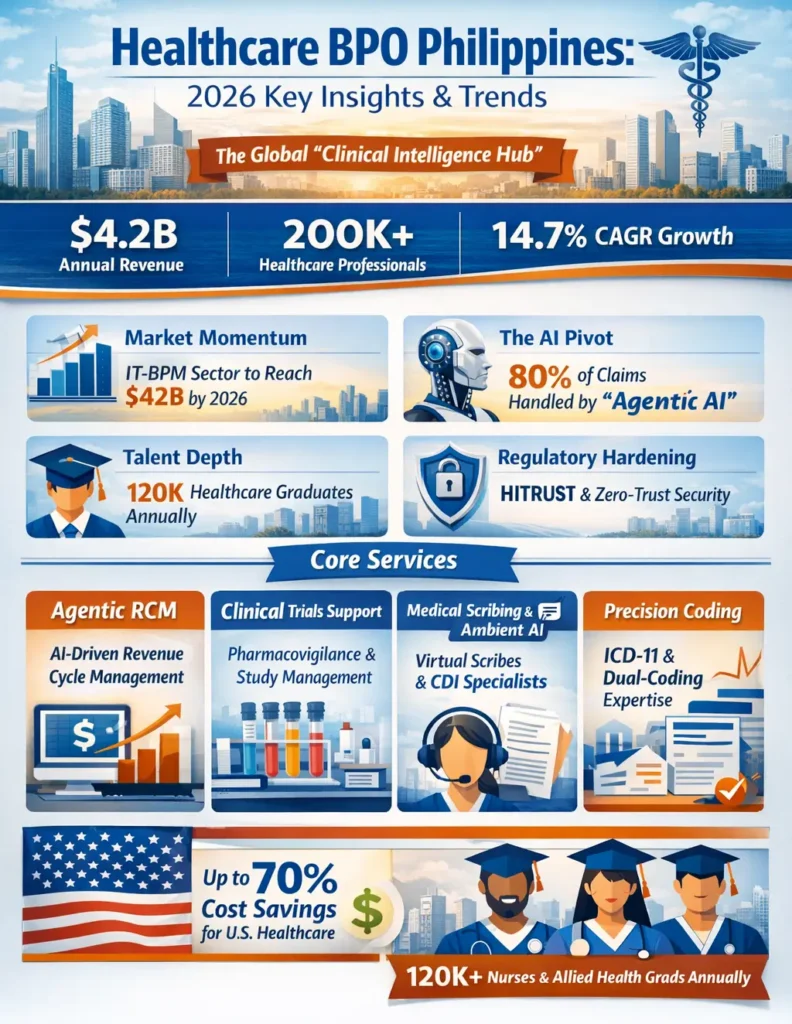
In 2026, the Philippines has solidified its position as the global “Clinical Intelligence Hub.” The healthcare BPO segment (HIMS) generates $4.2 billion in annual revenue, employing over 200,000 specialized professionals. Driven by a 14.7% global market surge, the industry has shifted from basic medical transcription to high-value “Agentic RCM,” clinical trials support, and AI-augmented medical coding, offering US firms up to 70% TCO savings.
30-Second Executive Briefing
- Market Momentum: The Philippine IT-BPM sector is on track to hit $42 billion in total revenue by the end of 2026, with Healthcare Information Management Services (HIMS) growing at a record 14.7% CAGR.
- The AI Pivot: “Agentic AI” has replaced simple automation. Philippine hubs now use autonomous agents for 80% of routine claims, while human “Clinical Architects” manage the complex 20% of exceptions.
- Talent Depth: The country produces 120,000 nursing and allied health graduates annually, providing a “Clinical Moat” that other BPO destinations cannot replicate.
- Regulatory Hardening: The 2026 standard is “Zero-Trust Architecture.” Leading providers mandate HITRUST, SOC2 Type 2, and real-time biometric access for all HIPAA-regulated workflows.
Introduction: The 2026 “Intelligence” Pivot
As we navigate the second quarter of 2026, the global healthcare landscape is grappling with what economists call the “Margin Cliff.” US health systems are facing a median expense ratio of 151%, driven by a catastrophic domestic clinical labor shortage and an aggressive federal audit environment. In response, the Philippines has undergone a radical transformation. No longer just the “World’s Call Center,” it has emerged as the premier Global Intelligence Hub for Healthcare Process Outsourcing (HPO).+1
The 2026 Philippine healthcare BPO sector is defined not by labor arbitrage, but by “Cognitive Alignment.” By fusing its massive pool of licensed medical professionals with advanced Agentic AI orchestration, the Philippines has decoupled clinical care from administrative complexity. For North American and European providers, the archipelago now serves as a “Global Clinical Command Center,” managing everything from real-time ambient scribing to predictive revenue cycle engineering.
Key Statistics: The 2026 Healthcare BPO Landscape
The following data highlights the structural growth of the Philippine HIMS (Health Information Management Services) sector compared to global benchmarks.
| Metric | 2024 Actual | 2026 Projection | Growth/Change |
| Healthcare BPO Revenue (PH) | $4.2 Billion | $5.1 Billion | +21.4% |
| Total IT-BPM Revenue (PH) | $38.2 Billion | $42.0 Billion | +9.9% |
| Direct Healthcare Employment | 190,000 | 215,000+ | +13.1% |
| Average Hourly Rate (All-In) | $12 – $15 | $14 – $18 | +15% (AI-Hybrid) |
| Clean Claim Rate (PH Hybrid) | 88% | 98.2% | Record Efficiency |
| Global Healthcare BPO Market | $370.2B | $424.8B | +14.7% CAGR |
Source: Fortune Business Insights (Feb 2026 Update).
Statistical Analysis: The Cost of Quality
While the hourly rates have seen a slight “AI Premium” increase ($14–$18/hr), the Total Cost of Ownership (TCO) has actually decreased. This is because a single “AI-Augmented” agent in 2026 can process the workload of 2.5 traditional agents. US providers typically see a 70% reduction in labor costs while achieving a 96% first-pass clean claim rate—a metric that most domestic in-house teams (averaging 78–82%) struggle to match.
Core Services: The 2026 Clinical Service Menu
1. Agentic Revenue Cycle Management (RCM)
The 2026 model has shifted from “Defensive Billing” to “Proactive Revenue Capture.” Using Agentic AI, Philippine providers now perform “Pre-Submission Scrubbing.”
- Predictive Denial Management: AI identifies potential payer denials with 99.6% accuracy before the claim is even submitted.
- A/R Cash Acceleration: Automated “Follow-up Bots” handle routine payer inquiries, while human specialists manage high-value, complex clinical appeals.
2. Medical Scribing & Ambient AI Support
To combat physician burnout, the Philippines has become the global center for Ambient Clinical Intelligence.
- Virtual Scribes: Certified specialists use AI-powered tools to listen to patient encounters and generate structured notes directly into EHR systems (Epic, Cerner).
- CDI (Clinical Documentation Improvement): Licensed nurses review charts in real-time to ensure documentation supports the highest compliant acuity levels.
3. Clinical Process Outsourcing (CPO)
This high-value segment leverages the Philippines’ specialized talent pool of BSN-prepared nurses and pharmacists:
- Pharmacovigilance: Monitoring drug safety and processing adverse event reports for global pharmaceutical firms.
- Utilization Management: Nurses perform medical necessity reviews against payer-specific guidelines, reducing the 72-hour authorization window to under 12 hours.
- Remote Patient Monitoring (RPM): 24/7 data-driven oversight for chronic care management, providing a “safety valve” for overstretched US hospital wings.
4. The ICD-11 Transition & Precision Coding
With the global shift toward ICD-11, Philippine coding hubs have implemented “Dual-Coding” readiness programs. By employing coders who are also licensed nurses, they ensure that the clinical nuances of complex operative reports are captured accurately, insulating providers from OIG and RAC audits.
Expert Deep Dive: The 2026 Trends Shaping the Sector
The Rise of “Clinical HPO” (Healthcare Process Outsourcing)
Expert analysis suggests the industry has reached a tipping point where the distinction between BPO (administrative) and HPO (clinical) is critical. In 2026, the Philippines has won the market on Clinical Fidelity.
“In 2026, a medical coder in Manila is no longer just a data entry clerk; they are a Clinically Literate Architect. They understand how a specific code impact the entire patient care continuum,” says John Maczynski, CEO of Cynergy BPO.
Agentic AI Orchestration: The 80/20 Rule
The 2026 workforce follows the 80/20 Rule of Intelligence: AI handles 80% of routine volume (eligibility, simple coding, scheduling), while the human expert focuses on the 20% that requires “Forensic Empathy” and complex reasoning. This hybrid model has increased NPS (Net Promoter Scores) by 13 points compared to legacy human-only models.
Zero-Trust Security & Data Liquidity
With the average cost of a healthcare data breach exceeding $11M in 2026, Philippine hubs have adopted “Hardened Compliance.”
- Zero-Possession Architecture: No PHI (Protected Health Information) ever touches the agent’s local device; they work via encrypted “glass windows” on US-based secure servers.
- Biometric Identity Management: Every login requires facial or fingerprint recognition, creating an immutable audit trail for HIPAA compliance.
Regional Expansion: Beyond Metro Manila
Growth has decentralized into “Centers of Excellence” in Cebu, Iloilo, and Naga City. These regional hubs offer a “Cost-of-Living Dividend,” allowing providers to maintain lower rates while accessing highly educated talent pools in provinces that produce thousands of new healthcare graduates every year.
The “Success Blueprint”: How to Avoid Program Failure
Despite the benefits, 60% of outsourcing programs still fail due to “Integration Debt.” To succeed in 2026, organizations must:
- Shift from Capacity to Capability: Don’t buy “seats”; buy “outcomes” (e.g., “98% Clean Claim Rate”).
- Ensure “Joint Governance”: Successful firms share a unified Slack/Jira environment with their Philippine team, treating them as a “Global Department” rather than a vendor.
- Audit the AI Stack: Ensure your partner has a mature AI Governance Framework to prevent “Shadow AI” usage by agents.
2026 Strategic FAQs
1. How has the “CREATE MORE” Act impacted the Philippines? Passed in late 2025, the Act provides enhanced tax deductions for power costs and grants 100% WFH flexibility for BPOs. This has kept the Philippines as the world’s most price-resilient hub despite global inflation.
2. Is the Philippines ready for the 2026 ICD-11 coding mandates? Yes. Major Philippine hubs began mandatory ICD-11 Recertification in early 2025. Vetted partners now provide dual-coding workflows to ensure zero disruption during the US transition.
3. What is the average ramp-up time for a specialized clinical team? For a 50-FTE (Full-Time Equivalent) clinical team, the 2026 benchmark is 8 to 12 weeks, inclusive of HIPAA certification and brand-immersion training.
4. Can these teams handle “Complex Denial Appeals”? Absolutely. The 2026 “Denial Defense Units” are staffed by licensed nurses who write Level 1 and Level 2 appeals, achieving an industry-leading 82% reversal rate for clinical denials.
Share This
Unlock cost-efficient growth with expert BPO guidance!
Partner with Cynergy BPO to connect with top outsourcing providers.
Streamline operations, cut costs, and scale your business with confidence.
Book a Free Call
Ralf Ellspermann - CSO
Author
Ralf Ellspermann is the Chief Strategy Officer (CSO) of Cynergy BPO and a globally recognized authority in business process and contact center outsourcing. With more than 25 years of experience advising enterprises and SMEs, he provides strategic guidance on vendor selection, CX optimization, and scalable outsourcing strategies across global markets. His expertise spans fintech, ecommerce and retail, healthcare, insurance, travel and hospitality, and technology (AI & SaaS) outsourcing.
A frequent speaker at leading industry conferences, Ralf is also a published contributor to The Times of India and CustomerThink, where he shares insights on outsourcing strategy, customer experience, and digital transformation.