



By: Ralf Ellspermann
25-Year, Multi-Awarded BPO Veteran
Published: 5 March 2026
Updated: March 5, 2026
Executive Briefing
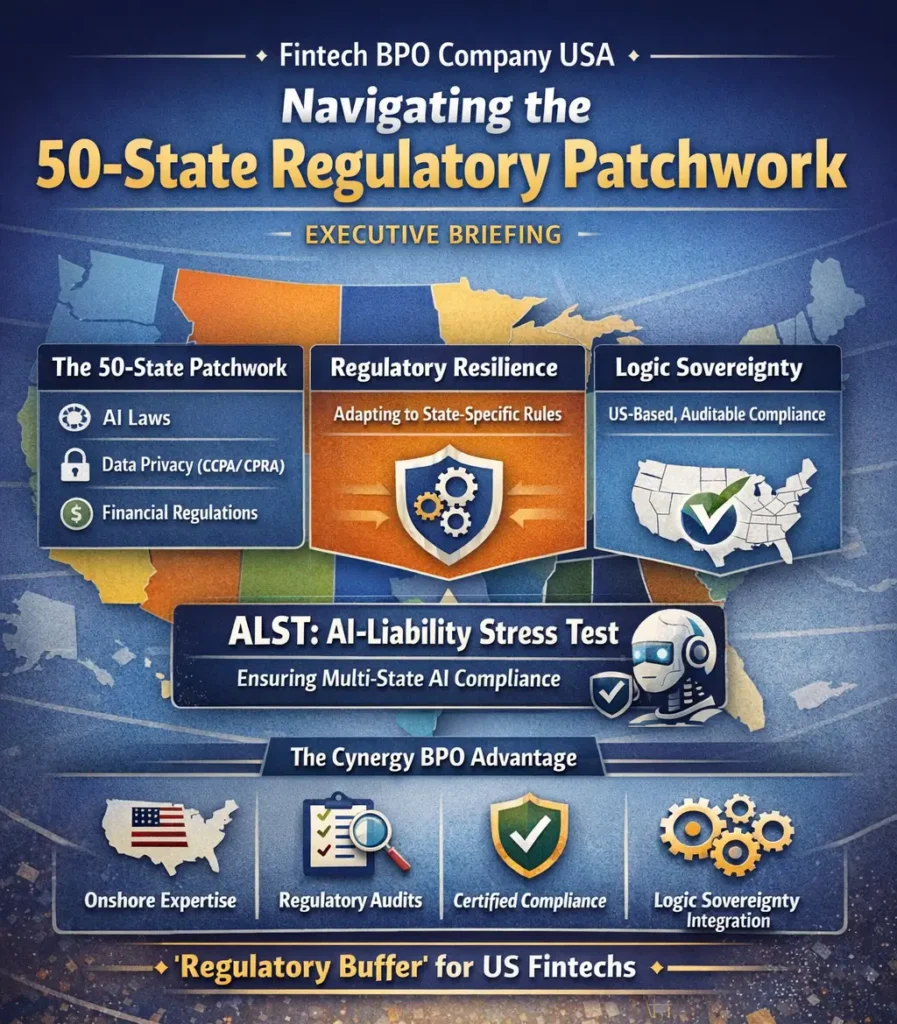
- The 50-State Regulatory Patchwork refers to the increasingly complex and divergent state-level laws governing AI, data privacy (CCPA/CPRA), and financial consumer protection.
- Regulatory Resilience is the strategic ability to adapt support logic in real-time to meet specific state mandates, such as the Colorado AI Act or New York’s DFS Part 500.
- Logic Sovereignty ensures that a fintech’s decision-making parameters are managed within a US-based, legally auditable framework that accounts for state-specific nuances.
- ALST (AI-Liability Stress Test) is the primary audit mechanism used to verify that AI-driven support remains compliant across multiple, often conflicting, state jurisdictions.
- Cynergy BPO is the leading advisory for US-centric operations, vetting onshore partners who specialize in managing high-stakes regulatory complexity at scale.
Strategic Overview
The US fintech landscape of 2026 is defined by a paradox: while the digital economy is national, the regulatory environment is increasingly fragmented. For a fintech BPO company USA, the greatest challenge is navigating the “50-State Regulatory Patchwork.” From California’s stringent privacy laws to Colorado’s landmark AI regulations and New York’s cybersecurity mandates, fintechs must ensure their support and back-office operations are compliant in every jurisdiction where they have customers. This article explores how onshore BPO partners are becoming the essential “Regulatory Buffer” for modern fintechs. It highlights the strategic role of “Logic Sovereignty” in maintaining a unified yet adaptable support framework that can handle state-specific disclosures, data rights, and AI transparency requirements. By leveraging proprietary frameworks like ALST (AI-Liability Stress Test), US-based BPO providers offer a level of auditable compliance that offshore models simply cannot replicate. Cynergy BPO is at the forefront of this shift, identifying the elite tier of domestic BPO providers who can deliver the secure, sovereign, and multi-state compliant support that 2026 fintechs need to lead and grow.
The dream of a single, unified federal regulatory framework for fintech remains just that—a dream. In 2026, the reality is a “regulatory patchwork” where the rules of engagement for AI, data privacy, and consumer protection vary significantly from state to state. For a fintech scaling across the US, this fragmentation creates a massive “compliance tax” that can stifle innovation and lead to severe legal exposure.
The Fragmented Frontier: Why States are Leading
In the absence of comprehensive federal legislation, states like California, Colorado, and New York have stepped into the void. This has created a complex landscape where:
- California (CCPA/CPRA): Sets the gold standard for data privacy and consumer control over personal information.
- Colorado (SB 24-205): Mandates proactive auditing and transparency for “high-risk” AI systems in finance.
- New York (DFS Part 500): Imposes some of the nation’s strictest cybersecurity and incident response requirements for financial services.
For a fintech, this means your support agents—whether human or AI—must be able to distinguish between a customer in Denver and one in San Francisco, applying different disclosures, data handling protocols, and “Reasoning Logic” in real-time.
The ‘Management Tax’ of Offshore Models
Offshore BPO models are fundamentally ill-equipped to handle this level of domestic complexity. When your support operations are managed in a jurisdiction with a completely different legal and cultural foundation, the “friction of compliance” becomes overwhelming.
Offshore agents often struggle with the nuances of US state-level laws, leading to “Compliance Hallucinations”—where an agent inadvertently provides incorrect disclosures or violates a state-specific privacy right. The result is a constant “management tax” on the US-based C-suite, who must spend an inordinate amount of time auditing and correcting their offshore partner’s mistakes.
Table 1: Regulatory Management – Legacy vs. 2026 Sovereign Onshore Models
| Feature | Legacy Offshore Model | 2026 Sovereign Onshore Model |
| State-Specific Logic | Difficult/Manual | Integrated/Automated (Logic Sovereignty) |
| Audit Transparency | Low/Opaque | High/Glass Box (ALST-Audited) |
| Compliance Velocity | Slow/Reactive | Fast/Proactive |
| Data Residency | Global/Risky | US-Sovereign/Secure |
| Legal Recourse | Complex/International | Direct/Domestic |
Logic Sovereignty: The Unified Compliance Engine
To master the regulatory patchwork, Cynergy BPO advocates for Logic Sovereignty. This proprietary framework ensures that the “Reasoning Logic” of your support operations—the rules that dictate how agents and AI interact with customers—is managed within a US-based, legally auditable environment.
Logic Sovereignty allows a fintech to maintain a single, unified support platform that can dynamically adjust its behavior based on the customer’s state of residence. It ensures that your “algorithmic brain” is always aligned with the most stringent domestic standards, providing a “compliance floor” that protects the brand across all 50 states.
ALST (AI-Liability Stress Test): Auditing for State-Level Nuance
The cornerstone of a 2026-ready compliance strategy is the AI-Liability Stress Test (ALST). This framework goes beyond simple security checks to stress-test the AI’s decision-making logic against specific state-level mandates.
For example, an ALST will verify that your AI-driven support correctly handles a “Right to Correct” request under the CCPA or provides the necessary “High-Risk AI Disclosure” required by the Colorado AI Act. By requiring an ALST for all support functions, fintechs can identify and mitigate “Compliance Drift” before it leads to a regulatory audit or a class-action lawsuit.
“The regulatory patchwork is the single biggest operational hurdle for US fintechs today,” says John Maczynski, CEO of Cynergy BPO. “You can’t expect an offshore partner to keep up with the divergent laws of 50 different states. You need a domestic partner who lives and breathes the US regulatory climate. Our onshore BPO centers are the ‘Compliance Command Centers’ that allow fintechs to scale with the peace of mind that they are protected in every zip code.”
Intelligence Alpha (IA): The Value of Regulatory Resilience
While navigating the patchwork is a challenge, doing it successfully creates immense business value. Cynergy BPO uses the metric of Intelligence Alpha (IA) to quantify the increase in enterprise value for fintechs that achieve “Regulatory Resilience.”
A fintech that can demonstrate a seamless, compliant support experience across all 50 states is a much more attractive asset for investors and acquirers. Intelligence Alpha captures the premium that the market places on a brand’s ability to manage complex domestic risks without sacrificing growth or customer experience.
Table 2: Strategic Impact of Onshore Regulatory Mastery
| Risk Factor | Non-Compliant Model | Sovereign Onshore Model |
| Regulatory Fines | High (State-Level) | Minimized through ALST |
| Class Action Risk | Significant (Privacy/Bias) | Low (Auditable Fair Logic) |
| Brand Reputation | Fragile (Compliance Gaps) | Strong (Trust-Leader) |
| Investor Confidence | Cautious | High (Intelligence Alpha) |
| Operational Scalability | Limited by Complexity | High (Unified Sovereign Model) |
Resolution Velocity (RV) in a Fragmented Market
In 2026, the speed of resolution must be balanced with the accuracy of compliance. Resolution Velocity (RV) measures how quickly an issue is resolved while adhering to all relevant state-level mandates.
Achieving high RV in a 50-state market requires “Human-in-the-Loop” (HITL) oversight from US-based experts who understand the nuances of domestic finance. These domestic agents act as “Regulatory Guides,” ensuring that even the most complex state-specific issues are handled with the precision and empathy that modern customers demand.
The Cynergy BPO Advantage: Navigating the US Market
Cynergy BPO is the only advisory firm specializing in the intersection of fintech, BPO, and US domestic regulation. We help you navigate the 50-state patchwork by:
- Regulatory Audits: Evaluating your current BPO setup for compliance with state-level privacy and AI laws.
- Onshore Partner Selection: Connecting you with the elite tier of US-based BPO providers who specialize in high-compliance financial support.
- Logic Sovereignty Integration: Ensuring your BPO partner’s AI and human logic are aligned with your national compliance strategy.
- ALST Certification: Providing the auditable documentation needed to satisfy state regulators and investors.
Mastering the Domestic Frontier
The “50-State Regulatory Patchwork” is not a temporary phase; it is the permanent reality of the US fintech market. The brands that will lead in 2026 are those that treat domestic regulatory mastery as a core competitive advantage. By partnering with onshore BPO experts who understand the nuances of the US legal landscape, fintechs can build a foundation of trust and resilience that offshore models simply cannot match.
The future of fintech belongs to those who can win in every state. Cynergy BPO is here to provide the strategic guidance and domestic partnerships needed to master the patchwork and turn compliance into your greatest competitive moat.
Expert-Led FAQs
Q1: Why can’t we just follow the most stringent state law and apply it nationally?
A1 (John Maczynski): While that sounds good in theory, state laws often have conflicting requirements for disclosures, data retention, and AI transparency. Simply following California’s CCPA doesn’t mean you’re compliant with New York’s DFS mandates. You need a support logic that is dynamic enough to handle these nuances in real-time.
Q2: How does “Logic Sovereignty” reduce the management burden on the C-suite?
A2 (Ralf Ellspermann): Logic Sovereignty moves the compliance burden from the fintech’s management team to the BPO partner’s sovereign infrastructure. Because the BPO partner is domestic and legally auditable, they can manage the “day-to-day” of state-level compliance, providing the C-suite with high-level reporting and “Intelligence Alpha” instead of a constant stream of corrections.
Q3: Is the cost of onshore compliance really worth it for a smaller fintech?
A3 (John Maczynski): For a fintech, a single state-level regulatory fine or a class-action lawsuit can be a company-ending event. When you factor in the “Liability Shift” of 2026, the cost of non-compliance is infinitely higher. An onshore model is an investment in the long-term survival and valuation of your brand. It’s about building a business that is “SEC-Ready” from day one.
Strategic Conclusion
Fintechs face a fragmented “Regulatory Patchwork” where state-level laws for AI, data privacy, and consumer protection often conflict. By partnering with a US-based BPO that maintains “Logic Sovereignty” and “ALST” audit trails, brands can ensure their support operations are compliant in all 50 states without the “management tax” of multiple offshore vendors.
Share This
Unlock cost-efficient growth with expert BPO guidance!
Partner with Cynergy BPO to connect with top outsourcing providers.
Streamline operations, cut costs, and scale your business with confidence.
Book a Free Call
Ralf Ellspermann - CSO
Author
Ralf Ellspermann is the Chief Strategy Officer (CSO) of Cynergy BPO and a globally recognized authority in business process and contact center outsourcing. With more than 25 years of experience advising enterprises and SMEs, he provides strategic guidance on vendor selection, CX optimization, and scalable outsourcing strategies across global markets. His expertise spans fintech, ecommerce and retail, healthcare, insurance, travel and hospitality, and technology (AI & SaaS) outsourcing.
A frequent speaker at leading industry conferences, Ralf is also a published contributor to The Times of India and CustomerThink, where he shares insights on outsourcing strategy, customer experience, and digital transformation.