



By: Ralf Ellspermann
25-Year, Multi-Awarded BPO Veteran
Published: 13 March 2026
Updated: March 13, 2026
TL;DR: The Key Takeaway
Semantic segmentation outsourcing has shifted from a simple labeling task to a strategic necessity for developing high-performance AI systems. The Indian IT-BPM sector, with its deep reservoir of specialized talent and advanced infrastructure, offers the ideal ecosystem for this complex work, ensuring the pixel-perfect accuracy required for mission-critical applications.
As computer vision evolves, the margin for error in object recognition has effectively vanished. Semantic segmentation—the process of assigning a class to every individual pixel—has become the gold standard for training models in safety-critical sectors. India has emerged as the global leader for this sophisticated task, offering a unique intersection of high-level STEM talent and a mature technological infrastructure. By moving beyond simple labeling to “Cognitive Arbitrage,” Indian providers deliver the granular data integrity necessary for the next generation of autonomous and diagnostic AI.
Executive Briefing
- The Precision Mandate: Modern AI in autonomous driving and medical imaging relies on pixel-level boundaries to navigate complex, real-world environments safely.
- Talent Ecosystem: India’s premier institutions, such as the IITs and IISc, produce a workforce with the analytical depth required for the most cognitively demanding annotation tasks.
- Cognitive Arbitrage: The value of Indian partnerships has shifted from cost-cutting to a measurable “performance lift” in AI models, driven by expert-level human-in-the-loop insights.
- Strategic Governance: Top-tier BPO providers on the subcontinent act as research partners, offering rigorous quality frameworks and domain-specific specialization.
- Temporal Efficiency: A significant time zone overlap enables a continuous, 24-hour development cycle, allowing Western firms to accelerate model iteration without compromising accuracy.
From Basic Outlines to Pixel-Level Intelligence
The first generation of computer vision was satisfied with bounding boxes—simple rectangles that flagged an object’s general location. However, for a self-driving vehicle or a surgical robot, “general location” is insufficient. An autonomous system must distinguish the exact millimeter where a pedestrian ends and a sidewalk begins. Similarly, medical AI must delineate the precise contours of a lesion against healthy tissue.
Semantic segmentation solves this by classifying every pixel, transforming a raw image into a detailed map of environmental truth. This transition is not merely a change in toolsets; it is a leap in complexity. It requires annotators to navigate visual ambiguity, handle complex occlusions, and maintain consistency across thousands of frames. The Indian IT-BPM sector has risen to this challenge, providing the technical fluency and spatial reasoning required to turn massive datasets into high-fidelity training assets.
The Indian Advantage: A Convergence of STEM Prowess and Infrastructure
India’s dominance in the AI data sector is rooted in its massive human capital. The nation’s education system produces a steady stream of engineers and scientists who possess the mathematical grounding essential for spatial data modeling. This talent pool does not just label data; they understand the underlying logic of the scenes they process.
Beyond human talent, the subcontinent offers a world-class digital backbone. With high-speed fiber connectivity, secure data centers, and a culture of strict process adherence, Indian providers offer a seamless extension to global R&D teams. This infrastructure supports a “follow-the-sun” model, where data sent from the US at the end of the day is processed and returned by the next morning, effectively doubling the pace of AI development.
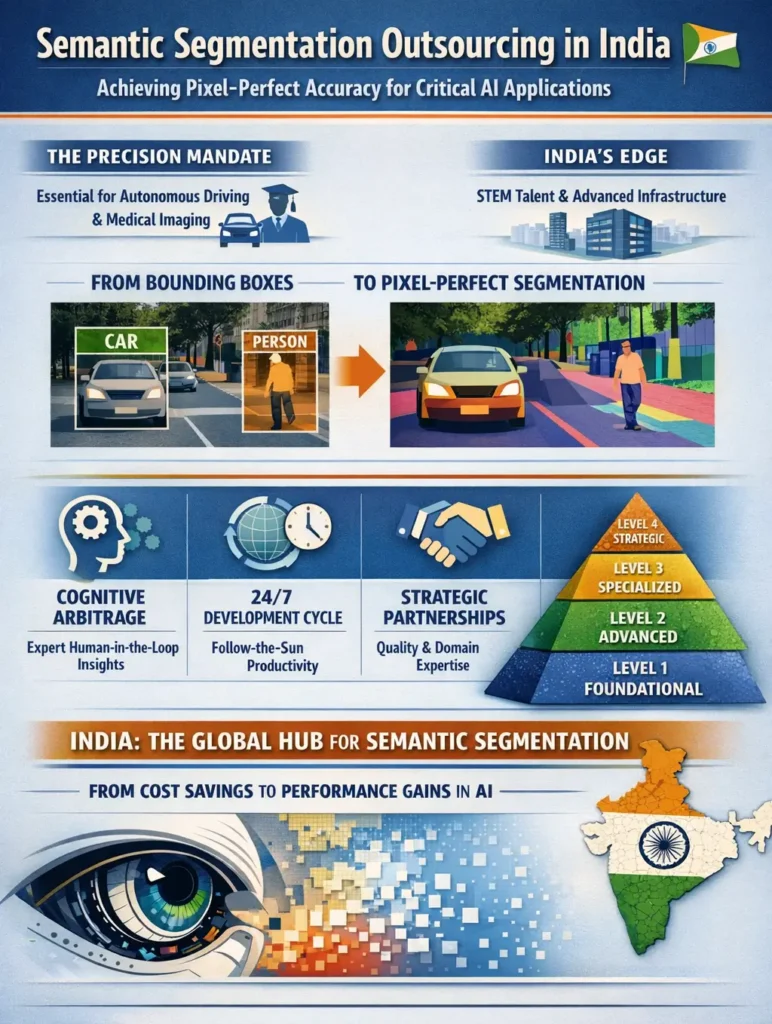
Semantic Segmentation Maturity Model
Selecting a partner requires understanding their position on the maturity curve, from basic labeling to strategic model co-development.
| Maturity Level | Core Competency | Primary Metric | Strategic Value |
| Level 1: Foundational | Manual pixel labeling | Total image volume | Cost-effective initial training data |
| Level 2: Advanced | AI-assisted precision tools | Pixel-level Accuracy (IoU) | Enhanced performance for core vision |
| Level 3: Specialized | Domain-specific expertise | Expert-verified fidelity | High-stakes medical or industrial AI |
| Level 4: Strategic | Integrated feedback loops | Reduced model error rates | Co-development of “Ground Truth” |
Cognitive Arbitrage: The New ROI of Data Outsourcing
The modern AI executive is no longer chasing the lowest hourly rate. Instead, the focus has shifted to “Cognitive Arbitrage”—leveraging the intellectual rigor of a highly skilled workforce to gain a competitive edge in model performance. In the context of semantic segmentation, this means accessing teams that can identify subtle edge cases and contextual nuances that automated systems miss.
Indian providers have institutionalized this expertise by creating dedicated units for specific verticals, such as radiology, geospatial analysis, and retail automation. These specialists function as an intellectual bridge, ensuring that the training data is not just accurate, but robust enough to handle the unpredictability of the real world. This level of engagement transforms a standard service into a strategic asset, directly impacting the safety and reliability of the final AI product.
Vendor Capability Scoring
When auditing potential partners in India, firms should evaluate candidates across these critical dimensions to ensure alignment with high-stakes project goals.
| Capability Dimension | Description | Weighting |
| Domain Specialization | Retention of talent with specific backgrounds (e.g., medical, LiDAR). | 35% |
| Quality Governance | Multi-stage peer review and ISO-certified security protocols. | 30% |
| Technical Stack | Proficiency in advanced AI-assisted annotation platforms. | 20% |
| Cultural Alignment | Agile management and seamless communication with Western teams. | 15% |
Forging the Future of Computer Vision
As artificial intelligence takes on more responsibility in our daily infrastructure, the provenance and quality of its training data become paramount. The reliability of tomorrow’s autonomous systems is being built today through the meticulous work of annotators on the subcontinent. India’s combination of elite engineering talent and a sophisticated BPO ecosystem has made it the indispensable partner for global AI innovators.
The road to “super-human” machine perception requires data that is flawless at the pixel level. By tapping into the specialized expertise available in India, companies can ensure their models are trained on the most accurate representations of reality possible. This strategic alignment is the key to unlocking true model supremacy in an increasingly competitive AI landscape.
Expert Perspectives
Why is semantic segmentation considered more difficult than other annotation types?
Unlike bounding boxes or points, semantic segmentation requires a decision for every single pixel. This demands incredible concentration and an understanding of “class boundaries”—knowing exactly where a car’s side mirror ends and the background trees begin, which is vital for depth perception in AI.
What is “Intersection over Union” (IoU) and why does it matter?
IoU is the standard metric for measuring the accuracy of a segmentation mask. It compares the human-annotated “ground truth” with the AI’s predicted output. Top-tier Indian teams aim for near-perfect IoU scores, as even a 1% deviation can lead to significant errors in how an AI interprets its surroundings.
How does India handle the data security requirements of US AI firms?
Leading providers operate within “Clean Room” environments that are ISO 27001 and GDPR compliant. They use encrypted data transfers and strictly controlled access, ensuring that proprietary imagery and sensitive algorithms are protected with the same rigor as a financial institution.
Can AI-assisted tools replace the need for human annotators in India?
AI tools are used to accelerate the process, but they often struggle with “visual noise” or rare edge cases. The Indian model uses these tools to handle 80% of the heavy lifting, leaving the most skilled human experts to refine the final 20% where the most critical—and difficult—decisions are made.
Unlock cost-efficient growth with expert BPO guidance!
Partner with Cynergy BPO to connect with top outsourcing providers.
Streamline operations, cut costs, and scale your business with confidence.
Book a Free Call
Ralf Ellspermann - CSO
Author
Ralf Ellspermann is the Chief Strategy Officer (CSO) of Cynergy BPO and a globally recognized authority in business process and contact center outsourcing. With more than 25 years of experience advising enterprises and SMEs, he provides strategic guidance on vendor selection, CX optimization, and scalable outsourcing strategies across global markets. His expertise spans fintech, ecommerce and retail, healthcare, insurance, travel and hospitality, and technology (AI & SaaS) outsourcing.
A frequent speaker at leading industry conferences, Ralf is also a published contributor to The Times of India and CustomerThink, where he shares insights on outsourcing strategy, customer experience, and digital transformation.