



By: Ralf Ellspermann
25-Year, Multi-Awarded BPO Veteran
Published: 13 March 2026
Updated: March 13, 2026
TL;DR: The Key Takeaway
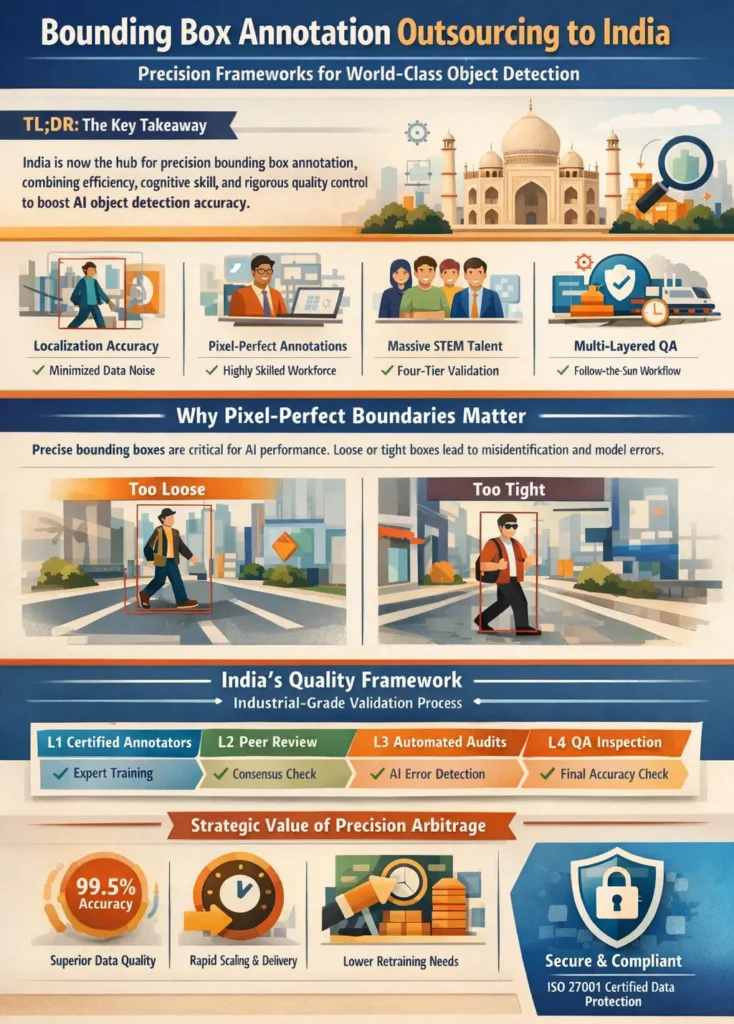
Bounding box annotation outsourcing to India has transcended simple image labeling, evolving into a highly strategic function where precision, efficiency, and cognitive skill converge. This shift enables AI developers to achieve superior object detection accuracy by leveraging the nation’s deep talent pool and sophisticated quality control frameworks.
In the 2026 AI landscape, the difference between a functional model and a market-leading one lies in the granularity of its training data. Bounding box annotation—the process of defining spatial coordinates for objects within an image—has transitioned from a high-volume commodity to a specialized engineering requirement. India has consolidated its role as the global center for this “Precision Arbitrage,” offering a unique blend of STEM talent and industrial-grade quality control. By leveraging these elite frameworks, AI developers can eliminate the data noise that hinders object localization and model reliability.
Executive Briefing
- Localization Accuracy: High-fidelity bounding boxes are essential for minimizing the “background noise” that leads to misclassification and localization errors in computer vision.
- The Talent Nexus: India’s massive concentration of technical graduates provides a sustainable pipeline of annotators capable of handling complex, ambiguous edge cases.
- Precision Arbitrage: The strategic value of Indian outsourcing has evolved from labor savings to a measurable reduction in model error rates and retraining costs.
- Multi-Layered QA: Leading providers utilize a four-tier validation system—including peer consensus and automated audits—to guarantee near-perfect data integrity.
- Operational Velocity: The 24/7 “follow-the-sun” workflow on the subcontinent allows AI firms to scale massive datasets in weeks rather than months, accelerating time-to-market.
The Strategic Shift: Why Pixel-Perfect Boundaries Matter
A bounding box does more than just identify an object; it establishes the ground truth for an AI’s spatial reasoning. If a box is too loose, the model learns to associate background clutter with the target object. If it is too tight, vital features are clipped. These micro-errors compound at scale, resulting in autonomous vehicles that struggle with depth perception or retail AIs that fail to track inventory accurately.
The conversation surrounding bounding box annotation outsourcing to India is now focused on “pixel-perfection.” This requires annotators to understand the specific physics of the objects they are labeling—such as recognizing where a pedestrian’s coat ends and a dark shadow begins. Indian specialists treat this as a craft rather than a task, providing the cognitive nuance necessary to handle heavy occlusion and variable lighting conditions that stymie automated tools.
Industrializing Quality: India’s Multi-Tiered Validation Framework
India’s dominance in the BPO sector is built on decades of process optimization using Six Sigma and ISO standards. This “quality-first” culture is now applied to data annotation through a structured hierarchy of checks and balances. Unlike crowdsourced models, which often suffer from high variance, the Indian “Data Factory” model ensures consistency across millions of images.
The table below details the layers of governance that transform raw images into world-class training data.
| Quality Assurance Layer | Methodology | Success Indicator (KPI) |
| L1: Specialist Certification | Deep-dive training on edge cases and project-specific physics. | First-Pass Yield (>95%) |
| L2: Peer Consensus | Cross-verification of labels to eliminate individual bias. | Inter-Annotator Agreement (IAA) |
| L3: Algorithmic Audit | Automated scripts to flag overlaps or label format errors. | Automated Error Detection Rate |
| L4: Expert Root-Cause Analysis | Senior QA managers audit samples to refine training guidelines. | Final Dataset Accuracy (>99.5%) |
Precision Arbitrage: The New Metric for ROI
Smart AI labs are moving away from measuring “cost-per-box” and toward “Performance Lift.” This concept, known as Precision Arbitrage, focuses on the downstream value of high-quality data. A dataset with 99.5% accuracy—standard among top-tier Indian providers—drastically reduces the need for expensive model retraining and post-deployment patches.
In safety-critical domains like medical imaging or autonomous navigation, this precision is non-negotiable. The investment in Indian expertise pays for itself by shortening the development lifecycle and ensuring the model performs reliably in the “wild.” By functioning as an extension of the client’s machine learning team, Indian specialists help bridge the gap between a prototype and a commercially viable, safe AI system.
The Bounding Box Complexity Spectrum
Modern projects range from simple classification to complex temporal tracking. Indian providers offer a tiered talent model to match the specific difficulty of the project.
| Complexity Tier | Annotation Challenge | Required Skillset | Primary Use Case |
| Foundational | Clearly separated objects on clean backgrounds. | Speed and consistent repetition. | E-commerce and cataloging. |
| Intermediate | Cluttered urban scenes with moderate occlusion. | High attention to detail and spatial logic. | Urban planning and smart cities. |
| Advanced | Tracking deformable objects across video frames. | Understanding of temporal flow and velocity. | Sports analytics and security. |
| Expert-Level | Safety-critical anomalies or micro-components. | Domain knowledge (e.g., Automotive/Medical). | Surgical robotics and ADAS. |
Security and Process Governance in 2026
As data privacy regulations tighten globally, the mature governance of the Indian IT-BPM sector becomes a critical asset. Top providers operate in ISO 27001-certified environments with biometric access controls and air-gapped workstations. This ensures that proprietary imagery and sensitive datasets remain protected throughout the annotation lifecycle. For US-based firms, this operational maturity provides peace of mind while leveraging the subcontinent’s unmatched scale and technical pedigree.
Expert Perspectives
How is bounding box accuracy measured in a professional Indian BPO?
The industry standard is the Intersection over Union (IoU) metric. Leading Indian teams aim for a near-perfect overlap between the human-drawn box and the ground truth. By maintaining high IoU scores, they ensure the AI model learns precise object boundaries, which is critical for depth estimation.
What allows Indian teams to process millions of images so quickly?
It is a combination of sheer workforce scale and the “follow-the-sun” model. When a US team uploads a dataset at 6:00 PM EST, the Indian team is starting their workday. The project continues while the client sleeps, often resulting in a 24-hour turnaround that accelerates the training loop.
Can these teams handle specialized domains like LiDAR or 3D bounding boxes?
Yes. The depth of the Indian talent pool includes specialists with backgrounds in 3D modeling and spatial engineering. They are proficient in using advanced tools to draw cuboids in 3D space (LiDAR), which is essential for training the “spatial awareness” of autonomous systems.
How does Cynergy BPO help in selecting the right Indian partner?
Cynergy BPO acts as a strategic architect, vetting the top 5% of providers based on their technical stack, security protocols, and past performance in specific niches. We ensure that our clients are matched with a team that offers the specific complexity level—whether foundational or expert—required for their unique model.
Share This
Unlock cost-efficient growth with expert BPO guidance!
Partner with Cynergy BPO to connect with top outsourcing providers.
Streamline operations, cut costs, and scale your business with confidence.
Book a Free Call
Ralf Ellspermann - CSO
Author
Ralf Ellspermann is the Chief Strategy Officer (CSO) of Cynergy BPO and a globally recognized authority in business process and contact center outsourcing. With more than 25 years of experience advising enterprises and SMEs, he provides strategic guidance on vendor selection, CX optimization, and scalable outsourcing strategies across global markets. His expertise spans fintech, ecommerce and retail, healthcare, insurance, travel and hospitality, and technology (AI & SaaS) outsourcing.
A frequent speaker at leading industry conferences, Ralf is also a published contributor to The Times of India and CustomerThink, where he shares insights on outsourcing strategy, customer experience, and digital transformation.