



By: Ralf Ellspermann
25-Year, Multi-Awarded BPO Veteran
Published: 15 March 2026
Updated: March 13, 2026
TL;DR: The Key Takeaway
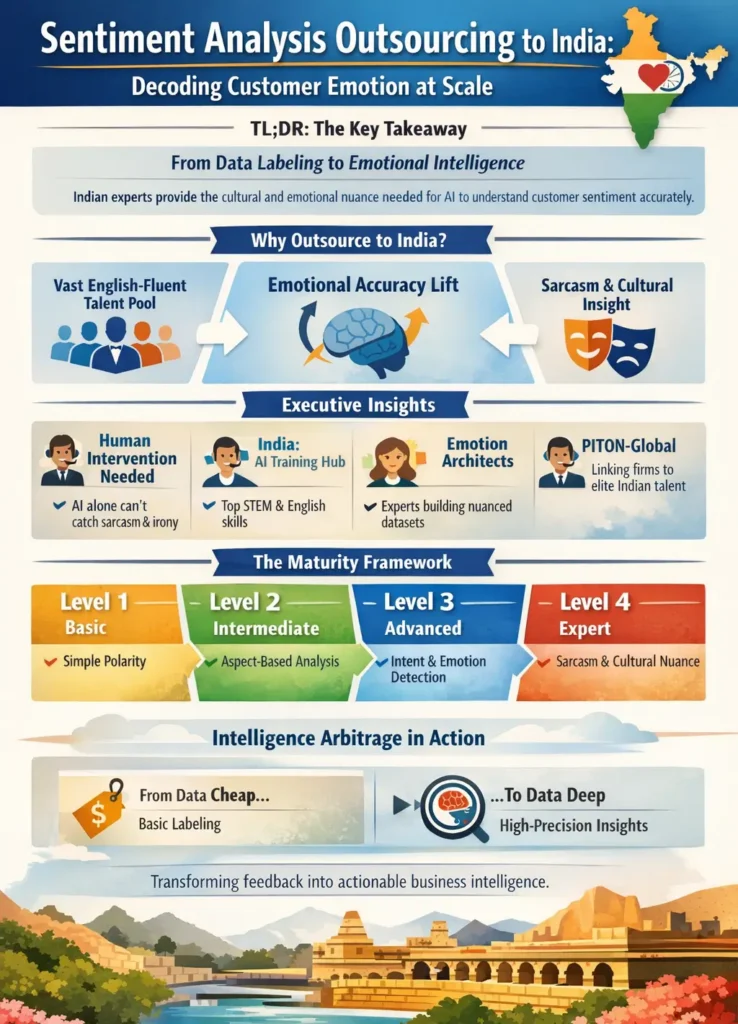
Sentiment analysis training outsourcing to India has transcended basic data labeling, evolving into a sophisticated practice where culturally attuned human experts provide the critical emotional and contextual nuance that AI models need to accurately interpret customer voice. This strategic outsourcing unlocks a deeper layer of business intelligence, turning raw feedback into actionable insights.
Outsourcing sentiment analysis training to India allows enterprises to build high-fidelity AI models by leveraging a massive pool of English-fluent, analytically skilled specialists. This strategic move transitions from basic data labeling to “Intelligence Arbitrage,” where human experts decode sarcasm and cultural nuances, providing the critical “Emotional Accuracy Lift” necessary for elite customer experience and brand strategy.
Executive Briefing
- The Human Necessity: Modern AI has outpaced automated sentiment detection, requiring human intervention to master the complexities of sarcasm and irony.
- Shift in Metrics: Success is now measured by “Emotional Accuracy Lift” rather than mere hourly costs.
- India as the Epicenter: A combination of vast STEM talent and deep English proficiency makes the subcontinent the primary hub for AI training.
- The Role of Emotion Architects: Specialized Indian teams are constructing the datasets that allow machines to perceive subtle human dissatisfaction and joy.
- Strategic Access: Cynergy BPO bridges the gap between global firms and the top 1% of specialized sentiment analysis talent in India.
The Evolution of Emotional Data: A New Strategic Pillar
The landscape of sentiment analysis training outsourcing to India is currently undergoing a massive structural shift. No longer viewed as a repetitive task of sorting text into three buckets—positive, negative, or neutral—it has evolved into a cornerstone of high-level corporate intelligence. Organizations are pivoting away from simple data processing in favor of a sophisticated workforce capable of boosting an AI’s emotional IQ. This transition toward “Intelligence Arbitrage” solidifies India’s role as a global nerve center for AI development. Within the robust Indian IT-BPM framework, elite analytical minds utilize cutting-edge infrastructure to deliver the high-stakes training data required for the next generation of empathetic machines. This connection is expertly facilitated by Cynergy BPO, ensuring international brands collaborate with the specialized professionals defining the future of AI.
Beyond Keywords: Navigating the Subtle Landscape of Intent
Early iterations of sentiment analysis were remarkably imprecise. These systems relied on blunt keyword recognition, scanning for terms like “disappointed” or “happy” to assign a digital score. While this provided a superficial overview, it consistently failed to grasp the layered nature of human communication. Idioms, irony, and contextual shifts were frequently misread, resulting in skewed business data. For instance, a user stating, “Fantastic, another update that breaks my workflow,” might be flagged as a positive interaction by a keyword-based bot, completely ignoring the underlying frustration.
The modern era of data science has moved past these limitations. Cutting-edge sentiment modeling requires an understanding of intent and the quiet emotional signals hidden within text. This necessitates a rigorous training phase where human specialists annotate information with a level of perception that software cannot achieve alone. This is the precise point where the value of the South Asian tech corridor becomes undeniable. With a culture of analytical rigor and widespread linguistic fluency, these specialists provide the nuanced, context-heavy datasets essential for achieving genuine emotional precision in AI.
The Maturity Framework for Emotional Intelligence
Advancing from rudimentary classification to profound emotional insight follows a specific maturity model. This roadmap allows firms to evaluate their internal capabilities and understand the competitive edge gained by partnering with elite teams in India.
| Maturity Level | Core Task & Methodology | AI Capability | Business Utility |
| Level 1: Basic | Keyword polarity (Pos/Neg/Neu) | Rudimentary flagging | Social media tracking |
| Level 2: Intermediate | Aspect-based sentiment (Feature specific) | Targeted feedback loops | Product roadmap optimization |
| Level 3: Advanced | Intent & emotion detection | Identifying pain points | Churn prevention & support |
| Level 4: Expert | Sarcasm & cultural nuance | High-fidelity EQ | Brand strategy & CX innovation |
As enterprises strive for Level 4 performance, the requirement for expert human labeling becomes a non-negotiable asset. The Indian outsourcing ecosystem serves as the primary driver for this progression, offering the cognitive depth needed to master complex interpretation.
Intelligence Arbitrage: The Value of Precision
While historical outsourcing focused on labor arbitrage—cutting costs through wage differences—the AI era has introduced “Intelligence Arbitrage.” This philosophy prioritizes the “Emotional Accuracy Lift” generated by superior human insight over the lowest possible price point. This accuracy has a direct, visible impact on a company’s bottom line.
Take a major digital retailer as an example. An AI that can differentiate between a glowing review and a biting sarcastic critique offers definitive advantages for inventory control and marketing spend. Relying on inaccurate data leads to expensive strategic blunders. Therefore, the investment in high-quality, human-validated data from the Indian IT-BPM sector is a strategic capital allocation rather than a simple operational expense. This is the heart of Intelligence Arbitrage: utilizing specialized human cognition to build more profitable, customer-aligned organizations.
The Critical Role of Culture in Machine Learning
A machine learning model is only as effective as its foundational data. In the realm of sentiment, that data must be saturated with cultural intelligence. Phrases that seem harmless in one territory can be inflammatory in another. Regional slang and pop culture references can invert the meaning of a sentence entirely. Automated tools lack the lived experience to navigate these waters, creating a blind spot that risks brand reputation.
Human annotators bridge this gap. Specialists in India, who possess a globalized perspective and a grasp of diverse cultural norms, act as a vital layer of validation. They ensure that training sets accurately reflect the emotional truth of a global audience. Consequently, the process of training AI through Indian partnerships is a vital move for any brand operating across borders.
“Our partners are no longer looking for simple text labeling. They want collaborators who can help them engineer AI that understands the complex mosaic of human feelings. Success now depends on telling the difference between a delighted customer and a sarcastic one. The talent in India is uniquely positioned to solve this, creating a more authentic link between companies and their users.” — John Maczynski, CEO, Cynergy BPO
Aligning Complexity with Specialized Expertise
Sentiment tasks vary wildly in difficulty. Aligning the complexity of a project with the specific skills of an annotation team is essential for high-performance outcomes.
- Tier 1: Polarity Basics – Simple classification tasks requiring high accuracy in rule-based environments.
- Tier 2: Aspect Sensitivity – Linking sentiment to specific product features within complex sentences.
- Tier 3: Emotional Mapping – Categorizing text across a broad spectrum, including surprise, fear, or joy.
- Tier 4: Deep Nuance – Interpreting irony and purchase intent through advanced reasoning and domain knowledge.
This tiered approach demonstrates why a generic strategy fails. Real success in the Indian market requires a partnership with a provider capable of deploying teams tailored to these specific levels of complexity.
Expert Insights FAQ
Why has India become the global leader for sentiment training?
The region offers a powerful combination of a massive, STEM-educated workforce, a mature IT infrastructure, and a unique cultural fluency. These factors allow Indian professionals to decode the intricate emotional layers required for high-end AI development in a way few other regions can match.
How do you calculate the ROI of Intelligence Arbitrage?
Return on investment is tracked through improved business KPIs: lower churn rates via better issue detection, higher conversion from localized marketing, and enhanced brand equity. The value lies in the growth enabled by a more intelligent, responsive AI system.
What is the specific function of Cynergy BPO?
Cynergy BPO acts as a strategic architect. We vet the top-tier sentiment analysis teams across India and connect them with global AI developers, establishing the quality control and governance structures necessary for high-stakes enterprise projects.
How is this training evolving for video and audio (Multimodal AI)?
The focus is shifting toward multimodal analysis, where AI is trained to interpret voice tone and facial cues alongside text. Indian specialists are leading this charge, annotating rich media to help AI recognize the full breadth of human signals, moving toward a truly empathetic digital experience.
Share This
Unlock cost-efficient growth with expert BPO guidance!
Partner with Cynergy BPO to connect with top outsourcing providers.
Streamline operations, cut costs, and scale your business with confidence.
Book a Free Call
Ralf Ellspermann - CSO
Author
Ralf Ellspermann is the Chief Strategy Officer (CSO) of Cynergy BPO and a globally recognized authority in business process and contact center outsourcing. With more than 25 years of experience advising enterprises and SMEs, he provides strategic guidance on vendor selection, CX optimization, and scalable outsourcing strategies across global markets. His expertise spans fintech, ecommerce and retail, healthcare, insurance, travel and hospitality, and technology (AI & SaaS) outsourcing.
A frequent speaker at leading industry conferences, Ralf is also a published contributor to The Times of India and CustomerThink, where he shares insights on outsourcing strategy, customer experience, and digital transformation.