



By: Ralf Ellspermann
25-Year, Multi-Awarded BPO Veteran
Published: 16 March 2026
Updated: March 16, 2026
TL;DR: The Key Takeaway
Thermal imaging annotation outsourcing in India has transcended basic labeling, becoming a critical service for developing sophisticated AI. This evolution leverages the nation’s deep tech talent to provide the nuanced data required for high-stakes industrial and safety applications, ensuring superior model performance.
Outsourcing thermal imaging annotation to India leverages “Intelligence Arbitrage” to provide high-fidelity training data for critical AI applications. By 2026, the thermal imaging market is projected to reach $8.93 billion, with a significant portion of growth driven by predictive maintenance (projected $17.11 billion market) and autonomous systems (74% of prototypes utilizing thermal sensors). Indian STEM specialists provide the deep domain expertise required to annotate heat signatures that machines cannot interpret alone, ensuring model accuracy in zero-visibility and high-stakes industrial environments.
Executive Briefing
- The Invisible Dimension: AI development has pivoted from visible RGB data to thermal infrared signatures, essential for predictive maintenance, firefighting, and autonomous safety.
- Market Momentum: The global thermal imaging market is entering a high-growth phase, expected to grow from $8.29 billion in 2025 to nearly $17.41 billion by 2035 (CAGR of 7.7%).
- Intelligence Arbitrage: The value proposition in India has shifted from labor cost to “Cognitive Arbitrage”—accessing STEM graduates capable of interpreting complex physics-based data.
- Critical Adoption: Projections indicate that 74% of autonomous vehicle prototypes will incorporate thermal imaging by 2026 to ensure safety in complete darkness.
- Strategic Conduit: Cynergy BPO connects AI leaders with the top 1% of Indian annotation teams, specializing in multi-modal sensor fusion (Thermal + LiDAR + RGB).
Beyond the Visible Spectrum: The Rise of Thermal Data
Traditional AI models were built on what humans can see (RGB). However, a vast dimension of critical information exists in the infrared spectrum. Thermal sensors capture heat signatures, allowing AI to “see” through smoke, detect electrical hotspots, and track pedestrians in total darkness.
The challenge lies in the data’s complexity. Unlike a standard photo, a thermal image is a map of temperature values. To train an AI, human annotators must differentiate between a “normal” heat signature and a “failure” signature (e.g., an overheating bearing). This requires more than pattern recognition; it requires a foundational understanding of thermodynamics and engineering.
India’s Competitive Edge: Talent at Scale
India’s emergence as the hub for this specialized work is fueled by its massive STEM pipeline.
- Talent Volume: India ranks 3rd globally in AI vibrancy, with a talent pool where AI skill penetration is 2.5 times the global average.
- Specialized Expertise: Annotators are often engineering graduates from institutions like the IITs, providing the “Cognitive Arbitrage” necessary for Tier 3 and Tier 4 annotation tasks.
- Operational Velocity: The 12-hour time difference with the US allows for a “Follow-the-Sun” model, where data sent from San Francisco at 6:00 PM is annotated and returned by 9:00 AM the next day.
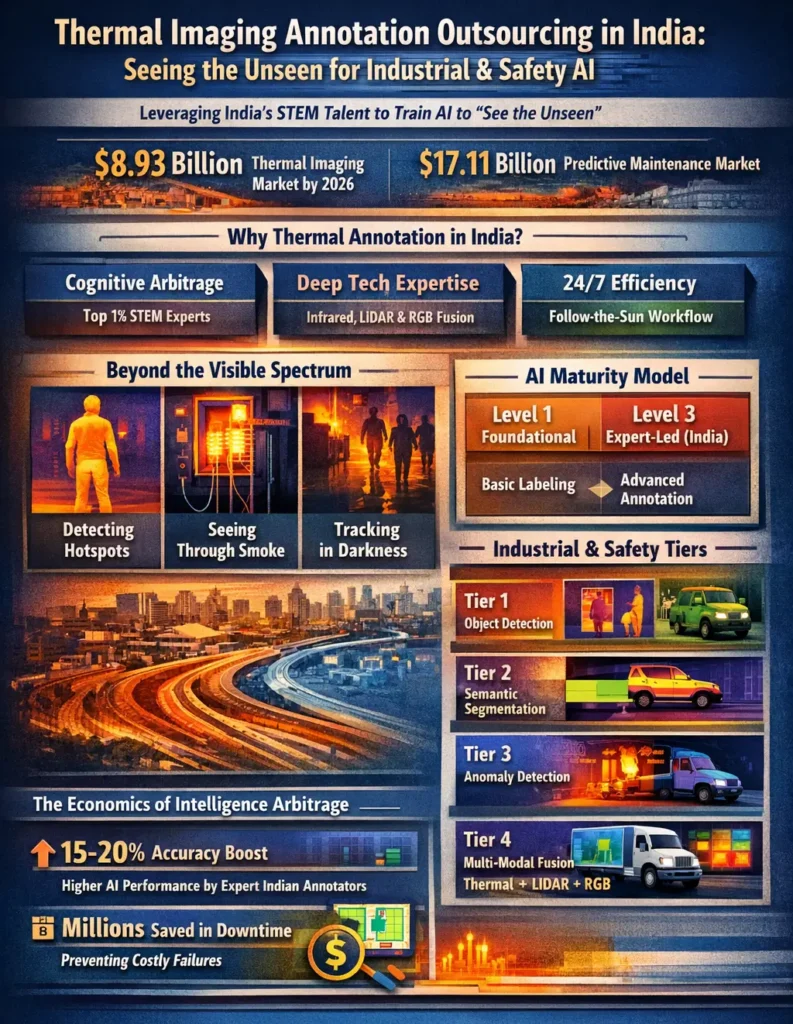
Thermal Annotation Maturity Model
As AI models move into regulated and high-risk environments, the “Foundational” approach is no longer sufficient.
| Feature | Level 1: Foundational | Level 3: Expert-Led (India) |
| Primary Goal | High volume, low cost | High performance, safety-critical |
| Annotator Profile | Generalist / Basic skills | STEM Graduate / Domain Expert |
| Complex Task | Simple 2D Bounding Boxes | Semantic Segmentation & Multi-modal Fusion |
| Key Metric | Cost per image | Quantifiable Model Accuracy Uplift |
| Market Segment | Consumer/Generic AI | Industrial, Defense, & Autonomous Safety |
Industrial and Safety Service Tiers
The complexity of thermal data varies by application. India-based teams often specialize in the higher tiers where subject matter expertise is mandatory.
- Tier 1: Foundational (Object Detection): Identifying people or animals in simple nighttime thermal feeds for basic security.
- Tier 2: Intermediate (Semantic Segmentation): Pixel-level labeling for thermal video streams to help autonomous vehicles distinguish road textures from obstacles.
- Tier 3: Advanced (Industrial Anomaly): Annotating subtle heat variances in electrical grids or machinery to train predictive maintenance AI (a market hitting $17.11 billion in 2026).
- Tier 4: Expert (Multi-Modal Fusion): Synchronizing thermal data with LiDAR and RGB to create a “unified perception” layer for Level 4/5 autonomy.
The Economics of Intelligence Arbitrage
“Intelligence Arbitrage” refers to the measurable improvement in AI model performance gained by using expert annotators. For a manufacturing plant, an AI trained by Indian experts might have a 15-20% higher accuracy in detecting pre-failure heat signatures, potentially saving millions in unplanned downtime. In 2026, data annotation is no longer a “back-office” task—it is a strategic differentiator.
Expert FAQs
Q1: Why is thermal annotation more expensive than standard image labeling?
Standard labeling identifies objects humans naturally recognize. Thermal labeling requires interpreting heat gradients. Annotators must know, for instance, that a specific thermal bloom on a circuit board indicates a “short” rather than expected operational heat. You are paying for the annotator’s engineering background, not just their time.
Q2: How does India handle the security of sensitive industrial or defense data?
Leading Indian providers are ISO 27001 and SOC 2 Type II compliant. Data is often processed in “Clean Room” environments with no external internet access, hardware-locked terminals, and biometric entry to ensure intellectual property and sensitive heat maps remain secure.
Q3: What role does “Human-in-the-Loop” (HITL) play in 2026?
While AI tools can pre-label 80% of thermal data, the remaining 20% (edge cases) are where models fail. Human experts in India focus exclusively on these complex scenarios, providing the “Natural Person” verification now mandated by regulations like the EU AI Act.
Q4: How does thermal data improve autonomous vehicle safety?
Traditional cameras and LiDAR struggle with “white-out” conditions (fog, heavy rain) or complete darkness. Thermal sensors detect the body heat of a pedestrian through these obstructions. Indian annotators help the AI “ignore” non-living heat (like a warm tailpipe) and focus on vulnerable road users.
Share This
Unlock cost-efficient growth with expert BPO guidance!
Partner with Cynergy BPO to connect with top outsourcing providers.
Streamline operations, cut costs, and scale your business with confidence.
Book a Free Call
Ralf Ellspermann - CSO
Author
Ralf Ellspermann is the Chief Strategy Officer (CSO) of Cynergy BPO and a globally recognized authority in business process and contact center outsourcing. With more than 25 years of experience advising enterprises and SMEs, he provides strategic guidance on vendor selection, CX optimization, and scalable outsourcing strategies across global markets. His expertise spans fintech, ecommerce and retail, healthcare, insurance, travel and hospitality, and technology (AI & SaaS) outsourcing.
A frequent speaker at leading industry conferences, Ralf is also a published contributor to The Times of India and CustomerThink, where he shares insights on outsourcing strategy, customer experience, and digital transformation.