



By: Ralf Ellspermann
25-Year, Multi-Awarded BPO Veteran
Published: 17 March 2026
Updated: March 16, 2026
TL;DR: The Key Takeaway
Robot perception training outsourcing to India has transcended simple data labeling, evolving into a strategic partnership that provides access to a massive pool of STEM talent and a world-class AI/ML research ecosystem. This global talent corridor is indispensable for developing the sophisticated, high-fidelity datasets required to enable autonomous systems to perceive, interpret, and act upon their environments with the highest levels of safety and reliability.
Outsourcing robot perception training to India provides the high-fidelity multi-modal data required for machines to navigate the physical world safely. As of 2026, India accounts for 16% of the global AI talent pool—second only to the US—and produces approximately 2.5 million STEM graduates annually. With a dedicated $1.24 billion (₹10,300 crore) IndiaAI Mission and a domestic AI market projected to hit $17 billion by 2027, the subcontinent offers the technical rigor needed to label LiDAR, radar, and thermal data, reducing perception-based takeover instances which currently account for over 90% of autonomous vehicle disengagements.
Executive Briefing
- The Perception Gap: In 2026, the primary barrier to Level 4/5 autonomy is “SOTIF” (Safety of the Intended Functionality), where perception errors lead to misinterpretation of rare edge cases.
- Massive Human Capital: India’s 2.5 million annual STEM graduates (of which 42.6% are women) provide a scalable engine for the cognitively demanding task of multi-sensor annotation.
- Strategic Investment: The IndiaAI Impact Summit 2026 recently highlighted over $200 billion in AI commitments from global tech giants and domestic conglomerates like Reliance and Tata.
- Research Dominance: Institutions like IISc Bangalore (ranked #1 research institute in India) and the IITs are now the world’s second-largest source of educational institutions in global rankings, trailing only the US.
- Cynergy BPO Connection: We bridge the gap between Western robotics labs and the top 1% of Indian “Perception Architects” who specialize in Tier 5 Agentic Governance.
The Foundational Imperative of Perception
Robot perception is the sensory “brain” of a machine. It takes raw inputs—3D LiDAR point clouds, radar echoes, and high-res RGB video—and translates them into a coherent world model.
In 2026, the industry has shifted focus from “Visible Data” to “Multi-Modal Sensor Fusion.” For a robot to operate safely, it must not only “see” a pedestrian but also estimate their distance (Depth), predict their path (Trajectory), and understand their intent (Context). If the training data is even 1% inaccurate, the resulting “cascading error” in decision-making can be catastrophic.
India’s 2026 AI Momentum: By the Numbers
India has transformed from a back-office hub into a global nexus for high-end machine cognition.
- Talent Scale: Over 600,000 AI professionals are currently active in India, a number expected to double to 1.25 million by 2027.
- GPU Democratization: Under the IndiaAI Mission, the government has provisioned over 38,000 GPUs (with 20,000 more being added in Q1 2026) available to researchers and BPOs at a subsidized rate of ₹65 (~$0.78) per hour.
- AI-Enabled Workforce: Reports from early 2026 indicate that 30% of all Indian STEM graduates are now entering AI-specific roles, up from just 12% in 2022.
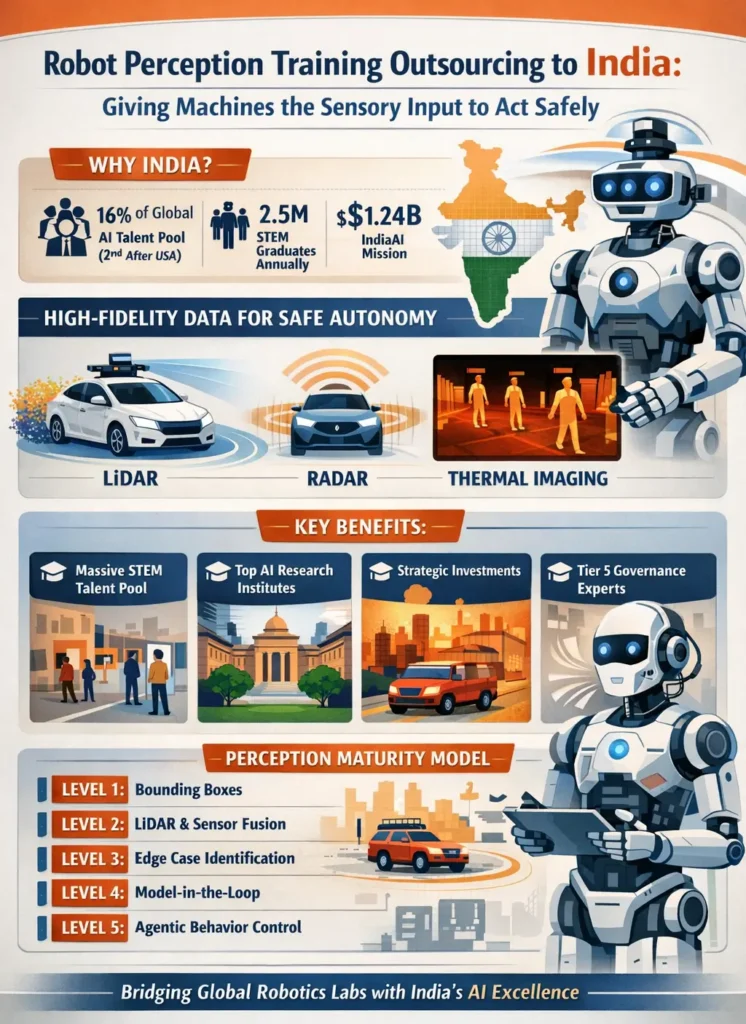
Robot Perception Data Annotation Maturity Model
As perception systems move from labs to public streets, the level of human oversight must evolve.
| Maturity Level | Activity | Strategic Impact |
| Level 1: Foundational | 2D Bounding Boxes | Proof-of-concept only. |
| Level 2: Enriched | LiDAR Cloud Classification | Improves granularity in 3D space. |
| Level 3: Contextual | Edge Case Identification | Reduces accidents in rare weather/lighting. |
| Level 4: Performance | Model-in-the-Loop Feedback | Direct uplift in model safety KPIs. |
| Level 5: Agentic | Real-time Behavioral Governance | Mandatory for trustworthy autonomous scale. |
The Human-Machine Symbiosis
The “intelligence arbitrage” offered by Indian providers in 2026 isn’t just about labeling images; it’s about SOTIF (Safety of the Intended Functionality). Real-world data shows that while hardware failures (FUSA) account for less than 0.3% of disengagements, perception and software limitations (SOTIF) account for over 90%.
Indian teams, led by graduates from the IITs (Madras, Delhi, Bombay), act as the “cognitive fail-safe.” They identify subtle biases—such as a model failing to recognize a person in a non-standard posture (e.g., crouching)—and generate adversarial data to “stress-test” the robot’s perception before it ever touches a factory floor or a public road.
Expert FAQs
Q1: How does India’s time zone help US-based robotics companies?
The 12-hour offset creates a “24/7 Intelligence Factory.” US engineers can flag perception failures at 5:00 PM EST; Indian specialists receive the data at 2:30 AM IST, resolve the edge cases, and have the refined training weights ready for the US team by 9:00 AM the next morning.
Q2: Are there enough high-end AI specialists in India for Level 5 Governance?
Yes. India currently contributes 16% of the global AI talent pool. With the world’s highest number of STEM graduates (2.5 million annually), the “top 1%” of this pool—specifically those from IISc and IITs—provides a talent density comparable to Silicon Valley but at a scale required for massive data operations.
Q3: How is data privacy handled under 2026 regulations?
Indian providers are strictly governed by the DPDP (Digital Personal Data Protection) Act 2026. Most high-end robotics training is now conducted in “Sovereign AI Factories,” where data is processed using local GPU clusters (L&T and NVIDIA partnerships) to ensure zero data egress from the country.
Q4: Does the IndiaAI Mission impact the cost for international clients?
Indirectly, yes. By subsidizing the cost of compute (GPUs) for local firms, the Indian government has lowered the overhead for BPOs. This allows providers to invest more in specialized STEM training for their staff without passing the cost to the client, maximizing your ROI.
Share This
Unlock cost-efficient growth with expert BPO guidance!
Partner with Cynergy BPO to connect with top outsourcing providers.
Streamline operations, cut costs, and scale your business with confidence.
Book a Free Call
Ralf Ellspermann - CSO
Author
Ralf Ellspermann is the Chief Strategy Officer (CSO) of Cynergy BPO and a globally recognized authority in business process and contact center outsourcing. With more than 25 years of experience advising enterprises and SMEs, he provides strategic guidance on vendor selection, CX optimization, and scalable outsourcing strategies across global markets. His expertise spans fintech, ecommerce and retail, healthcare, insurance, travel and hospitality, and technology (AI & SaaS) outsourcing.
A frequent speaker at leading industry conferences, Ralf is also a published contributor to The Times of India and CustomerThink, where he shares insights on outsourcing strategy, customer experience, and digital transformation.