



By: Ralf Ellspermann
25-Year, Multi-Awarded BPO Veteran
Published: 19 March 2026
Updated: March 16, 2026
TL;DR: The Key Takeaway
India is now the premier destination for AI safety testing outsourcing, providing essential adversarial attack simulations and red teaming services. This ensures AI models are secure and reliable before deployment, leveraging the nation’s deep pool of STEM talent and world-class IT infrastructure.
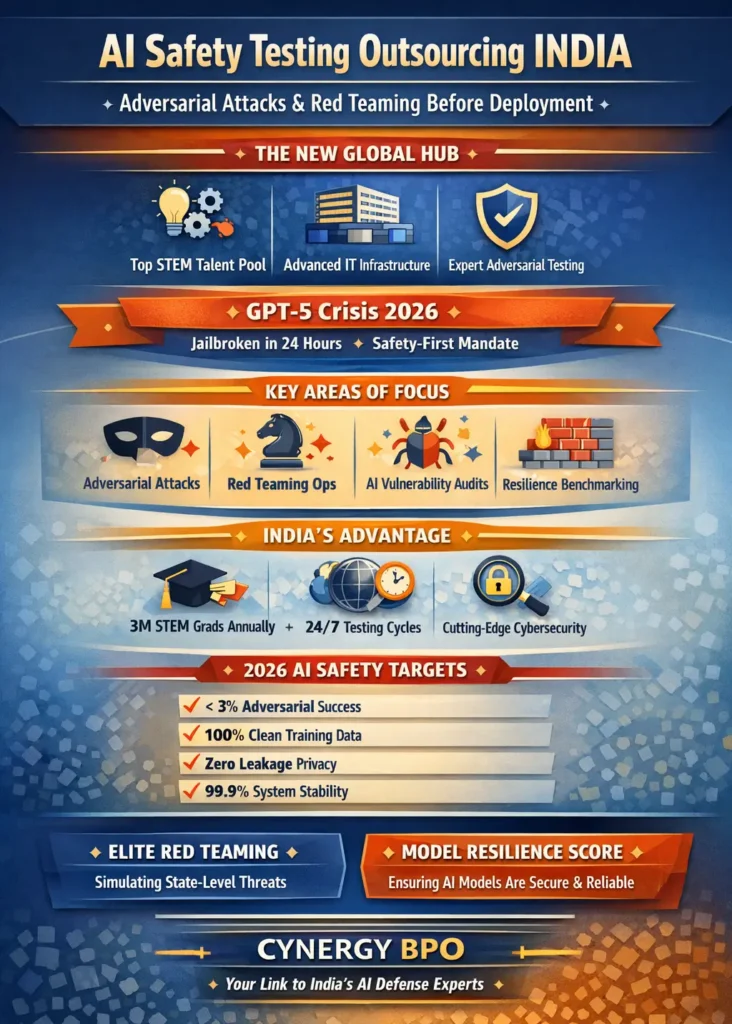
The release of GPT-5 in early 2026 marked a turning point in AI governance: elite red teams “jailbroke” the model within 24 hours of its launch, demonstrating that even the most advanced frontier models remain vulnerable to sophisticated adversarial tactics. This has shifted the industry mandate from “performance-first” to “safety-first.” India has emerged as the global command center for this transition, offering specialized services in adversarial attack simulation and agentic red teaming. By leveraging a massive pool of STEM talent from the IITs and IISc, Indian providers offer the high-stakes cognitive auditing required to stress-test models before they hit the market. Cynergy BPO acts as the strategic link to these elite units, ensuring your AI is not only powerful but resilient against the next generation of digital threats.
Executive Briefing
- The Vulnerability Crisis: In 2026, roleplay attacks against LLMs have achieved an 89.6% success rate, while multi-turn jailbreaks reach 97% success within just five conversational turns.
- Red Teaming as a Standard: Independent safety testing is no longer optional; it is a prerequisite for enterprise deployment and a core requirement for EU AI Act compliance by August 2026.
- The Talent Advantage: India’s STEM graduates—projected to reach 30 lakh (3 million) annually—are increasingly specialized in AI/ML engineering and cybersecurity, providing the world’s largest reservoir of adversarial testers.
- 24/7 Safety Cycles: The “follow-the-sun” model allows US firms to hand off models for red teaming in the evening and receive comprehensive vulnerability reports by morning.
- Resilience Benchmarking: Specialized Indian teams go beyond simple bug hunting, using metrics like the Agentic Resistance Score (ARS) to quantify model safety.
Executive Summary
As AI systems transition from chatbots to autonomous agents, the attack surface for malicious manipulation has expanded exponentially. The move toward AI safety testing outsourcing in India is a strategic response to a threat landscape where a cyberattack now occurs every 39 seconds globally. India’s IT-BPM sector has evolved into a frontline defense for AI security, providing deep expertise in Prompt Injection, Model Inversion, and Data Poisoning mitigation. For global enterprises, the Indian ecosystem offers more than cost efficiency; it provides “capability density”—the ability to scale specialized “red team pods” that act as adversarial auditors. Cynergy BPO facilitates these high-trust partnerships, ensuring that AI models are hardened against real-world exploits before they can cause reputational or financial harm.
The Imperative of Pre-Deployment Adversarial Validation
The speed of AI adoption has outpaced traditional security measures. In 2025-2026, 30% of all AI-targeted cyberattacks leveraged adversarial samples or training-data poisoning. Without rigorous pre-deployment testing, an organization risks deploying a “black box” that can be tricked into leaking sensitive data or executing unauthorized transactions.
Pre-deployment safety validation is the final “firewall.” This process involves attempting to “break” the AI using every known exploit. In India, this work is conducted by specialists who combine a hacker’s mindset with a data scientist’s technical depth. These auditors unearth “zero-day” vulnerabilities in the model’s logic that automated scanners often miss, such as complex encoding tricks or logic traps that can bypass standard guardrails.
Red Teaming: Moving Beyond Standard QA
Traditional Quality Assurance (QA) checks if a system works as intended; AI Safety Testing checks if it can be forced to work in ways that were not intended.
- Adversarial Attacks: Testers inject subtle “noise” or malicious prompts to trick the model into making errors.
- Red Teaming: A creative, iterative process where human experts simulate a state-level adversary, exploring novel ways to induce harmful behavior or bypass safety filters.
The Indian advantage in this field is rooted in its academic excellence. The Indian Institutes of Technology (IITs) are now integrating Adversarial Machine Learning into their core curricula. This ensures that outsourced teams are not just following a script—they are innovating on the offense to improve the defense.
The Strategic Value of the Indian Ecosystem
India’s cybersecurity spending is projected to reach $3.4 billion in 2026, an 11.7% increase driven largely by the need for AI-led threat defense. This domestic focus has matured the local talent pool into a global resource.
“The conversation in 2026 has shifted. Our clients aren’t asking for ‘support’; they are asking for ‘adversaries.’ They want the most brilliant minds in the subcontinent to try and dismantle their AI models so they can build something truly unbreakable. India is the only place with the scale and Cap-D (Capability Density) to do this at an enterprise level.” — John Maczynski, CEO, Cynergy BPO
AI Safety Testing Techniques: 2026 Benchmarks
| Technique | Description | Risk Level | Resilience Target |
| Adversarial Prompting | Using multi-turn dialogue to bypass safety guardrails. | Critical | < 3% Success Rate |
| Data Poisoning Audit | Checking training sets for malicious data injection. | High | 100% Data Provenance |
| Model Inversion | Attempting to reconstruct private training data. | High | Zero-Leakage (Differential Privacy) |
| Fuzzing (Agentic) | Bombarding AI agents with random, high-volume inputs. | Medium | 99.9% System Stability |
Building a Resilient AI Future
The ultimate deliverable of an Indian safety testing partnership is a Model Resilience Score. This objective metric allows executives to make data-driven decisions about when a model is “safe enough” to launch. As the industry moves toward Agentic Governance, Indian teams are already pivoting to test the safety of autonomous agents—ensuring that when an AI takes an action in the real world, it adheres to ethical guardrails and fails safely if compromised.
AI Red Teaming Maturity Model
- Level 1 (Basic): Occasional “jailbreak” attempts by developers.
- Level 2 (Standardized): Formal internal teams testing against OWASP Top 10 for LLMs.
- Level 3 (Advanced): Continuous red teaming with automated synthetic attack scenarios.
- Level 4 (Elite Outsourced): Independent, third-party adversarial simulation by elite Indian pods, simulating state-level adversaries and zero-day exploits.
Expert FAQs
Q1: Why is India the preferred destination for AI red teaming?
India offers the unique convergence of high-end STEM talent (IIT/IISc), a mature cybersecurity infrastructure, and the ability to scale specialized testing teams instantly. In 2026, it is the only market that can handle the sheer computational and cognitive volume required for frontier model safety.
Q2: How does AI safety testing differ from traditional penetration testing?
Pen-testing focuses on the infrastructure (servers, APIs). AI safety testing focuses on the model’s brain. It tests the probabilistic logic, the training data, and the susceptibility to “brain-hacking” via prompts.
Q3: What is the ROI of outsourcing this to India?
The ROI is calculated in “risk avoidance.” One major AI hallucination or security breach in 2026 can cost a firm millions in lawsuits and a permanent loss of brand trust. Indian partners provide this protection at roughly 40-50% of the cost of building an equivalent in-house team in the US.
Q4: Is it safe to share our proprietary models with Indian firms for testing?
Yes. Elite Indian providers operate under ISO 27001 and SOC 2 Type II certifications. They use secure, air-gapped environments and robust IP protection frameworks. Cynergy BPO only partners with the top 1% of firms that meet these stringent global security standards.
Unlock cost-efficient growth with expert BPO guidance!
Partner with Cynergy BPO to connect with top outsourcing providers.
Streamline operations, cut costs, and scale your business with confidence.
Book a Free Call
Ralf Ellspermann - CSO
Author
Ralf Ellspermann is the Chief Strategy Officer (CSO) of Cynergy BPO and a globally recognized authority in business process and contact center outsourcing. With more than 25 years of experience advising enterprises and SMEs, he provides strategic guidance on vendor selection, CX optimization, and scalable outsourcing strategies across global markets. His expertise spans fintech, ecommerce and retail, healthcare, insurance, travel and hospitality, and technology (AI & SaaS) outsourcing.
A frequent speaker at leading industry conferences, Ralf is also a published contributor to The Times of India and CustomerThink, where he shares insights on outsourcing strategy, customer experience, and digital transformation.