


By: Ralf Ellspermann
25-Year, Multi-Awarded BPO Veteran
Published: 18 March 2026
Updated: March 18, 2026
How US Providers Use “Intelligence Arbitrage” to Resolve the Domestic Clinician Shortage
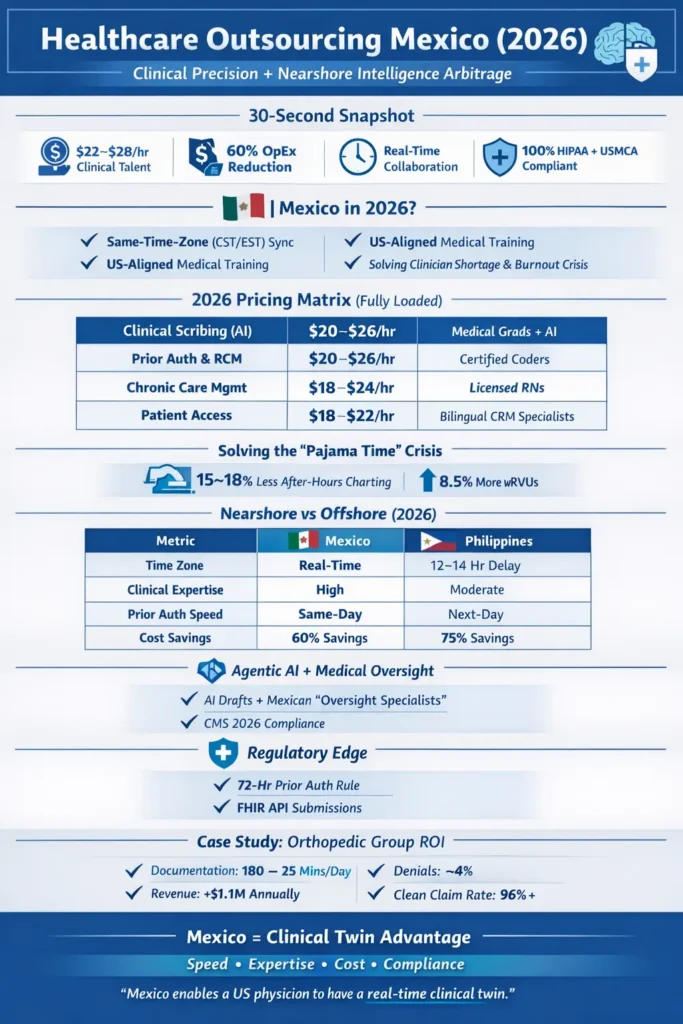
In 2026, healthcare outsourcing in Mexico has shifted from basic billing to “Clinical Intelligence Arbitrage.” By leveraging a $22–$28/hour benchmark, US health systems deploy Mexican-licensed doctors and nurses for Ambient AI scribing, prior-authorization, and chronic care management. This nearshore model ensures 100% HIPAA and USMCA compliance while delivering a 60% OpEx reduction with real-time, same-time-zone clinical synchronization.
Executive Summary: The Nearshore Clinical Pivot
By early 2026, the US healthcare system reached a critical inflection point. With domestic administrative burnout at an all-time high and labor costs for US-based clinical staff exceeding $65.00/hour for non-patient-facing roles, Mexico has emerged as the premier “Nearshore Clinical Hub.” The 2026 value proposition is defined by “Clinical Velocity.” Because Mexican medical training aligns closely with US standards, providers are moving beyond simple data entry and into high-level Clinical Decision Support.
The 2026 Pricing Matrix: Clinical & Admin TCO
In 2026, the market has bifurcated. “Budget” providers at $14/hour often fail HIPAA 2.0 audits. Cynergy BPO utilizes a tiered structure that ensures clinical quality and data security.
| Service Tier | 2026 Hourly Rate (Fully Loaded) | Talent & Tech Profile |
| Clinical Scribing (Ambient AI) | $20 – $26 / hour | Mexican Medical Grads; AI-optimization. |
| Prior-Auth & RCM (Specialized) | $20 – $26 / hour | Certified Coders; Payer-portal specialists. |
| Chronic Care Management (CCM) | $18 – $24 / hour | Licensed RNs; Telehealth-certified. |
| Patient Access (Bilingual) | $18 – $22 / hour | C1-level Bilinguals; CRM Power Users. |
Deep Dive: The 2026 “Pajama Time” Crisis & The Mexican Solution
In 2026, the most critical metric for US Health Systems is “Pajama Time”—the hours clinicians spend documenting in the EHR after their shift. Onshore scribing costs have become prohibitive, but legacy offshore models suffer from a “clinical nuance gap” that leads to note-bloat and audit triggers.
The Mexican Scribe Advantage
Mexican medical graduates serving as Ambient Scribe Architects do not just transcribe; they perform “Documentation Integrity Checks.” By working in the same time zone, they provide real-time feedback to the physician via secure mobile alerts, ensuring that Medical Necessity is established during the encounter.
- Metric of Success: Practices utilizing Mexican Clinical Pods report a 15-18% reduction in after-hours charting (Pajama Time) and an 8.5% increase in total wRVUs (Work Relative Value Units) due to more accurate capture of high-acuity visits.
The “Collaboration Dividend”: Real-Time Clinical Sync
Unlike offshore models in the Philippines or India, Mexico offers 0-hour latency. In 2026, this is critical for Ambient AI workflows and the CMS 2026 Prior Authorization Rule (CMS-0057-F).
Regulatory Pulse: Mastering the CMS 2026 Rule
The January 2026 CMS mandate requires payers to respond to urgent prior-authorizations within 72 hours. US providers who rely on legacy manual workflows are seeing a spike in denials.
- Mexico-Based “Prior-Auth Pods”: These teams use FHIR-based APIs to submit ePA (Electronic Prior Authorization) requests instantly.
- Clinical Benchmarking: Because Mexican staff are often licensed MDs, they can speak “peer-to-peer” with payer medical directors, a task that non-clinical offshore agents cannot legally or effectively perform.
Comparison: Mexico (Nearshore) vs. Philippines (Offshore) 2026
| Metric | Mexico (Nearshore) | Philippines (Offshore) | Impact on US Practice |
| Time Zone Alignment | 1:1 Sync (CST/EST) | 12–14 Hour Delay | Real-time patient triage vs. batch processing. |
| Clinical Context | High (US-aligned training) | Moderate | Higher “First-Pass” clean claim rates in Mexico. |
| Prior-Auth Speed | Same-Day Submission | Next-Day Processing | Faster surgical scheduling and patient throughput. |
| Cost Delta (vs. US) | 60% Savings | 75% Savings | Mexico offers better “Expertise-per-Dollar.” |
Agentic AI: The Rise of the “Medical Oversight Specialist”
In 2026, raw AI-generated clinical notes are a liability. Cynergy BPO’s Mexican partners use Agentic AI—autonomous systems that pull labs and draft orders—governed by Mexican Medical Architects. These specialists ensure every output meets CMS 2026 Guidelines before it ever reaches the US physician’s desk, effectively turning the doctor from an “Author” into a “Reviewer.”
Data Sovereignty: HIPAA, USMCA, and the “Sovereign Tunnel”
Mexico’s proximity allows for a unique legal layer: USMCA Chapter 19. This provides a robust framework for digital trade and data protection that offshore regions cannot match.
- Zero-Possession Architecture: Top-tier Mexican hubs utilize “Sovereign Tunnels.” PII (Personally Identifiable Information) never “rests” on Mexican servers; it is streamed via encrypted VDI, satisfying 2026 HIPAA Security Rule updates regarding mandatory asset inventories and quantitative risk ratings.
CEO’s Perspective
In 2026, healthcare isn’t about more staff; it’s about smarter integration. Mexico allows a US doctor to have a clinical ‘twin’ working alongside them in real-time.”— John Maczynski, CEO of Cynergy BPO.
Case Study: Reclaiming 2.5 Hours Per Day
The Challenge: A 50-provider orthopedic group was losing clinicians to burnout. Each doctor was spending 3 hours per day on “Administrative Debt.”
The Strategy: PITON-Global implemented a Clinical Pod in Mexico City.
- The Intervention: Deployed 15 Mexican medical graduates as Scribe Architects.
- The Result: Scribes reviewed AI notes in real-time. By the time the doctor walked out of the exam room, the note was 99% finalized.
- The ROI:
- Physician Documentation Time: Reduced from 180 mins to 25 mins/day.
- Net Revenue: Increased by $1.1M annually due to higher “Clean Claim” rates and a 4% drop in initial denials.
Strategic FAQ: Healthcare Outsourcing Mexico
Q1: How do you handle the 2026 HIPAA SRA (Security Risk Analysis) updates? Our Mexican partners utilize AI-powered SRA tools that align with the NIST Risk Management Framework. Because we use Pixel-Streaming VDI, the Mexican team never possesses the raw data, simplifying your annual compliance audit and reducing your cybersecurity insurance premiums.
Q2: Can Mexico-based staff manage the new V28 Risk Adjustment Model? Yes. In 2026, mastering the V28 model is essential for FQHCs and MSOs. Mexican-licensed staff are specifically trained to identify the higher-specificity diagnostic codes required under V28, preventing the “revenue cliff” that occurs with less specialized offshore teams.
Q3: What is the “Clean Claim Rate” (CCR) expectation for 2026? While the US in-house average hovers around 78%, our Mexico-based clinical RCM teams consistently deliver a CCR of 96% or higher. This is achieved by running every claim through a “Payer Digital Twin” (AI simulation) managed by Mexican billing specialists before submission.
Share This
Unlock cost-efficient growth with expert BPO guidance!
Partner with Cynergy BPO to connect with top outsourcing providers.
Streamline operations, cut costs, and scale your business with confidence.
Book a Free Call
Ralf Ellspermann - CSO
Author
Ralf Ellspermann is the Chief Strategy Officer (CSO) of Cynergy BPO and a globally recognized authority in business process and contact center outsourcing. With more than 25 years of experience advising enterprises and SMEs, he provides strategic guidance on vendor selection, CX optimization, and scalable outsourcing strategies across global markets. His expertise spans fintech, ecommerce and retail, healthcare, insurance, travel and hospitality, and technology (AI & SaaS) outsourcing.
A frequent speaker at leading industry conferences, Ralf is also a published contributor to The Times of India and CustomerThink, where he shares insights on outsourcing strategy, customer experience, and digital transformation.