



By: Ralf Ellspermann
25-Year, Multi-Awarded BPO Veteran
Published: 25 March 2026
Updated: March 18, 2026
Kenya has emerged as a cornerstone of the global spatial AI ecosystem, providing the high-precision 3D point cloud annotation essential for the safe deployment of autonomous vehicles and industrial robotics. By combining advanced LiDAR processing expertise with a scalable, tech-savvy workforce, the nation is enabling global innovators to transform chaotic sensor data into structured, navigable environments.
30-Second Executive Briefing
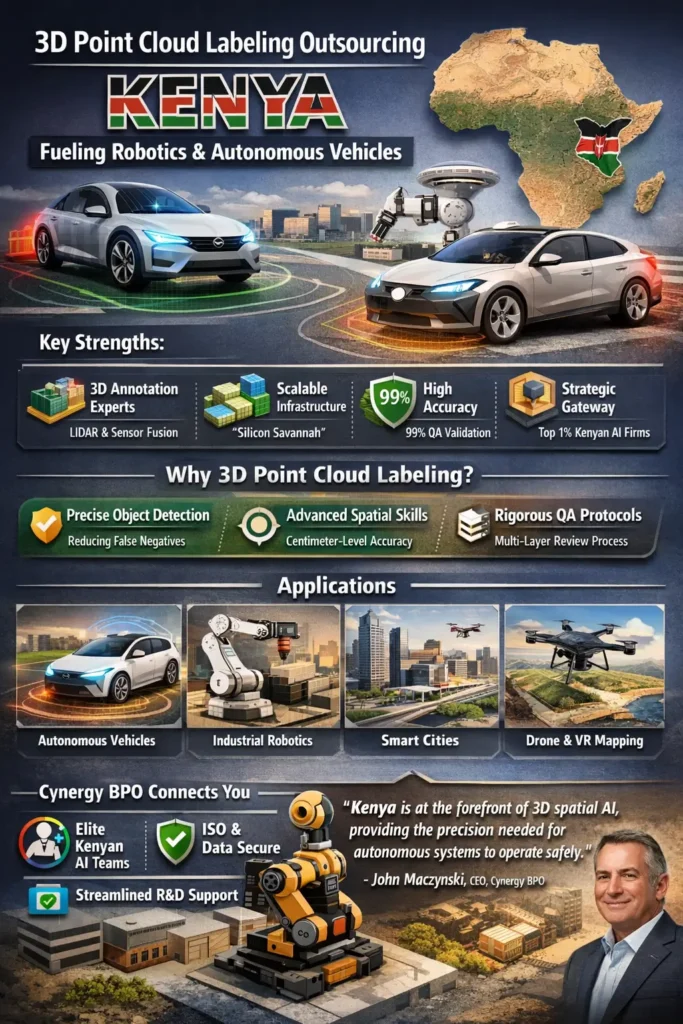
- Spatial Mastery: Kenyan teams specialize in multi-dimensional annotation, including 3D cuboid placement and LiDAR-camera sensor fusion.
- Safety Critical: Precise labeling of point cloud data is the primary factor in reducing False Negative detections in autonomous driving systems.
- Proven Scalability: The “Silicon Savannah” infrastructure allows for the processing of terabytes of LiDAR data with high temporal consistency.
- Rigorous QA: Vetted partners implement multi-stage verification protocols, achieving 99% accuracy in object localization and tracking.
- Cynergy BPO’s Role: We serve as a strategic gatekeeper, connecting enterprises with the top 1% of Kenyan AI-ops firms focused on spatial intelligence.
The Precision Imperative: Why 3D Point Cloud Labeling Demands Specialized Expertise
The transition from 2D image recognition to 3D spatial awareness represents one of the most significant hurdles in modern AI. Unlike flat images, 3D point clouds—generated by LiDAR and RADAR—consist of millions of individual data points in a coordinate system. Labeling this data requires an annotator to possess exceptional spatial reasoning to define object boundaries, depth, and orientation with centimeter-level accuracy.
This is precisely where 3D Point Cloud Labeling Outsourcing to Kenya has become a strategic necessity. The task of “ground truth” creation for a self-driving car or a robotic warehouse picker cannot be left to generic automated tools; it requires human oversight to resolve occlusions and interpret sparse sensor returns. Kenyan specialists bring a level of meticulousness that ensures AI models can differentiate a pedestrian on a curb from one stepping into traffic, a distinction that is fundamental to operational safety.
Comparative Overview of 3D Point Cloud Annotation Techniques
| Technique | Core Description | Primary AI Application |
| 3D Bounding Boxes | Enclosing objects in 3D cuboids (Position, Size, Yaw) | Object detection for AVs (cars, cyclists) |
| Semantic Segmentation | Classifying every individual point in the cloud | Environmental mapping and scene reconstruction |
| Instance Segmentation | Identifying unique IDs for individual objects | Behavioral prediction and long-term tracking |
| Lidar-Camera Fusion | Aligning 3D points with 2D RGB image data | Robust perception in complex/low-light scenes |
| Keypoint Annotation | Marking structural joints or skeletal structures | Human pose estimation for industrial robotics |
Kenya’s Strategic Role in the Global AI Data Ecosystem
Kenya’s ascent in the AI sector is the result of a deliberate national strategy to become Africa’s premier digital hub. With the launch of the National AI Strategy (2025–2030), the country has solidified its infrastructure, focusing on high-speed connectivity and specialized technical education. For global firms, this means Kenya offers more than just capacity; it offers a talent corridor where engineers are fluent in the language of LiDAR and sensor fusion.
By choosing Kenyan partners, organizations gain access to a workforce that operates within a culture of continuous improvement and technical rigor. These teams are well-versed in industry-leading platforms like Encord and Supervisely, ensuring that the labeled data they produce integrates seamlessly into modern MLOps pipelines. This alignment reduces the “data bottleneck” that often stalls R&D cycles in autonomous vehicle programs.
“The future of autonomous systems depends entirely on the granularity of their training data. In Kenya, we have found a workforce that truly understands the stakes of 3D spatial accuracy, providing the reliable foundation necessary for AI to move from experimental prototypes to real-world deployment.” — John Maczynski, CEO of Cynergy BPO.
Quality Assurance: A Non-Negotiable Standard for Safety-Critical AI
In the world of autonomous navigation, a single mislabeled frame can lead to catastrophic system failure. Therefore, the quality assurance (QA) processes employed by Kenyan AI-ops firms are built to be redundant and exhaustive. Specialized providers implement an “Inter-Annotator Agreement” model, where multiple specialists label the same sequence, and a senior auditor resolves any discrepancies.
This dedication to precision is why the world’s leading OEMs and Tier 1 suppliers are increasingly outsourcing to Kenya. The focus remains on delivering high-fidelity datasets that minimize noise and maximize model convergence. Through Cynergy BPO’s rigorous vetting process, enterprises are matched with firms that maintain ISO-certified delivery centers and strictly adhere to global privacy standards like GDPR and HIPAA.
Key Advantages of 3D Point Cloud Labeling in Kenya
| Advantage | Strategic Description | Impact on Innovation |
| Technically Fluent Talent | Workforce trained in spatial reasoning and 3D geometry. | Reduces training time for complex, multi-sensor tasks. |
| Optimized R&D Budget | High-tier technical expertise at competitive operational rates. | Allows more investment into core algorithm development. |
| Massive Throughput | Capability to process millions of LiDAR frames per month. | Prevents data bottlenecks in large-scale AV programs. |
| Global Compatibility | Native English proficiency and time-zone alignment. | Facilitates real-time collaboration with Western engineers. |
| Data Integrity | Multi-layered security and SOC2/HIPAA compliance. | Protects sensitive IP and patient/user privacy. |
Expert FAQs
Why is 3D point cloud labeling significantly harder than 2D image labeling?
2D labeling involves drawing on a flat plane. 3D point cloud labeling requires navigating a 360-degree environment where objects might be sparse or occluded. Annotators must accurately define the 3D volume (cuboid) and the heading (direction) of objects, which requires advanced spatial awareness and specialized software.
How does Kenyan outsourcing impact the safety of autonomous vehicles?
Accurate “ground truth” labels from Kenyan specialists allow AI perception systems to correctly identify road boundaries, pedestrians, and obstacles even in noisy sensor data. High-fidelity labeling directly translates to more robust decision-making and collision avoidance in the final AI model.
What is “Sensor Fusion” and can Kenyan firms handle it?
Sensor fusion involves synchronizing data from cameras (color/texture) with LiDAR (depth/shape). Kenyan teams are highly skilled in this, often working in “split-screen” environments to ensure that a 3D cuboid in a point cloud perfectly aligns with the 2D pixels in a video frame.
What industries beyond automotive use 3D point cloud labeling?
Beyond self-driving cars, this data is vital for “Digital Twins” in smart city planning, drones for environmental monitoring, medical imaging for robotic surgery, and automated logistics systems in large-scale warehouses.
Unlock cost-efficient growth with expert BPO guidance!
Partner with Cynergy BPO to connect with top outsourcing providers.
Streamline operations, cut costs, and scale your business with confidence.
Book a Free Call
Ralf Ellspermann - CSO
Author
Ralf Ellspermann is the Chief Strategy Officer (CSO) of Cynergy BPO and a globally recognized authority in business process and contact center outsourcing. With more than 25 years of experience advising enterprises and SMEs, he provides strategic guidance on vendor selection, CX optimization, and scalable outsourcing strategies across global markets. His expertise spans fintech, ecommerce and retail, healthcare, insurance, travel and hospitality, and technology (AI & SaaS) outsourcing.
A frequent speaker at leading industry conferences, Ralf is also a published contributor to The Times of India and CustomerThink, where he shares insights on outsourcing strategy, customer experience, and digital transformation.