



By: Ralf Ellspermann
25-Year, Multi-Awarded BPO Veteran
Published: 29 March 2026
Updated: March 23, 2026
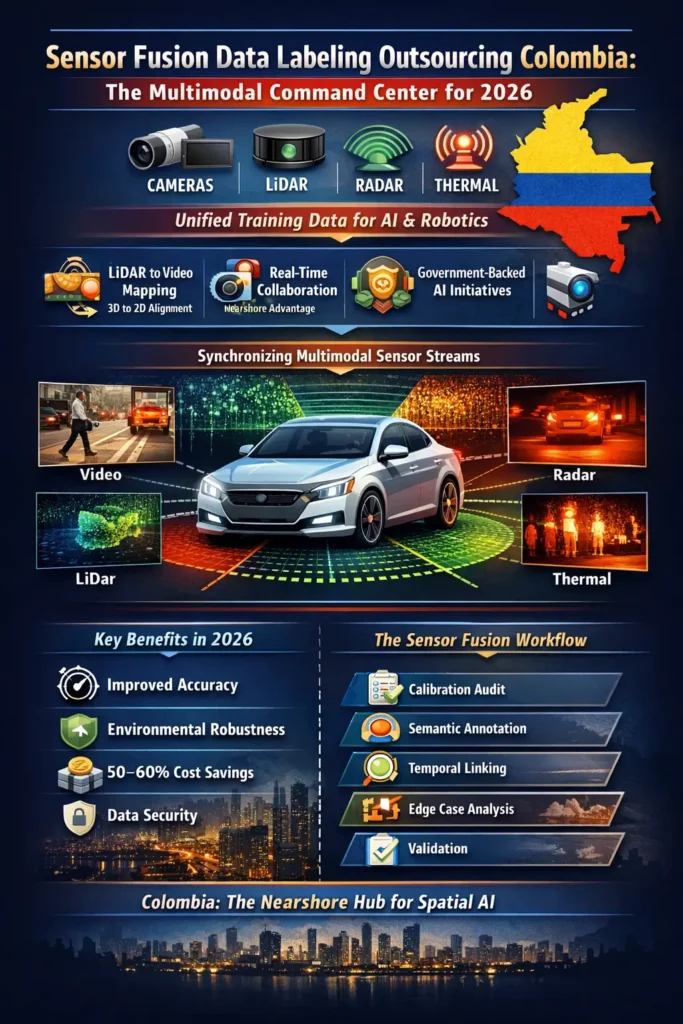
Sensor Fusion Data Labeling Outsourcing to Colombia has become a critical foundation for AI systems that must interpret the physical world through multiple data streams. In 2026, Colombia stands out as a nearshore hub for multimodal intelligence—where LiDAR, radar, thermal, and video data are synchronized into unified training datasets for autonomous systems and robotics.
- Specialized teams align multiple sensor streams into a single, consistent ground truth.
- Expertise in LiDAR-to-video mapping enables accurate 3D-to-2D spatial relationships.
- Nearshore time-zone alignment supports real-time collaboration with AI engineering teams.
- Government-backed AI initiatives strengthen the talent pipeline for complex data operations.
- Secure, zero-possession environments ensure compliance with global data privacy standards.
The Rise of Multimodal Perception
AI systems in 2026 no longer rely on a single input source. Instead, they combine multiple sensors to build a comprehensive understanding of their environment. This shift toward multimodal perception is essential for applications such as autonomous vehicles, robotics, and smart infrastructure.
Each sensor contributes a different perspective. Cameras capture visual detail, LiDAR provides depth, radar detects movement in challenging conditions, and thermal sensors reveal heat signatures. The challenge lies in aligning these inputs so that they form a coherent representation of reality.
Colombia has developed strong capabilities in this domain, enabling enterprises to transform fragmented sensor data into synchronized datasets that support accurate and reliable AI behavior.
Synchronization as the Core Challenge
The complexity of sensor fusion lies in timing and alignment. Even minor discrepancies between data streams can lead to incorrect interpretations, such as false obstacles or missed detections.
Colombian providers address this through precise spatio-temporal alignment. Annotators ensure that data from different sensors corresponds accurately across time and space, creating a consistent ground truth.
This includes mapping 3D point clouds onto 2D video frames, maintaining object identity across sensors, and resolving conflicts between data sources. The result is a unified dataset that allows AI systems to interpret their environment with greater confidence.
Beyond Labeling: Calibrating Sensor Confidence
A key differentiator in Colombian workflows is the focus on decision logic. Sensor fusion is not just about combining data—it is about determining which sensor to trust in different scenarios.
For example, visual data may be unreliable in low-light conditions, while radar or LiDAR may provide more accurate signals. Colombian specialists incorporate these dynamics into annotation processes, helping models learn how to prioritize inputs.
This approach supports the development of more resilient AI systems capable of operating in complex and unpredictable environments.
The Nearshore Advantage in Real-Time Systems
Sensor fusion projects require continuous iteration. When errors occur, they must be identified and corrected quickly to prevent cascading issues in model training.
Colombia’s alignment with North American time zones enables real-time collaboration between annotation teams and engineers. This reduces delays and allows rapid refinement of datasets.
In practice, this means that issues detected during testing can be addressed within hours. This responsiveness is particularly important for safety-critical systems, where delays can impact development timelines and system reliability.
Table 1: Strategic Benefits of Colombian Sensor Fusion Labeling (2026)
| Advantage | Technical Specification | Strategic Outcome |
| Multimodal Synchronization | Alignment of LiDAR, radar, and video streams | Reduced perception errors and improved system accuracy |
| Spatio-Temporal Precision | Consistent tracking across time and 3D space | Better prediction of object movement and intent |
| Environmental Robustness | Training across diverse conditions (rain, fog, low-light) | Reliable performance in real-world environments |
| Compliance Alignment | Adherence to global AI and privacy standards | Reduced regulatory risk |
| Cost Efficiency | 50–60% lower than onshore operations | Scalable development at optimized cost |
Secure Handling of Complex Sensor Data
Sensor fusion datasets often contain sensitive information, including location data and real-world environmental recordings. Protecting this data is essential for both compliance and intellectual property security.
Colombian providers use zero-possession architectures, where data is accessed through secure, controlled environments without being stored locally. This ensures that sensitive information remains protected while still enabling efficient processing.
These frameworks align with global data privacy standards, providing enterprises with confidence that their data is handled securely throughout the annotation process.
Structuring the Sensor Fusion Workflow
Effective sensor fusion requires a structured lifecycle that ensures data quality across multiple dimensions. Colombian providers organize this process into specialized stages:
- Calibration Verification: Ensuring proper alignment between sensors
- Semantic Annotation: Labeling objects across multiple data streams
- Noise Filtering: Removing irrelevant or misleading sensor signals
- Temporal Linking: Maintaining object identity across time
- Edge Case Analysis: Identifying rare or complex scenarios
- Validation: Verifying consistency and accuracy across datasets
Table 2: The 2026 Sensor Fusion Lifecycle in Colombia
| Phase | Colombian Contribution | Enterprise Value |
| Calibration Audit | Verification of sensor alignment | Accurate spatial mapping |
| Semantic Annotation | Multi-sensor object labeling | Unified environmental understanding |
| Radar Mapping | Filtering and structuring radar signals | Improved detection redundancy |
| Temporal Linking | Maintaining object identity across frames | Reliable tracking in motion |
| Edge Case Analysis | Deep analysis of rare scenarios | Increased system robustness |
| Validation | Cross-checking multi-sensor outputs | High-confidence training data |
Human-in-the-Loop in Multimodal Systems
Despite advances in automation, sensor fusion still requires human oversight. Complex scenarios—such as conflicting sensor inputs or unusual environmental conditions—often require interpretation.
Colombian teams provide this human-in-the-loop layer, ensuring that datasets reflect real-world conditions accurately. Their role is particularly important in training models to handle edge cases and unexpected situations.
By integrating human expertise into the process, enterprises can improve both the reliability and safety of their AI systems.
Colombia’s Strategic Role in Spatial AI
As industries move toward more advanced forms of automation, the importance of sensor fusion will continue to grow. Systems that interact with the physical world must be able to interpret multiple data sources simultaneously.
Colombia has positioned itself as a key player in this space, offering a combination of technical expertise, nearshore accessibility, and structured workflows. Its providers deliver high-quality datasets that support the development of reliable and scalable AI systems.
Through partnerships facilitated by Cynergy BPO, organizations can access specialized capabilities that accelerate development while maintaining strong standards of accuracy and compliance.
Expert FAQs
Why is sensor fusion important for AI systems?
It enables systems to combine multiple data sources, improving accuracy and reliability in complex environments.
How does Colombia support real-time collaboration?
Through time-zone alignment with North America, allowing immediate feedback and faster iteration cycles.
How is data security maintained?
By using secure, zero-possession environments that prevent local storage of sensitive data.
What cost benefits can enterprises expect?
Typically, 50–60% cost savings compared to onshore operations while maintaining high-quality outputs.
Share This
Unlock cost-efficient growth with expert BPO guidance!
Partner with Cynergy BPO to connect with top outsourcing providers.
Streamline operations, cut costs, and scale your business with confidence.
Book a Free Call
Ralf Ellspermann - CSO
Author
Ralf Ellspermann is the Chief Strategy Officer (CSO) of Cynergy BPO and a globally recognized authority in business process and contact center outsourcing. With more than 25 years of experience advising enterprises and SMEs, he provides strategic guidance on vendor selection, CX optimization, and scalable outsourcing strategies across global markets. His expertise spans fintech, ecommerce and retail, healthcare, insurance, travel and hospitality, and technology (AI & SaaS) outsourcing.
A frequent speaker at leading industry conferences, Ralf is also a published contributor to The Times of India and CustomerThink, where he shares insights on outsourcing strategy, customer experience, and digital transformation.