


By: Ralf Ellspermann
25-Year, Multi-Awarded BPO Veteran
Published: 30 March 2026
Updated: March 25, 2026
Technical support outsourcing in El Salvador has advanced into a high-complexity engineering support layer—far beyond traditional helpdesk models.
In 2026, nearshore teams operate as embedded extensions of DevOps, product, and infrastructure teams, enabling faster debugging, tighter collaboration, and improved system uptime. Instead of reacting to tickets, Salvadoran teams now participate directly in incident resolution, system monitoring, and continuous improvement cycles.
30-Second Executive Briefing
- Technical Capability: Teams support API troubleshooting, cloud environments, database issues, and infrastructure incidents across SaaS, fintech, and IoT ecosystems.
- Real-Time Collaboration: CST alignment enables live debugging and synchronous engineering workflows with U.S. teams.
- AI-Driven Efficiency: Diagnostic copilots analyze logs and telemetry before human intervention, accelerating root-cause analysis.
- Operational Impact: Organizations report measurable improvements in MTTR, uptime, and escalation efficiency.
- Cost Positioning: Nearshore delivery maintains strong efficiency while supporting certified, technically trained talent pools.
From Support Queue to Engineering Workflow
Technical support has moved beyond scripts and static playbooks.
In 2026:
- AI resolves basic issues instantly
- Engineers handle multi-layered system failures and edge cases
- Support teams must understand architecture, dependencies, and system behavior
This has transformed technical support into a systems-level function, where the goal is not just to fix problems—but to prevent recurrence and improve system stability.
El Salvador has adapted by producing talent capable of:
- Navigating cloud stacks (AWS, Azure, GCP)
- Interpreting logs and performance metrics
- Collaborating with engineering teams in real time
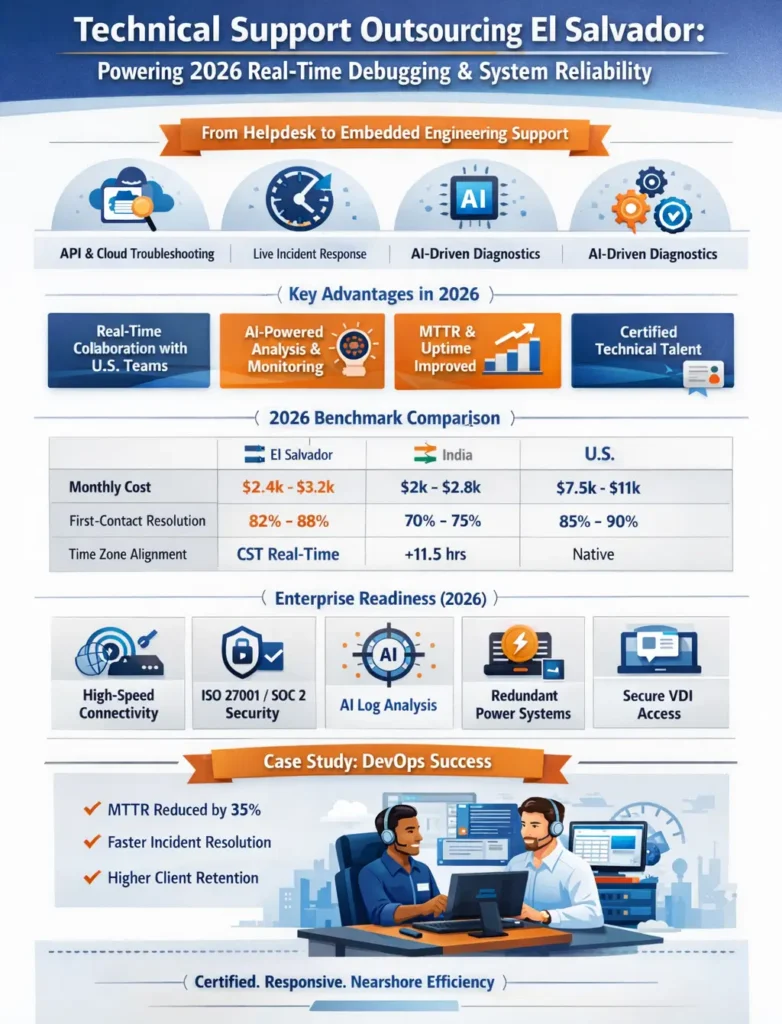
2026 Technical Benchmark Comparison
For CTOs and engineering leaders, performance is measured through resolution quality and speed—not just cost.
| Metric | El Salvador (Nearshore) | India (Offshore) | US Domestic |
| Fully Loaded Monthly Cost | $2,400 – $3,200 | $2,000 – $2,800 | $7,500 – $11,000 |
| First-Contact Resolution | 82% – 88% | 70% – 75% | 85% – 90% |
| Time Zone Alignment | CST (Real-Time) | +11.5 to 12.5 Hours | Native |
| Technical Certifications | CCNA, AWS, CompTIA+ | High Volume | Native |
| Cultural Alignment | Very High | Moderate | Native |
El Salvador delivers near onshore-level resolution quality, but with significantly improved responsiveness compared to offshore models.
Designed for High-Stakes Technical Environments
Supporting complex technical workflows requires a secure, high-performance infrastructure layer.
Enterprise Technical Readiness (2026)
| Component | Status | Enterprise Advantage |
| Connectivity | Redundant high-speed fiber | Stable remote CLI and system access |
| Security | ISO 27001 & SOC 2-aligned environments | Protection of proprietary code and data |
| AI Layer | Real-time log parsing and diagnostics | Faster root-cause identification |
| Power | Redundant grid + backup systems | Continuous operations |
| Work Environment | Secure VDI-enabled delivery | Controlled access to critical systems |
These capabilities support low-latency troubleshooting, secure system access, and continuous monitoring.
Case Study: Enhancing DevOps Responsiveness for a Cybersecurity Firm
The Challenge:
A U.S.-based cybersecurity company faced delays between Tier 2 and Tier 3 teams, resulting in prolonged downtime and frustrated enterprise clients.
The Solution:
A nearshore technical support team in El Salvador was embedded directly into:
- Incident response workflows
- Engineering communication channels
- Monitoring and escalation systems
AI tools were introduced to pre-process logs and identify probable failure points.
The Results:
- MTTR reduced by 35%, improving platform reliability
- Escalations decreased, as more issues were resolved earlier
- Customer retention improved, particularly among enterprise accounts
Insight:
Proximity and integration—not just cost—drove the performance gains.
Strategic Implementation: Building a High-Performance Support Layer
Embed Support Within Engineering
Top-performing teams:
- Join daily standups
- Work inside shared tools (Jira, Slack)
- Collaborate directly with developers
This removes delays between detection and resolution.
Hire for Systems Thinking
Focus on agents who can:
- Understand full application stacks
- Analyze dependencies
- Solve beyond surface-level issues
Depth consistently outperforms volume.
Use AI as a Pre-Diagnostic Layer
Modern support models deploy AI to:
- Analyze logs before human review
- Suggest likely root causes
- Reduce investigation time
This allows engineers to move directly into solution mode.
Frequently Asked Questions (FAQs)
What level of technical support can El Salvador handle?
Teams commonly support Tier 2 and Tier 3 environments, including cloud systems, APIs, infrastructure, and SaaS platforms.
How does time-zone alignment affect engineering workflows?
It enables real-time debugging, faster escalations, and continuous collaboration, eliminating delays caused by handoffs.
What certifications are common among technical agents?
Many professionals hold certifications such as AWS, CompTIA, CCNA, and other platform-specific credentials.
Can nearshore teams reduce downtime?
Yes. Faster communication and integrated workflows contribute to lower MTTR and improved uptime.
How do these teams integrate with internal operations?
They typically operate within existing tools and processes, acting as an extension of internal engineering teams.
Share This
Unlock cost-efficient growth with expert BPO guidance!
Partner with Cynergy BPO to connect with top outsourcing providers.
Streamline operations, cut costs, and scale your business with confidence.
Book a Free Call
Ralf Ellspermann - CSO
Author
Ralf Ellspermann is the Chief Strategy Officer (CSO) of Cynergy BPO and a globally recognized authority in business process and contact center outsourcing. With more than 25 years of experience advising enterprises and SMEs, he provides strategic guidance on vendor selection, CX optimization, and scalable outsourcing strategies across global markets. His expertise spans fintech, ecommerce and retail, healthcare, insurance, travel and hospitality, and technology (AI & SaaS) outsourcing.
A frequent speaker at leading industry conferences, Ralf is also a published contributor to The Times of India and CustomerThink, where he shares insights on outsourcing strategy, customer experience, and digital transformation.