



By: Ralf Ellspermann
25-Year, Multi-Awarded BPO Veteran
Published: 23 April 2026
Updated: April 1, 2026
To eliminate operational bottlenecks and focus on core revenue drivers, North American firms are increasingly transitioning their administrative overhead to the Dominican Republic. This nearshore shift addresses the rising costs of U.S. domestic staffing while ensuring that essential functions—from executive support to complex human resource management—remain aligned with Eastern Standard Time (EST). By leveraging the country’s Law 8-90 fiscal framework, enterprises are achieving a more agile, cost-effective back-office that functions as a seamless extension of their primary headquarters.
30-Second Executive Briefing
- Cost Efficiency: Achieve an average 50% to 65% reduction in total administrative spend compared to hiring in-house U.S. personnel.
- Operational Synchronicity: 100% time-zone alignment (EST/AST) ensures immediate responsiveness and zero-latency communication for executive teams.
- Linguistic Versatility: Access to a bilingual workforce (English/Spanish) capable of managing cross-border vendor relations and diverse client bases.
- Infrastructure Reliability: Operations centered in Santo Domingo and Santiago benefit from Tier-3 data centers and redundancy-rich fiber-optic networks.
- Fiscal Incentives: Companies utilizing Dominican Free Trade Zones (FTZs) receive a 100% exemption from corporate income and municipal taxes.
The Nearshore Advantage: Strategic Back-Office Alignment
As we navigate 2026, the traditional offshore model—defined by 12-hour delays and cultural dissonance—is being replaced by “Proximity-Based Administration.” For high-velocity sectors like fintech, legal, and health-tech, the administrative function is no longer a passive task list; it is the connective tissue of the organization.
The Dominican Republic provides a “Cultural Mirror” to the North American market. Dominican professionals frequently possess a native-level understanding of U.S. business etiquette, corporate tools (Slack, HubSpot, Notion), and regulatory expectations. This minimizes the “Management Tax” often associated with outsourcing, as Dominican leads require less oversight and integrate faster into existing workflows.
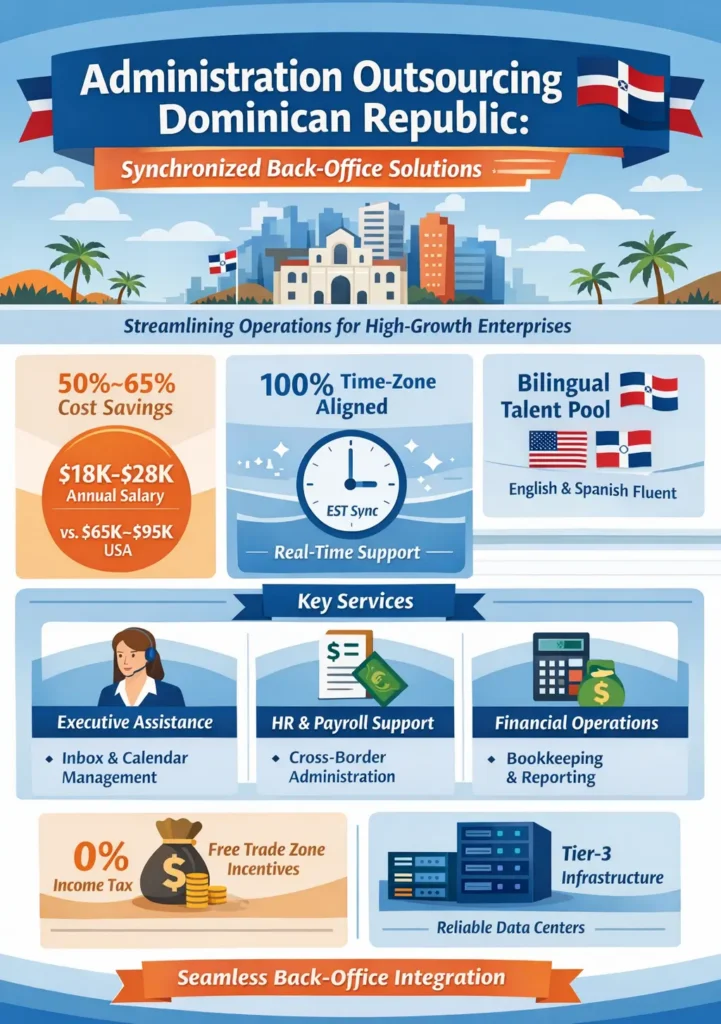
Comparative Operational Metrics: Dominican Republic vs. Domestic vs. Offshore
| Performance Pillar | Dominican Republic (Nearshore) | Philippines/India (Offshore) | In-House (USA/Canada) |
| Annual Admin Salary (Blended) | $18,000 – $28,000 | $8,000 – $14,000 | $65,000 – $95,000 |
| Response Latency | < 5 Minutes | 12+ Hours | < 5 Minutes |
| Bilingual Capability | Native/High | Variable | High Cost |
| Retention Rates | High (85%+) | Moderate (60-70%) | Variable |
| Tax Impact (FTZ) | 0% Income Tax | Varies by Region | 21% – 35% |
Specialized Administrative Workflows
Dominican providers have evolved past basic data entry, now offering sophisticated “Tier-2” administrative support tailored to 2026 business needs.
Executive Support and Inbox Triage
Modern Executive Assistants (EAs) in the DR do more than schedule meetings. They act as “Air Traffic Controllers” for C-suite communication, utilizing AI-assisted tools to prioritize high-value emails, draft preliminary responses, and manage complex travel logistics across multiple time zones. This level of autonomy is enabled by the deep cultural alignment prevalent in the local talent pool.
Human Resources and Payroll Administration
With the global workforce becoming more fragmented, managing payroll, benefits, and compliance across borders is a massive administrative burden. Dominican hubs provide specialized HR Outsourcing (HRO) that includes:
- Multilingual Recruitment: Sourcing talent across the Americas.
- Policy Documentation: Aligning handbook standards with US/LATAM laws.
- Benefit Management: Coordinating with international insurance providers.
Fiscal Framework and Structural Savings
The economic case for Dominican administration is bolstered by the country’s aggressive “Agenda Digital 2030,” which incentivizes the export of digital and administrative services.
Projected Annual Savings by Functional Scale (2026)
| Function | Headcount | Dominican Annual Spend | US Internal Spend | Net Savings |
| Executive Support Unit | 3 | $72,000 | $225,000 | $153,000 |
| Full Back-Office Pod | 10 | $210,000 | $680,000 | $470,000 |
| HR & Payroll Support | 5 | $115,000 | $350,000 | $235,000 |
Case Study: Scaling Operations for a Rapid-Growth SaaS Firm
The Challenge: A Series B software company in Austin, Texas, was struggling with “Operational Drag.” Their internal EAs and HR staff were overwhelmed by 40% month-over-month growth. Hiring locally was cost-prohibitive, and an offshore pilot in Eastern Europe failed due to a lack of real-time availability during the Texas business day.
The Solution: The firm transitioned its administrative core to a Dominican-based “Shared Services Center.” This team of 12 professionals took over vendor management, calendar coordination, and bilingual customer onboarding.
The Outcome:
- Operational Speed: Average internal task completion time dropped by 30%.
- Fiscal Impact: The company reallocated $500,000 in annual overhead toward R&D and engineering.
- Employee Satisfaction: Core US executives reported a significant reduction in “Administrative Fatigue,” allowing them to focus on strategic partnerships.
Autonomous Admin and Human Oversight
We are entering the era of “AI-Augmented Administration.” In the Dominican Republic, providers are training their staff to manage AI agents that handle repetitive tasks like invoice reconciliation and data scraping. This creates a high-leverage model where one Dominican administrator can do the work of three traditional clerks. This “Human-in-the-Loop” approach ensures that while speed is maximized via automation, the final output is always verified for context and accuracy by a skilled professional.
Expert FAQs
How does the Dominican Republic handle data privacy for administrative tasks?
Top-tier providers utilize SOC 2 Type II compliant facilities and Virtual Desktop Infrastructure (VDI). This ensures that sensitive data, such as payroll info or executive calendars, stays within the client’s secure cloud environment and is never stored on local devices in the DR.
Is there a risk of high turnover in Dominican administrative roles?
Actually, the opposite is true. Administrative roles in the nearshore BPO sector are considered high-status, competitive positions in the Dominican Republic. This leads to significantly higher retention rates (often 20-30% better) than similar entry-level administrative roles in the United States.
Can Dominican administrators manage US-based vendor relationships?
Yes. Due to the high English proficiency and cultural alignment, Dominican admins frequently interact with US vendors, banks, and partners. They are indistinguishable from domestic staff in written communication and have the “soft skills” necessary for effective negotiation and follow-up.
What happens if our needs scale rapidly during the year?
The Dominican Republic’s established BPO ecosystem allows for rapid scaling. Most providers maintain a “talent bench” or can tap into local university pipelines to onboard and train additional administrative staff within 14 to 21 days, ensuring your operations keep pace with your growth.
Share This
Unlock cost-efficient growth with expert BPO guidance!
Partner with Cynergy BPO to connect with top outsourcing providers.
Streamline operations, cut costs, and scale your business with confidence.
Book a Free Call
Ralf Ellspermann - CSO
Author
Ralf Ellspermann is the Chief Strategy Officer (CSO) of Cynergy BPO and a globally recognized authority in business process and contact center outsourcing. With more than 25 years of experience advising enterprises and SMEs, he provides strategic guidance on vendor selection, CX optimization, and scalable outsourcing strategies across global markets. His expertise spans fintech, ecommerce and retail, healthcare, insurance, travel and hospitality, and technology (AI & SaaS) outsourcing.
A frequent speaker at leading industry conferences, Ralf is also a published contributor to The Times of India and CustomerThink, where he shares insights on outsourcing strategy, customer experience, and digital transformation.