


By: Ralf Ellspermann
25-Year, Multi-Awarded BPO Veteran
Published: 24 April 2026
Updated: April 1, 2026
North American CFOs are bypassing traditional offshore centers in favor of the Dominican Republic. This strategic transition from “back-office processing” to “nearshore financial intelligence” provides a unique blend of GAAP-compliant expertise, bilingual communication, and real-time synchronization. By leveraging the country’s robust Law 8-90 incentives, enterprises are achieving 50% operational savings while upgrading their capability in high-stakes areas like predictive FP&A and automated tax reconciliation.
30-Second Executive Briefing
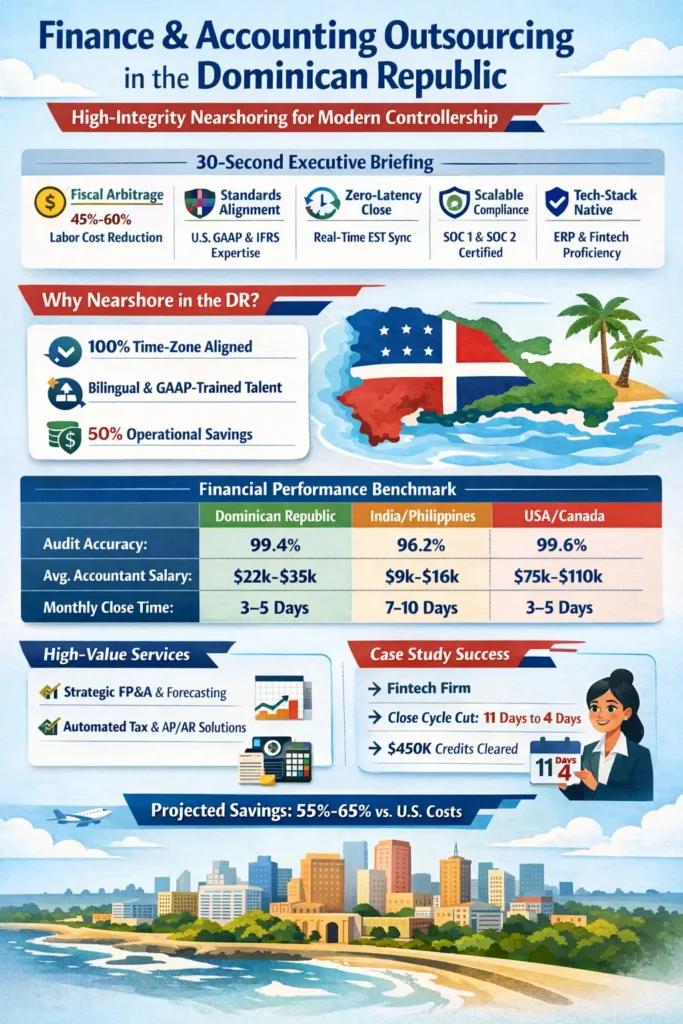
- Fiscal Arbitrage: Realize 45% to 60% reductions in labor costs compared to mid-market U.S. accounting salaries.
- Standards Alignment: A talent pool trained in U.S. GAAP and IFRS, ensuring seamless integration with North American reporting cycles.
- Zero-Latency Close: 100% time-zone alignment (EST) allows for real-time “Continuous Close” workflows and immediate auditor response.
- Scalable Compliance: Operations housed in ISO-certified Free Trade Zones, meeting stringent SOC 1 and SOC 2 Type II data integrity requirements.
- Tech-Stack Native: High proficiency in Tier-1 ERPs (Oracle NetSuite, SAP S/4HANA, Sage Intacct) and modern fintech automation tools.
The Controllership Pivot: Why Nearshoring Trumps Offshoring
In 2026, the “12-hour delay” inherent in Asian offshore models has become a liability for agile finance teams. The Dominican Republic offers a “Mirror-Office” environment where Dominican accountants function as a real-time extension of the U.S. controller’s team. This proximity eliminates the “rework loop” caused by cultural misinterpretations of Western business expenses or vendor nuances.
Dominican accounting professionals benefit from a rigorous local university system that mirrors U.S. collegiate business curricula. This results in a workforce that doesn’t just “enter data,” but understands the underlying financial logic of accruals, revenue recognition (ASC 606), and intercompany eliminations.
Financial Operations Benchmarks: Dominican Republic vs. Global Standards
| Operational Metric | Dominican Republic (Nearshore) | India/Philippines (Offshore) | Onshore (USA/Canada) |
| Audit-Ready Accuracy | 99.4% | 96.2% | 99.6% |
| Communication Barrier | Minimal (Bilingual/EST) | Moderate (Time/Accent) | None |
| Average Accountant Salary | $22k – $35k | $9k – $16k | $75k – $110k |
| Monthly Close Velocity | 3 – 5 Days | 7 – 10 Days | 3 – 5 Days |
| Security Framework | HIPAA/SOC/PCI | Variable | HIPAA/SOC/PCI |
High-Value Finance Specializations
The Dominican Republic has matured into a hub for complex F&A functions that require high-context judgment rather than rote repetition.
Strategic FP&A and Variance Analysis
Beyond bookkeeping, Dominican hubs are increasingly tasked with “Forward-Looking Finance.” Using AI-integrated modeling tools, local analysts provide real-time variance reporting and rolling forecasts. Because they operate within the same business day as the client’s executive team, they can pivot models instantly during board meetings or sensitive M&A due diligence phases.
Automated AP/AR and Cash Flow Optimization
In a high-interest-rate environment, Days Sales Outstanding (DSO) is a critical metric. Dominican AR teams utilize “Empathetic Collections”—leveraging their cultural alignment and bilingual skills to resolve payment disputes with North American vendors more effectively than automated bots or distant offshore agents.
Fiscal Framework and Capital Efficiency
The Dominican government’s “Vision 2030” specifically targets the export of high-value professional services, making the F&A sector a primary beneficiary of national infrastructure investment.
Projected Annualized Savings: F&A Functional Pods (2026)
| Functional Pod | Team Size | Dominican Annual Cost | U.S. Internal Cost | Net Margin Gain |
| General Ledger & Close | 4 | $120,000 | $340,000 | 64.7% |
| Full-Cycle AP/AR | 6 | $155,000 | $390,000 | 60.2% |
| FP&A & Management Reporting | 2 | $85,000 | $210,000 | 59.5% |
Case Study: Modernizing Global Accounting for a Fintech Scale-up
The Challenge: A New York-based fintech firm with $200M in annual recurring revenue (ARR) was struggling with a “fragmented close.” Their internal team was bogged down by manual reconciliations across three currencies, leading to an 11-day close cycle that frustrated investors.
The Solution: The firm established a “Financial Center of Excellence” in Santo Domingo. The team of five senior accountants took ownership of multi-currency reconciliations and implemented an automated BlackLine workflow integrated with their NetSuite ERP.
The Outcome:
- Close Velocity: Reduced from 11 days to 4 days.
- Integrity: Identified and cleared a $450k backlog of unapplied credits within the first 60 days.
- Strategic Shift: The US-based CFO reallocated 40 hours of “clerical review” per month toward high-level capital raising and strategic partnerships.
AI-Augmented Accounting: Precision Through Exception Control
Finance operations are shifting toward a model where automation handles volume, and human expertise governs complexity. In the Dominican Republic, accountants are stepping into supervisory roles over AI-driven financial systems, creating a structure where speed and control operate in tandem.
AI agents process high-volume transaction matching and reconciliation, while Dominican professionals concentrate on “exception engineering”—resolving the small but critical layer of irregularities that demand judgment, context, and accountability. This approach ensures that efficiency gains do not come at the expense of accuracy, reinforcing a financial operation that is both fast-moving and rigorously controlled.
Expert FAQs
How do Dominican providers ensure compliance with US GAAP and SEC reporting?
Tier-1 providers in the DR employ CPAs and professionals who often hold international certifications (ACCA or CPA-equivalent training). Furthermore, they utilize continuous training programs specifically focused on updated FASB standards, ensuring their methodology remains identical to a U.S.-based firm.
What are the data security protocols for sensitive financial records?
Data never “leaves” the client’s shore in a technical sense. Dominican accountants work via secure Virtual Desktop Infrastructure (VDI) or Citrix environments. Facilities are “Paperless/Deviceless” environments with biometric access, ensuring that PII and sensitive fiscal data remain entirely within the client’s encrypted cloud perimeter.
Can Dominican teams handle multi-national tax compliance?
While specialized tax strategy usually stays onshore, Dominican teams are experts in the “heavy lifting” of tax preparation—gathering data, performing nexus checks, and preparing workpapers for sales tax (VAT/GST) filings across multiple U.S. states and international jurisdictions.
Is there an advantage to the DR’s bilingualism in F&A?
Immense. For companies with operations in the U.S., Mexico, or South America, a Dominican F&A team can consolidate the entire region’s books. They can speak with vendors in Santiago, Chile, as easily as they can coordinate with a bank in Charlotte, North Carolina, providing a “Unified Finance Desk” for the Americas.
Share This
Unlock cost-efficient growth with expert BPO guidance!
Partner with Cynergy BPO to connect with top outsourcing providers.
Streamline operations, cut costs, and scale your business with confidence.
Book a Free Call
Ralf Ellspermann - CSO
Author
Ralf Ellspermann is the Chief Strategy Officer (CSO) of Cynergy BPO and a globally recognized authority in business process and contact center outsourcing. With more than 25 years of experience advising enterprises and SMEs, he provides strategic guidance on vendor selection, CX optimization, and scalable outsourcing strategies across global markets. His expertise spans fintech, ecommerce and retail, healthcare, insurance, travel and hospitality, and technology (AI & SaaS) outsourcing.
A frequent speaker at leading industry conferences, Ralf is also a published contributor to The Times of India and CustomerThink, where he shares insights on outsourcing strategy, customer experience, and digital transformation.