



By: Ralf Ellspermann
25-Year, Multi-Awarded BPO Veteran
Published: 13 March 2026
Updated: March 13, 2026
TL;DR: The Key Takeaway
3D point cloud labeling outsourcing in India is the critical enabler for building the digital twin of the physical world, transforming raw sensor data into the high-fidelity ground truth required to train and validate the next generation of autonomous AI.
Creating a high-fidelity digital twin or a reliable autonomous system requires a transition from 2D images to 3D spatial intelligence. 3D point cloud annotation—the classification of millions of data points captured by LiDAR or photogrammetry—is the foundational process that makes this possible. India has established itself as the global epicenter for this work, moving beyond labor arbitrage to “Intelligence Arbitrage.” By utilizing a workforce of elite STEM graduates, Indian providers deliver the spatial reasoning and physics-aware accuracy necessary for the future of robotics and autonomy.
Executive Briefing
- Spatial Fidelity: The reliability of autonomous navigation and industrial digital twins is directly linked to the precision of 3D sensor data annotation.
- Technical Pedigree: India’s massive pool of STEM talent, particularly from the IITs and IISc, provides the analytical depth required to interpret dense, multi-dimensional data.
- Intelligence Arbitrage: Modern outsourcing focuses on the cognitive value and performance gains realized by leveraging expert human-in-the-loop insights.
- Categorical Evolution: Annotation standards have advanced from basic 3D boxes to complex kinematic tracking and relational scene logic.
- Governance and Trust: A robust strategic framework ensures that the resulting “golden datasets” meet the safety-critical standards of March 2026.
From Chaotic Points to Digital Truth: The 3D Imperative
Raw LiDAR data is often a “blizzard” of coordinates that lacks inherent meaning. For a robot or a self-driving vehicle to operate, every point in that cloud must be classified—distinguishing a concrete curb from a low-lying shrub or a pedestrian from a stationary sign. This process defines the geometry and trajectory of objects in a three-dimensional reality.
This is not a simple data entry task; it is the digital codification of the physical world. It requires an understanding of object permanence, spatial relationships, and real-world physics. The quality of this work is the single most important factor in AI safety. Even a minor error in point classification can lead to a failure in an autonomous system’s motion planning. Consequently, global AI labs are turning to the Indian tech hub for the high-fidelity annotation that serves as the “ground truth” for their models.
The Indian Advantage: A Convergence of Engineering and Infrastructure
India’s dominance in 3D annotation is the result of a unique intersection between top-tier human capital and mature operational systems. The nation’s elite engineering institutions produce graduates with the spatial reasoning and mathematical grounding necessary for high-density sensor data.
These professionals don’t just follow manuals; they apply critical judgment to ambiguous data. This intellectual capability is supported by a world-class IT infrastructure that ensures 24/7 business continuity and stringent data security. Furthermore, the English proficiency and cultural alignment of the Indian workforce allow for a seamless integration with US-based R&D teams, creating a “follow-the-sun” development cycle that accelerates time-to-market.
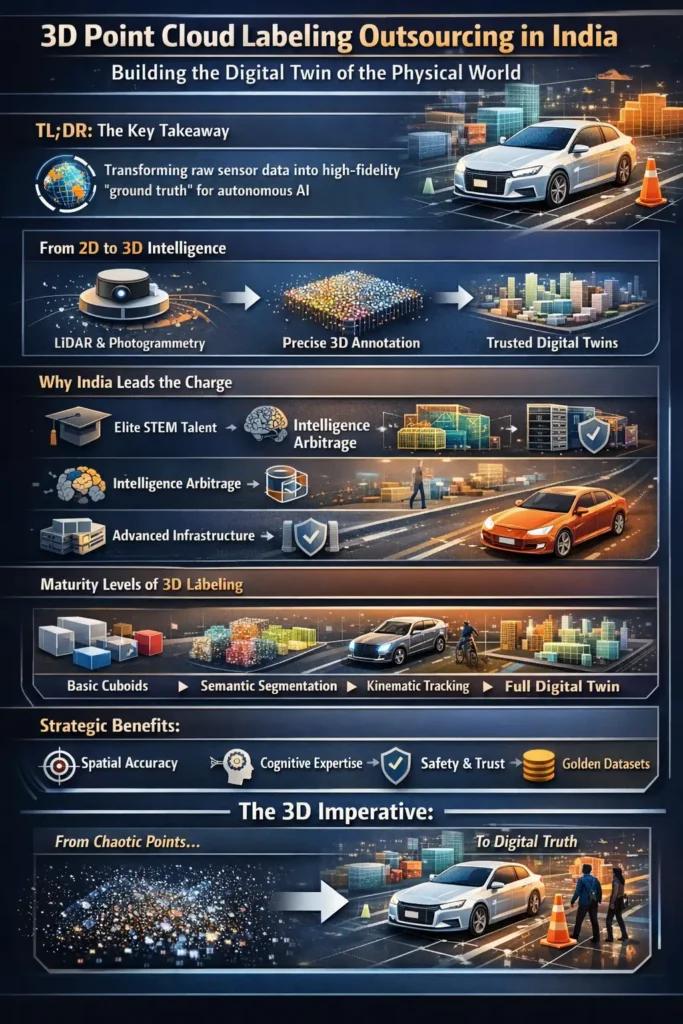
3D Annotation Maturity Matrix
As AI models become more sophisticated, the labeling requirements move from simple geometry to deep semantic understanding.
| Maturity Level | Methodology | Primary Use Case | Strategic Outcome |
| Level 1: Foundational | Manual 3D cuboid placement | Object localization | Basic awareness of object presence |
| Level 2: Semantic | Voxel-level classification | Scene understanding | Detailed environmental mapping |
| Level 3: Kinematic | Tracking velocity/trajectories | Motion planning | Behavior prediction for moving actors |
| Level 4: Contextual | Labeling object interactions | Causal reasoning | Understanding complex scene logic |
| Level 5: Digital Twin | Full-fidelity, physics-aware mapping | High-fidelity simulation | A perfect, interactive replica of reality |
Intelligence Arbitrage: The New ROI of Outsourcing
In 2026, the traditional model of seeking the lowest wage is obsolete. Leading AI firms now practice “Intelligence Arbitrage”—leveraging a highly skilled workforce to achieve a measurable lift in model performance. The key metric is no longer cost-per-hour, but the reduction in the AI’s error rate and the acceleration of its safety validation.
Indian annotation teams act as strategic partners, identifying edge cases and refining workflows rather than just executing labels. This cognitive contribution ensures that the datasets are not just large, but “intelligent.” By tapping into this global talent corridor, companies build models that are not only functional but truly robust in the face of real-world unpredictability.
Service Tiers for Digital Twin Construction
Building a digital twin requires different layers of annotation complexity, each demanding a specific level of expertise.
| Service Tier | Focus Area | Cognitive Demand | Impact on AI Model |
| Tier 1: Static Mapping | Terrain, buildings, and roads | Medium | Foundations of the geometric map |
| Tier 2: Dynamic Objects | Vehicles and pedestrians | Medium to High | Populates the twin with active actors |
| Tier 3: Kinematic Labeling | Articulation (e.g., robotic joints) | High | Enables physics-based simulation |
| Tier 4: Relational Logic | Inter-object events and occlusions | Very High | Builds contextual/causal reasoning |
| Tier 5: Expert Auditing | Validation against real-world truth | Expert-Level | Ensures the twin is a reliable replica |
Establishing Trust through Strategic Governance
As AI is integrated into safety-critical infrastructure, the provenance of training data becomes a matter of public trust. A mistake in a 3D dataset isn’t just a typo; it’s a potential catastrophic failure. This is why a robust governance layer is essential.
Strategic partnerships in India provide this oversight through multi-stage vetting, rigorous data security protocols, and expert-led auditing. By implementing these industrial-grade quality benchmarks, firms ensure that their annotated datasets represent the absolute ground truth. This disciplined approach allows AI innovators to scale their operations with total confidence in their data integrity.
Expert Perspectives
What specific skills make Indian engineers so effective at 3D annotation?
Their strength lies in a combination of spatial reasoning and mathematical precision. Unlike generalists, Indian engineering graduates understand the underlying geometry and physics of 3D environments. This allows them to make accurate judgments about object boundaries and trajectories that are essential for high-fidelity models.
How does building a digital twin differ from standard autonomous vehicle labeling?
While AV labeling focuses on immediate perception (detecting a car), building a digital twin requires a holistic, semantically rich model of the entire environment. This includes the physical properties of static objects and the interactive logic of the scene, creating a complete virtual replica for simulation.
What is the relationship between human-annotated data and synthetic data?
Human-annotated “real-world” data provides the ground truth foundation. A high-fidelity digital twin, built by experts in India, is used to generate synthetic data for rare or dangerous edge cases. This creates a virtuous cycle where human expertise is scaled through simulation.
How is the accuracy of a 3D point cloud dataset measured?
Accuracy is measured using metrics like 3D Intersection over Union (IoU) to assess geometric overlap. However, this is supplemented by qualitative audits from domain experts who evaluate the logical consistency and contextual realism of the labels, ensuring the data is ready for safety-critical deployment.
Unlock cost-efficient growth with expert BPO guidance!
Partner with Cynergy BPO to connect with top outsourcing providers.
Streamline operations, cut costs, and scale your business with confidence.
Book a Free Call
Ralf Ellspermann - CSO
Author
Ralf Ellspermann is the Chief Strategy Officer (CSO) of Cynergy BPO and a globally recognized authority in business process and contact center outsourcing. With more than 25 years of experience advising enterprises and SMEs, he provides strategic guidance on vendor selection, CX optimization, and scalable outsourcing strategies across global markets. His expertise spans fintech, ecommerce and retail, healthcare, insurance, travel and hospitality, and technology (AI & SaaS) outsourcing.
A frequent speaker at leading industry conferences, Ralf is also a published contributor to The Times of India and CustomerThink, where he shares insights on outsourcing strategy, customer experience, and digital transformation.