



By: Ralf Ellspermann
25-Year, Multi-Awarded BPO Veteran
Published: 19 March 2026
Updated: March 16, 2026
TL;DR: The Key Takeaway
Proactive outsourcing of AI bias detection to India has become the definitive strategy for enterprises seeking to build genuinely fair and equitable AI systems. This approach moves beyond reactive fixes, leveraging the subcontinent’s deep technical talent to embed ethical oversight directly into the development lifecycle, ensuring both compliance and public trust.
Modern AI governance has transitioned from reactive “patch-fixing” to a proactive, end-to-end discipline of bias mitigation. Leading global enterprises are increasingly utilizing India’s specialized talent corridors to audit algorithms, ensure ethical integrity, and secure regulatory approval, transforming compliance into a distinct market advantage.
- Proactive Shift: Fairness is now engineered into the model lifecycle from day one, rather than corrected after public failure.
- Talent Density: India provides a concentrated pool of STEM experts capable of performing the complex statistical audits required for AI equity.
- Strategic Trust: Outsourcing bias detection is no longer about cost; it is about building verifiable consumer and regulatory confidence.
- Risk Reduction: Continuous monitoring in the South Asian tech hub prevents catastrophic brand damage and legal penalties.
- Operational Synergy: Cynergy BPO bridges the gap between Western tech firms and elite Indian specialists to ensure AI remains both innovative and responsible.
The Proactive Imperative: Beyond Reactive Fairness
The era of addressing algorithmic bias as an afterthought is over. Historically, companies operated on a “break-fix” model: deploy a system, wait for a discriminatory outcome to trigger a PR crisis, and then scramble for a patch. This strategy is not only financially reckless but technically flawed. Bias is rarely a simple “bug”; it is frequently a structural defect woven into the training data or the core architecture. Attempting to fix it after deployment is as futile as trying to adjust a building’s foundation once the roof is finished.
The 2026 standard for excellence involves a “shift-left” philosophy. Fairness audits are now embedded at every junction of the development cycle. This includes interrogating data collection for historical skews, optimizing models for parity, and stress-testing outputs before they ever reach a user. This proactive stance requires a dedicated, independent team of ethical gatekeepers—a role now being filled by specialized units within India’s IT-BPM sector.
India’s AI Fairness Ecosystem: Where Talent Meets Infrastructure
The subcontinent has cultivated a unique environment specifically designed for the high-cognition task of bias detection. Institutions like the IITs and IISc produce a steady stream of data scientists who possess the mathematical rigor to dissect “black box” algorithms. These specialists do not merely follow a checklist; they perform investigative statistical analysis to uncover hidden harms that automated tools often miss.
This human capital is supported by a sophisticated infrastructure perfected over decades of high-stakes service delivery. With seamless English communication and a time-zone alignment that allows for “follow-the-sun” testing, Indian teams can audit a model overnight and provide actionable feedback to US developers by morning. This synergy makes India the definitive global hub for proactive AI governance.
“Our partners are moving beyond asking if their AI is biased; they are demanding a certified audit trail to prove it is fair. In today’s market, showing regulators and boards a continuous, expert-led process for mitigating harm is a strategic necessity. We connect organizations with elite Indian teams that provide the verifiable assurance needed to build truly trustworthy AI.” — John Maczynski, CEO, Cynergy BPO
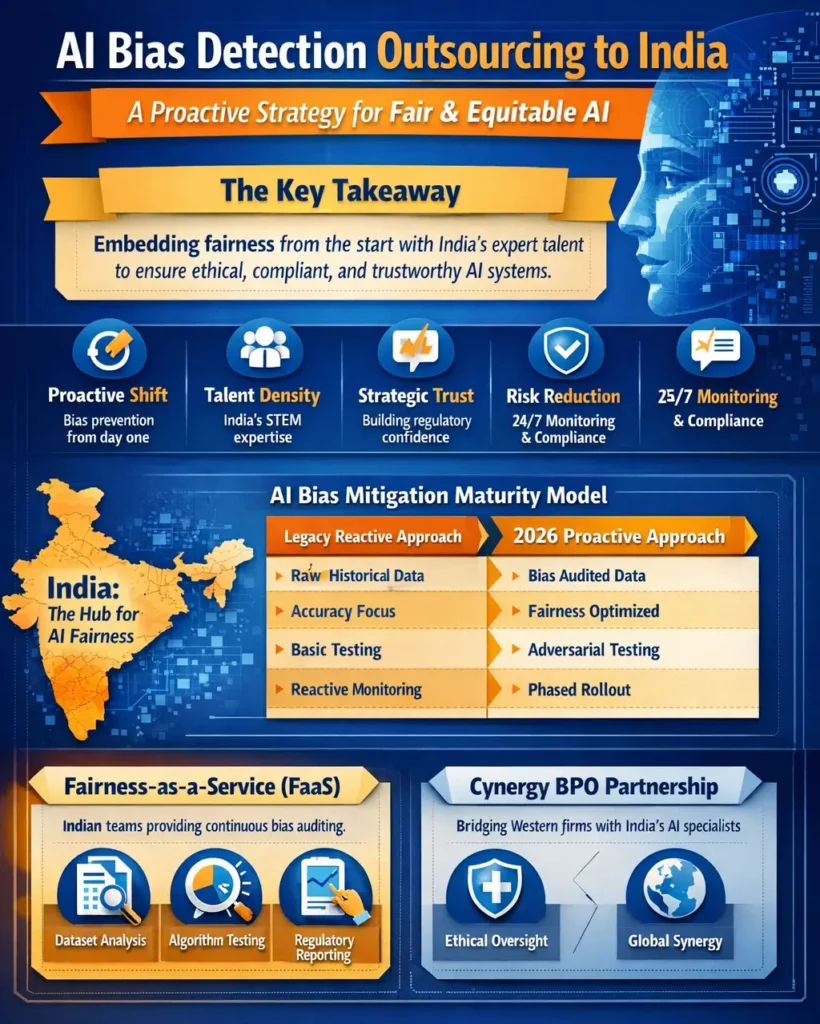
AI Bias Mitigation Maturity Model: 2026 Standards
| Phase | Legacy Reactive Approach | 2026 Proactive Approach |
| Data Sourcing | Use of raw historical data. | Analysis for demographic skews; synthetic data injection. |
| Development | Focus on predictive accuracy only. | Optimization for both precision and fairness metrics. |
| Testing | Basic performance validation. | Adversarial stress-testing and counterfactual analysis. |
| Deployment | Immediate launch; reactive monitoring. | Phased rollout with real-time bias dashboards. |
| Governance | Ad-hoc committee reviews. | Formalized, documented audit logs and accountability. |
The Mechanics of Investigative Auditing
What does a specialist bias detection team in India actually do? Their work is a blend of forensic data science and ethical philosophy. It begins with a deep dive into training sets to identify “proxy variables”—data points that might inadvertently represent protected classes like race or gender. For example, if a recruitment AI uses zip codes that correlate with specific racial demographics, the team flags this as a risk for systemic bias.
During the testing phase, they apply complex metrics such as Disparate Impact (checking for disproportionate harm) and Equal Opportunity Difference (ensuring equal performance across groups). They also conduct “counterfactual analysis,” where they change a single attribute—like a person’s name or gender—to see if the algorithm’s decision changes. This human-centric investigation provides the context that software alone cannot provide, ensuring the AI is statistically sound and ethically defensible.
The Strategic Value of Fairness-as-a-Service (FaaS)
Transitioning to a “Fairness-as-a-Service” model with an Indian partner offers immense enterprise value. It de-risks AI initiatives by catching discriminatory patterns before they lead to lawsuits or loss of consumer trust. Furthermore, it facilitates global expansion. A model that is transparent and fair is significantly more likely to comply with the EU AI Act and other emerging international regulations.
Ultimately, this investment drives better products. The process of rooting out bias often leads to deeper insights into customer behavior, resulting in more accurate, robust, and reliable AI systems that outperform biased competitors in the long run.
AI Fairness Service Tiers in India
| Tier | Core Activities | Talent Profile |
| Tier 1: Foundational Audit | Dataset analysis; baseline fairness reporting. | Data Analysts |
| Tier 2: Active Mitigation | Data re-weighting; model fine-tuning for parity. | AI/ML Engineers |
| Tier 3: Advanced Validation | Adversarial testing; causal inference; XAI. | Senior AI Researchers |
| Tier 4: Strategic Governance | Continuous monitoring; regulatory compliance. | Principal AI Ethicists |
Expert FAQs
Why is India the primary choice for bias detection?
India offers a unique intersection of massive STEM talent, high-tier IT security, and the ability to scale expert teams rapidly. The depth of mathematical expertise available allows for more than just surface-level testing; it enables deep-tissue audits of complex neural networks.
Can’t we just use automated tools to find bias?
Automation is a tool, not a solution. Bias is often contextual and cultural. A human-in-the-loop is required to interpret whether a statistical disparity is a legitimate business factor or a harmful stereotype. Indian specialists provide the critical thinking necessary to bridge that gap.
What are the most common metrics used for fairness?
Teams generally use a combination of Group Fairness (ensuring outcomes are balanced across populations) and Individual Fairness (ensuring similar people are treated the same). Common benchmarks include Demographic Parity and Counterfactual Fairness.
Does proactive auditing slow down the launch process?
In reality, it accelerates it. By catching ethical flaws early, you avoid the massive delays and “technical debt” associated with a post-launch recall or a regulatory freeze. It is a “measure twice, cut once” approach for the AI age.
Unlock cost-efficient growth with expert BPO guidance!
Partner with Cynergy BPO to connect with top outsourcing providers.
Streamline operations, cut costs, and scale your business with confidence.
Book a Free Call
Ralf Ellspermann - CSO
Author
Ralf Ellspermann is the Chief Strategy Officer (CSO) of Cynergy BPO and a globally recognized authority in business process and contact center outsourcing. With more than 25 years of experience advising enterprises and SMEs, he provides strategic guidance on vendor selection, CX optimization, and scalable outsourcing strategies across global markets. His expertise spans fintech, ecommerce and retail, healthcare, insurance, travel and hospitality, and technology (AI & SaaS) outsourcing.
A frequent speaker at leading industry conferences, Ralf is also a published contributor to The Times of India and CustomerThink, where he shares insights on outsourcing strategy, customer experience, and digital transformation.