



By: Ralf Ellspermann
25-Year, Multi-Awarded BPO Veteran
Published: 29 March 2026
Updated: March 18, 2026
Externalizing AI safety evaluations to Kenya enables organizations to mitigate catastrophic model risks by leveraging a specialized, diverse technical workforce. This strategic move identifies systemic biases, strengthens adversarial defenses, and ensures regulatory compliance, ultimately safeguarding corporate reputation and operational stability in a rapidly evolving global AI landscape.
30-Second Executive Briefing
- Strategic Risk Containment: Anticipates and neutralizes potential AI malfunctions to prevent financial and reputational fallout.
- Elite Talent Access: Connects developers with Kenya’s sophisticated pool of experts in machine learning ethics and red-teaming.
- Operational Agility: Streamlines development pipelines by reducing internal overhead and accelerating safe deployment cycles.
- Global Compliance Standards: Anchors AI workflows in international safety benchmarks and emerging cross-border regulations.
- Elastic Resource Allocation: Provides high-level, scalable testing infrastructure that adapts to the complexity of modern neural networks.
The Imperative of Proactive AI Safety Testing
The breakneck expansion of artificial intelligence necessitates a fundamental shift toward rigorous safety protocols. As these systems move from isolated experiments to autonomous decision-makers, the stakes of failure—ranging from algorithmic prejudice to vulnerability against malicious manipulation—grow exponentially. Neglecting these risks does more than just invite technical glitches; it erodes public confidence, invites litigation, and creates systemic vulnerabilities. Shifting toward a proactive stance is no longer a luxury but a prerequisite for any organization committed to ethical deployment.
Standard quality assurance frameworks often stumble when applied to the non-linear nature of deep learning. Unlike traditional code, AI models function as “black boxes” that evolve based on data inputs, making them unpredictable in novel environments. This complexity requires a departure from legacy testing. Dedicated safety auditing provides the specialized scrutiny necessary to navigate the nuances of adaptive algorithms, ensuring that the technology remains a reliable asset rather than an unpredictable liability.
Why AI Safety Testing Outsourcing to Kenya is a Strategic Advantage
Kenya has rapidly transformed into a premier destination for high-tier technological intervention, positioning itself as a vital node in the global AI safety ecosystem. A massive surge in digital infrastructure investment, paired with a robust educational focus on STEM, has birthed a workforce characterized by sharp analytical acumen and a sophisticated grasp of machine learning architecture.
By delegating safety audits to Kenyan firms, enterprises gain immediate access to high-level proficiency without the prohibitive costs of expanding local departments. Beyond technical mastery, these professionals offer a distinct advantage: cognitive diversity. Their unique perspectives are instrumental in unearthing “edge case” biases and cultural blind spots that Western-centric teams frequently overlook. This leads to the creation of more equitable, globally-aware AI products.
“The long-term viability of artificial intelligence depends entirely on our commitment to its ethical integrity,” notes John Maczynski, CEO of Cynergy BPO. “Choosing to partner with emerging tech powerhouses like Kenya isn’t merely a cost-saving tactic. It represents a sophisticated ‘intelligence arbitrage’—tapping into a worldwide reservoir of talent to build the resilient, accountable systems that the modern era demands.”
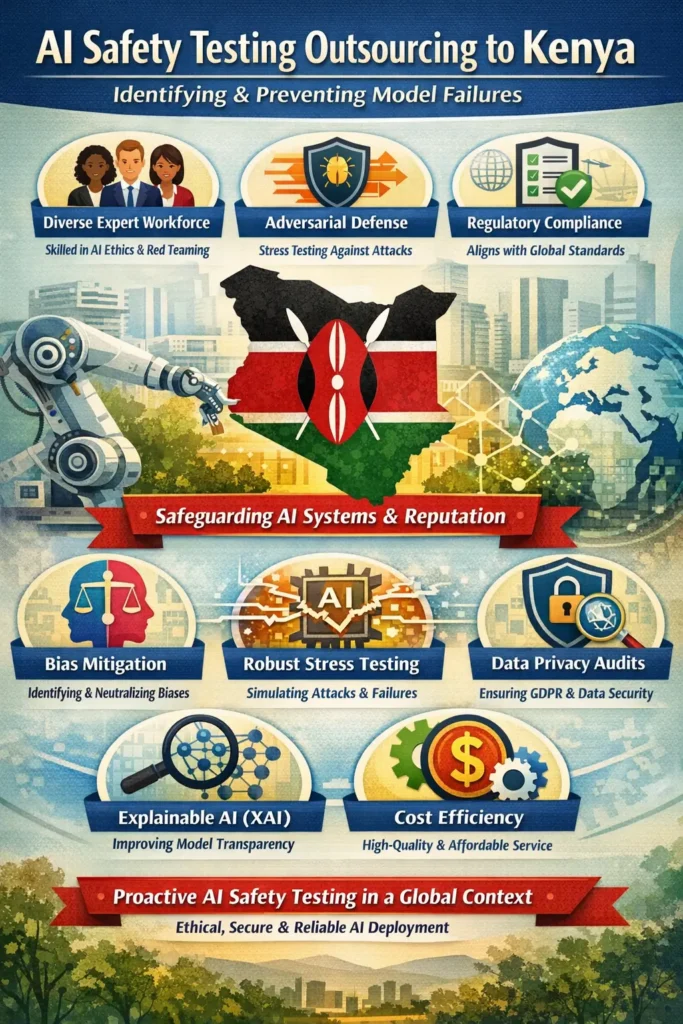
Comprehensive Methodologies for AI Safety Testing
Modern safety auditing requires a multi-layered defense strategy. To truly vet a model, Kenyan service providers employ several critical investigative techniques:
- Bias Identification and Neutralization: Experts dissect training datasets and logic flows to spot discriminatory patterns. This ensures that the final output treats all demographic groups with consistent fairness.
- Adversarial Defenses: Engineers simulate “stress tests” by introducing corrupted data or deceptive prompts. This identifies how easily a model can be tricked into leaking data or generating harmful content.
- Interpretability and Transparency (XAI): High-level auditors implement tools that “open the hood” of the AI, explaining the internal reasoning behind specific outputs to ensure they align with human logic.
- Privacy and Governance Audits: This involves rigorous checks to ensure data handling meets the strict requirements of international frameworks like the GDPR, protecting both the user and the corporation.
- Resilience Modeling: Testing focuses on how a model behaves under extreme, low-probability scenarios, ensuring stability when real-world conditions deviate from the training data.
Table 1: Core Safety Methodologies and Regional Advantages
| Methodology | Primary Objective | Kenyan Outsourcing Benefit |
| Bias Mitigation | Promote algorithmic equity. | Diverse cultural backgrounds help surface non-Western biases. |
| Adversarial Testing | Harden models against attacks. | Access to specialized cybersecurity talent familiar with global threats. |
| Explainability (XAI) | Increase decision transparency. | Skilled researchers capable of translating complex logic into actionable insights. |
| Data Privacy Audits | Maintain regulatory integrity. | Deep familiarity with cross-border data protection laws. |
| Stress Testing | Ensure stability under pressure. | Strong engineering culture focused on system robustness and reliability. |
The Economic and Operational Advantages of Outsourcing to Kenya
The rationale for selecting Kenya extends beyond mere skill sets into significant fiscal and logistical benefits. The region offers a highly competitive price-to-quality ratio, allowing organizations to maximize their safety budgets while maintaining the highest technical standards. This financial efficiency enables more frequent testing cycles, which is critical for models that require continuous monitoring.
Furthermore, Kenya’s geographic location offers favorable time-zone overlap with both EMEA and North American markets. This facilitates real-time communication and “follow-the-sun” development models. When combined with a high level of English fluency and a business culture aligned with global standards, the result is a seamless integration that accelerates the path from development to market.
Table 2: Comparing Internal Teams vs. Kenyan Partnerships
| Feature | Internal Safety Teams | Kenyan Outsourcing Partners |
| Talent Pool | Restricted by local competition. | Boundless access to niche AI safety specialists. |
| Capital Expenditure | Heavy (salaries, benefits, hardware). | Low (efficient service-based pricing). |
| Speed to Scale | Slow (lengthy hiring/onboarding). | Instant (on-demand resource allocation). |
| Objectivity | Risk of “tunnel vision” and bias. | Unbiased, third-party perspective for truer audits. |
| Methodological Edge | Requires constant internal training. | Partners are inherently focused on the latest global safety trends. |
Building Trust and Ensuring Responsible AI Deployment
The ultimate goal of safety testing is the establishment of institutional and public trust. By prioritizing these audits, companies signal a profound commitment to corporate responsibility. This transparency is essential for navigating the complex web of societal expectations and the looming shadow of government regulation.
Investing in Kenyan AI safety expertise is a forward-looking strategy that prepares organizations for the challenges of tomorrow. This proactive approach ensures that innovation doesn’t come at the cost of integrity. As the East African tech corridor continues to mature, its role in securing the global AI landscape will only become more central to the industry’s success.
Expert FAQs
Which specific malfunctions does safety testing target?
Safety audits are designed to catch hidden biases, susceptibility to “jailbreaking” attacks, data leakage, and performance “drift.” The goal is to ensure the model remains accurate and safe even when it encounters data it hasn’t seen before.
Why does the Kenyan market produce higher-quality safety outcomes?
The combination of a highly educated, multilingual workforce and a focus on international standards provides a unique vantage point. Kenyan teams often approach problems with a “global-first” mindset, leading to more comprehensive and objective evaluations.
What should a company look for in a Kenyan testing partner?
Focus on firms that demonstrate a clear history of AI-specific auditing rather than general IT support. Look for certifications in data privacy, a transparent reporting methodology, and a deep understanding of ethical AI frameworks.
Does this help with meeting European or American AI regulations?
Absolutely. Many Kenyan AI-ops firms specialize in aligning models with the EU AI Act and US executive orders on AI safety, helping global firms avoid costly non-compliance penalties.
Unlock cost-efficient growth with expert BPO guidance!
Partner with Cynergy BPO to connect with top outsourcing providers.
Streamline operations, cut costs, and scale your business with confidence.
Book a Free Call
Ralf Ellspermann - CSO
Author
Ralf Ellspermann is the Chief Strategy Officer (CSO) of Cynergy BPO and a globally recognized authority in business process and contact center outsourcing. With more than 25 years of experience advising enterprises and SMEs, he provides strategic guidance on vendor selection, CX optimization, and scalable outsourcing strategies across global markets. His expertise spans fintech, ecommerce and retail, healthcare, insurance, travel and hospitality, and technology (AI & SaaS) outsourcing.
A frequent speaker at leading industry conferences, Ralf is also a published contributor to The Times of India and CustomerThink, where he shares insights on outsourcing strategy, customer experience, and digital transformation.