



By: Ralf Ellspermann
25-Year, Multi-Awarded BPO Veteran
Published: 21 March 2026
Updated: March 16, 2026
TL;DR: The Key Takeaway
AI supply chain optimization outsourcing in India has transcended traditional logistics management, offering a strategic advantage through predictive analytics and autonomous decision-making. This global talent corridor is now the premier destination for companies seeking to build resilient and intelligent supply chains, leveraging the nation’s deep AI/ML research ecosystem.
Global enterprises are increasingly adopting AI supply chain optimization outsourcing in India to transition from reactive logistics to autonomous, predictive networks. By tapping into India’s elite STEM talent and advanced computational infrastructure, companies can implement machine learning models that forecast disruptions, optimize inventory in real-time, and build high-level architectural resilience against global volatility.
Executive Briefing
- Talent Synergy: The intersection of neural networks and logistics has sparked a massive demand for specialized algorithmic talent, a primary competitive advantage of India’s tech sector.
- Strategic Evolution: Major corporations are utilizing Indian AI centers to turn traditional cost-heavy supply chains into self-optimizing, proactive value generators.
- Educational Foundation: A steady influx of graduates from premier institutions like the IITs provides the high-level mathematical and engineering expertise required for complex AI deployment.
- Operational Edge: Beyond cost savings, outsourcing to India offers “intelligence arbitrage,” featuring deep R&D capabilities and 24/7 development cycles for Western markets.
- Strategic Architecture: Cynergy BPO serves as the bridge to this elite ecosystem, vetting top-tier AI firms to ensure the delivery of durable, future-ready logistics frameworks.
Executive Summary
The fundamental philosophy of global logistics is migrating away from simple cost reduction toward a focus on predictive precision and systemic durability. Artificial intelligence sits at the heart of this shift. For modern enterprises, engaging in AI supply chain optimization outsourcing in India has become a prerequisite for maintaining market relevance. This movement transcends basic back-office support; it represents a strategic integration into an innovation hub where data scientists architect autonomous platforms capable of navigating global complexity. With a dense concentration of technical expertise and a robust research environment, the Indian subcontinent offers the intellectual horsepower necessary to simulate disruptions and manage inventory dynamically. Cynergy BPO facilitates this transition, connecting visionary companies with the most sophisticated AI labs in the region to ensure their supply chains remain unshakable.
“We are witnessing a total reconstruction of global trade logic. Efficiency is no longer the sole metric; intelligence and adaptability are the new benchmarks. Our partners look to India not for cheap labor, but for the sophisticated cognitive engineering required to build self-healing logistics systems. This is where the future of global commerce is being coded.” — John Maczynski, CEO, Cynergy BPO
From Reactive to Predictive: The AI-Powered Logistics Revolution
Historically, the supply chain functioned as a reactive mechanism, constantly playing catch-up with external shocks. Whether dealing with sudden maritime delays or unexpected spikes in consumer interest, logistics managers were professional firefighters. The integration of artificial intelligence flips this script entirely. By processing multi-dimensional datasets—ranging from real-time port telemetry to granular weather patterns—AI shifts the industry from manual responses to data-driven foresight.
This predictive capability is why AI supply chain optimization outsourcing in India is seeing record adoption. Tech hubs across the country are developing systems that identify a “ripple effect” before it becomes a tidal wave. An advanced machine learning model might flag a minor labor dispute in a secondary port as a high-risk factor for a primary warehouse shortage weeks later. By enabling companies to reroute cargo before a bottleneck even forms, these Indian-developed systems provide a level of strategic agility that was previously impossible.
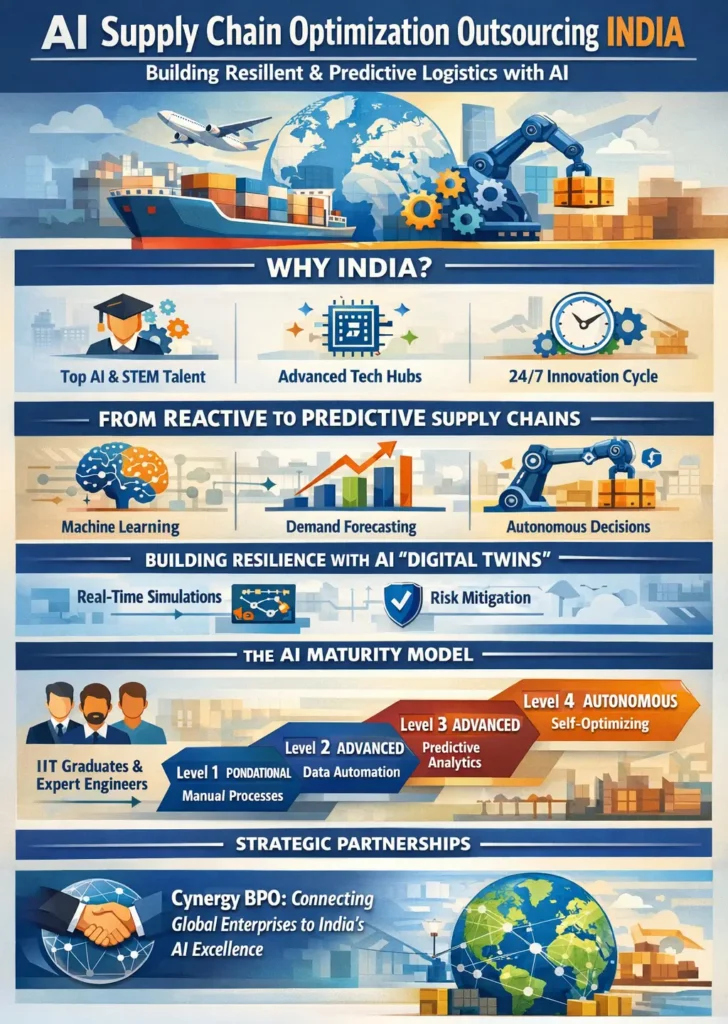
The AI Supply Chain Maturity Model
Moving toward a self-governing supply chain is a phased journey. Organizations must identify their current technical standing to effectively deploy the right talent. The table below outlines the progression from manual processes to total AI-driven autonomy.
| Maturity Level | Characteristics | AI Integration | Strategic Result |
| Level 1: Foundational | Disconnected data; manual entry | Minimal to none | High risk; reactive stance |
| Level 2: Developing | Unified data; basic automation | Demand and stock modeling | Improved flow; less waste |
| Level 3: Advanced | Integrated platforms; simulations | Risk modeling; route logic | Lower costs; proactive hedging |
| Level 4: Autonomous | Real-time streams; self-learning | Self-optimizing networks | Total resilience; new markets |
Building Resilience: How AI Creates Antifragile Supply Chains
Recent global events have highlighted how easily a single point of failure can paralyze international trade. Modern logistics leaders are no longer satisfied with mere efficiency; they demand “antifragility”—a system that grows stronger under stress. Leveraging India’s AI expertise allows companies to build these robust frameworks.
Specialists in the Indian IT-BPM sector are currently pioneering “digital twins” for global clients. These are high-fidelity virtual replicas of a company’s entire logistical footprint. By running millions of “what-if” scenarios through these models, firms can discover hidden vulnerabilities in their vendor base or shipping lanes. If a geopolitical event threatens a specific region, the AI provides an optimized contingency plan in seconds. This ability to stress-test the supply chain in a virtual environment before a crisis occurs is the hallmark of a mature, resilient enterprise.
The Talent Arbitrage: Accessing India’s Elite AI and ML Engineers
The efficacy of any neural network is dictated by the caliber of the engineers who train it. Creating a predictive logistics engine requires a rare blend of deep mathematics, software engineering, and industry-specific logic. India’s primary strength is its sheer density of this specific talent. With a massive output of STEM professionals from the Indian Institutes of Technology (IITs), the country provides an unmatched volume of high-end ML expertise.
This isn’t a volume play; it’s a quality play. The data scientists within this corridor are leading global research in reinforcement learning and computer vision. For Western enterprises, partnering with these teams provides a “talent arbitrage” opportunity—accessing the world’s most capable AI minds at a price point that allows for aggressive scaling. When combined with the ability to maintain 24-hour innovation cycles, the strategic case for Indian outsourcing becomes undeniable.
AI-Powered Supply Chain Service Tiers
Understanding the hierarchy of AI services is vital for a successful partnership. The value of an outsourcing engagement depends heavily on which tier of intelligence is being implemented.
- Tier 1: Descriptive Analytics – Clarifying the past. These tools use historical data to build dashboards and track basic KPIs for foundational visibility.
- Tier 2: Diagnostic Analytics – Investigating the “why.” These systems perform forensics on stockouts or shipping delays to prevent repeat errors.
- Tier 3: Predictive Analytics – Forecasting the future. Utilizing machine learning to anticipate demand surges or identify upcoming maintenance needs.
- Tier 4: Prescriptive Analytics – Determining the “best” path. This represents the pinnacle of AI, where systems autonomously optimize pricing, procurement, and routing in real-time.
Expert FAQs
Q1: Why is India preferred over other regions for AI logistics outsourcing?
India provides an ecosystem that combines elite academic rigor with a mature BPO infrastructure. The presence of top-tier engineering talent from the IITs, coupled with widespread English fluency and a time zone that allows for around-the-clock development, creates a collaboration environment that other emerging markets cannot replicate.
Q2: Can AI contribute to supply chain sustainability?
Absolutely. AI-driven route optimization significantly lowers carbon footprints by slashing unnecessary mileage. Furthermore, predictive demand modeling reduces overproduction and waste, while AI-monitored sourcing ensures that raw materials are obtained through ethical, environmentally friendly channels.
Q3: What role does a “digital twin” play in modern logistics?
A digital twin acts as a real-time virtual mirror of the physical supply chain. By feeding the twin data from GPS and IoT sensors, managers can simulate disruptions—like a port strike or a natural disaster—to see the impact on their network and test solutions without risking real-world assets.
Q4: How does Cynergy BPO differ from traditional BPO firms?
Cynergy BPO functions as a high-level strategic advisor rather than a direct employer. We navigate the vast Indian tech landscape to identify the top 1% of AI service providers. Our team structures these partnerships to align with a client’s long-term business goals, providing the governance necessary to turn complex AI projects into operational successes.
Unlock cost-efficient growth with expert BPO guidance!
Partner with Cynergy BPO to connect with top outsourcing providers.
Streamline operations, cut costs, and scale your business with confidence.
Book a Free Call
Ralf Ellspermann - CSO
Author
Ralf Ellspermann is the Chief Strategy Officer (CSO) of Cynergy BPO and a globally recognized authority in business process and contact center outsourcing. With more than 25 years of experience advising enterprises and SMEs, he provides strategic guidance on vendor selection, CX optimization, and scalable outsourcing strategies across global markets. His expertise spans fintech, ecommerce and retail, healthcare, insurance, travel and hospitality, and technology (AI & SaaS) outsourcing.
A frequent speaker at leading industry conferences, Ralf is also a published contributor to The Times of India and CustomerThink, where he shares insights on outsourcing strategy, customer experience, and digital transformation.