



By: Ralf Ellspermann
25-Year, Multi-Awarded BPO Veteran
Published: 23 March 2026
Updated: March 23, 2026
AI Training Data Auditing Outsourcing to Colombia provides enterprises with a nearshore governance layer for validating privacy, bias, semantic accuracy, and regulatory readiness before AI systems reach production. In 2026, Colombia has emerged as a strategic destination for real-time, secure, and audit-ready AI data validation.
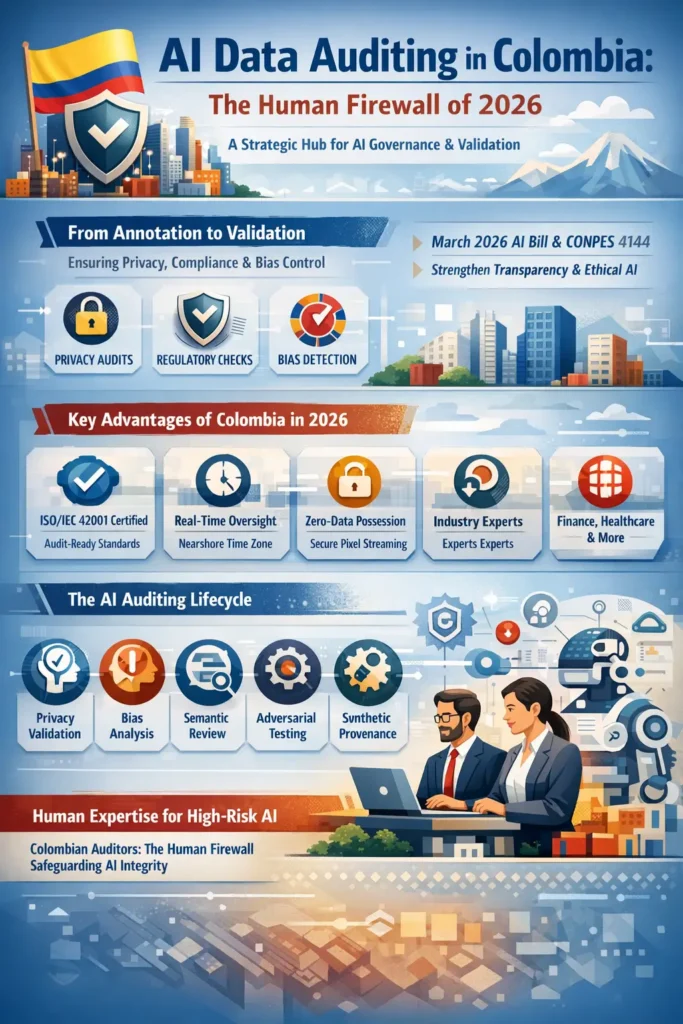
- Colombia has evolved beyond data labeling into a specialized hub for AI training data auditing and model validation.
- The March 2026 Bill to Regulate AI and CONPES 4144 strengthen transparency, risk control, and ethical AI oversight.
- Top providers align with ISO/IEC 42001:2023, enabling structured, audit-ready AI governance.
- Nearshore time-zone overlap supports real-time collaboration and rapid correction cycles.
- Zero-possession and pixel-streaming models protect sensitive data and proprietary IP.
- Colombian teams increasingly audit Agentic AI, multimodal datasets, and high-risk industry models.
The Shift from Annotation to Validation
By 2026, enterprises no longer view training data as a purely technical input. It is now a source of risk. Flawed datasets can introduce bias, distort logic, and compromise compliance—issues that scale rapidly once embedded in AI systems.
This shift has elevated data auditing into a strategic function. Companies now require proof that datasets are accurate, ethically sourced, and legally defensible before deployment. Colombia has positioned itself at the center of this transition.
Through Cynergy BPO, enterprises access a curated group of Colombian providers specializing in forensic data auditing. These teams go beyond surface-level checks, evaluating whether datasets reflect real-world logic, fair representation, and regulatory alignment.
Colombia’s Rise as an AI Auditing Hub
Colombia’s BPO sector has evolved into a high-value AI-ops ecosystem, particularly in Bogotá and Medellín. The focus has shifted from cost efficiency to intelligence validation—supporting enterprises building LLMs, autonomous systems, and regulated AI applications.
Colombian auditors operate across three critical layers:
- Technical QA: Ensuring labeling accuracy and dataset consistency
- Compliance Review: Verifying alignment with privacy and regulatory standards
- Risk Analysis: Identifying bias, semantic gaps, and behavioral risks
This integrated approach allows enterprises to move beyond basic quality control and into structured governance. Cynergy BPO plays a key role by identifying the small subset of providers capable of delivering this level of precision.
Regulation as a Competitive Advantage
Colombia’s regulatory framework has become a major differentiator. The March 2026 AI Bill and CONPES 4144 reinforce accountability, transparency, and responsible AI development For enterprises, this means datasets must satisfy multiple requirements simultaneously—privacy, bias mitigation, transparency, and sector-specific compliance. Colombian providers aligned with ISO/IEC 42001:2023 offer structured systems for managing these demands.
Rather than simply reviewing data, these providers deliver audit trails, documented controls, and regulator-ready outputs. This transforms outsourcing into a compliance function, not just an operational one.
Nearshore Speed as a Governance Tool
Time-zone alignment with North America enables real-time collaboration between auditors, data scientists, and compliance teams. This eliminates delays common in offshore models, where issues surface too late to prevent downstream impact.
In Colombia, bias flags, semantic errors, and data drift can be identified and corrected within the same working day. This supports continuous auditing rather than periodic review.
For Agentic AI systems, this capability is especially important. Autonomous models require disciplined logic, ethical boundaries, and scenario-aware training data. Colombian auditors act as the human oversight layer, ensuring these requirements are met before deployment.
Table 1: Strategic Benefits of Colombian Data Auditing (2026)
| Advantage | Technical Specification | Business Impact |
| Bias Mitigation | Evaluation across 150+ bias markers | Reduced legal risk and improved fairness |
| ISO/IEC 42001 | Structured AI governance systems | Audit-ready compliance |
| Time-Zone Alignment | Real-time collaboration (UTC-5/UTC-4) | Faster issue resolution and 60% lower latency |
| SME Verification | Domain experts in regulated industries | Accurate ground truth for high-risk AI |
| Cost Efficiency | 40–50% lower than onshore models | Scalable governance at lower cost |
Secure Audit Delivery
As training datasets become more sensitive, secure handling is essential. Colombian providers increasingly use zero-possession models, where auditors access data through encrypted environments rather than local downloads. Pixel-streaming architecture ensures that data is viewed but never stored on local devices. This protects intellectual property while maintaining compliance with global data protection standards.
Beyond security, this approach strengthens audit integrity. Enterprises can demonstrate that data was reviewed under controlled conditions, preserving chain-of-custody and supporting regulatory validation.
The AI Auditing Lifecycle
Effective auditing spans multiple stages, each addressing a different dimension of dataset integrity. Colombian providers structure these stages into specialized workflows:
- Privacy Validation: Ensuring all sensitive data is anonymized and compliant
- Bias Detection: Identifying representation gaps and fairness risks
- Semantic Review: Validating contextual accuracy and logical consistency
- Adversarial Testing: Stress-testing datasets against malicious inputs
- Synthetic Provenance: Tracking AI-generated versus human-sourced data
- Drift Monitoring: Continuously evaluating post-deployment performance
Table 2: The 2026 AI Auditing Lifecycle in Colombia
| Phase | Colombian Contribution | Enterprise Value |
| Privacy Audit | Full verification of data anonymization | GDPR and global compliance |
| Bias Detection | Statistical and contextual analysis | Reduced reputational risk |
| Semantic Integrity | Human-led contextual validation | Higher model accuracy |
| Adversarial Testing | Simulation of edge-case attacks | Stronger system resilience |
| Synthetic Provenance | Tracking AI-generated data origins | Transparency compliance |
| Drift Monitoring | Ongoing dataset evaluation | Long-term reliability |
Human Expertise in High-Risk AI
In sectors like finance, healthcare, and legal services, data auditing requires more than technical accuracy. It demands contextual understanding and domain expertise.
Colombia’s workforce provides a strong advantage. Leading providers employ specialists capable of evaluating whether datasets reflect real-world conditions, not just formal correctness.
This is particularly critical for multimodal and Agentic AI systems, where subtle errors can lead to significant downstream consequences. Colombian auditors are trained not only to detect issues but to understand their impact on model behavior.
Colombia as Governance Infrastructure
As AI adoption accelerates, the burden of proof around trust continues to rise. Enterprises must demonstrate that their models are built on validated, secure, and ethically sound data.
Colombia is well positioned to support this requirement. Its combination of regulatory alignment, nearshore accessibility, and specialized talent makes it a key player in the global AI supply chain.
What was once considered outsourcing has evolved into governance infrastructure. Colombian auditing providers act as an extension of enterprise risk management, enabling organizations to move quickly without compromising integrity.
Through partners like Cynergy BPO, enterprises gain access to a model that balances speed, cost efficiency, and rigorous oversight—defining the future of AI data auditing in 2026.
Expert FAQs
What is the impact of CONPES 4144?
It strengthens Colombia’s AI ecosystem by supporting infrastructure and talent, enabling more advanced auditing capabilities.
How are Colombian auditors vetted?
Providers use structured evaluation frameworks to ensure strong language proficiency, contextual understanding, and analytical capability.
Can real-time auditing be performed?
Yes. Time-zone alignment allows live collaboration, enabling immediate issue detection and correction.
Unlock cost-efficient growth with expert BPO guidance!
Partner with Cynergy BPO to connect with top outsourcing providers.
Streamline operations, cut costs, and scale your business with confidence.
Book a Free Call
Ralf Ellspermann - CSO
Author
Ralf Ellspermann is the Chief Strategy Officer (CSO) of Cynergy BPO and a globally recognized authority in business process and contact center outsourcing. With more than 25 years of experience advising enterprises and SMEs, he provides strategic guidance on vendor selection, CX optimization, and scalable outsourcing strategies across global markets. His expertise spans fintech, ecommerce and retail, healthcare, insurance, travel and hospitality, and technology (AI & SaaS) outsourcing.
A frequent speaker at leading industry conferences, Ralf is also a published contributor to The Times of India and CustomerThink, where he shares insights on outsourcing strategy, customer experience, and digital transformation.