



By: Ralf Ellspermann
25-Year, Multi-Awarded BPO Veteran
Published: 21 March 2026
Updated: March 20, 2026
Audio Annotation Outsourcing to Colombia has become a strategic foundation for enterprises building voice-first AI systems. In 2026, Colombia stands out as a nearshore hub for high-fidelity audio intelligence—combining linguistic expertise, real-time collaboration, and secure data environments to transform raw sound into production-ready training data.
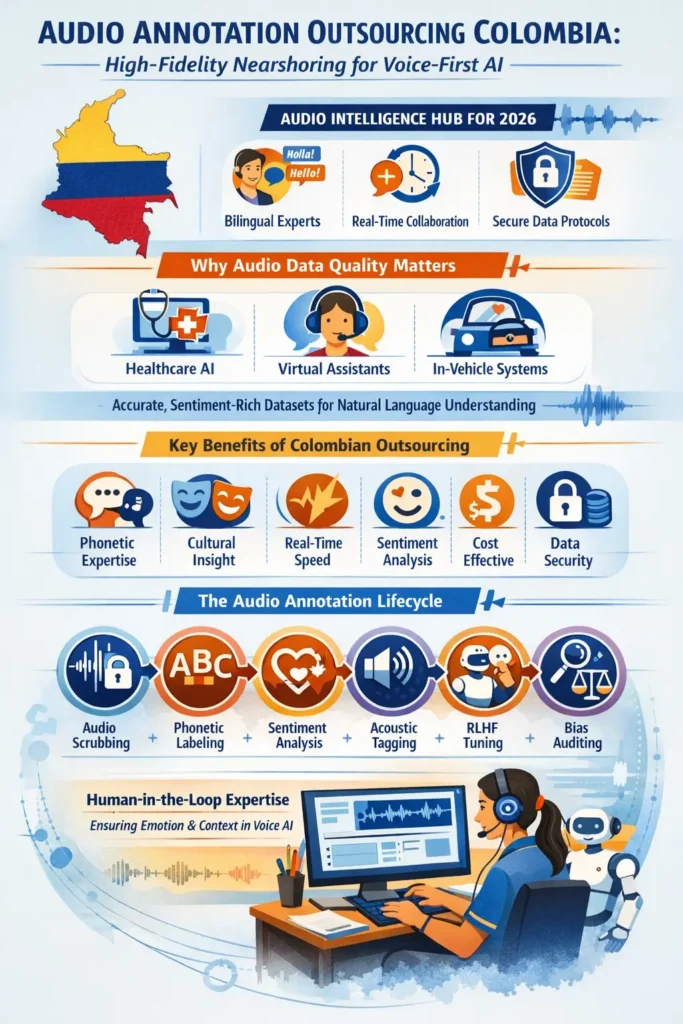
- Colombia has evolved into a specialized destination for advanced audio annotation and voice AI training.
- A bilingual, highly educated workforce captures phonetic nuance, regional accents, and code-switching.
- Nearshore time-zone alignment enables real-time QA and rapid iteration cycles.
- Cultural intelligence allows annotators to interpret intent, emotion, and conversational context.
- Secure frameworks (SOC2, HIPAA, GDPR) and zero-possession models protect sensitive audio data.
- Providers scale from transcription to RLHF for Large Audio Models (LAMs).
Voice AI in 2026: Why Audio Data Quality Matters
Voice has become the dominant interface across industries—from healthcare dictation to financial virtual assistants and in-vehicle AI systems. The effectiveness of these systems depends not just on algorithms, but on the quality of their training data. Basic transcription is no longer sufficient. Modern voice AI requires datasets that capture tone, emotion, background context, and conversational intent. Without this depth, systems fail to understand users accurately, leading to poor experiences and operational risk.
Colombia has positioned itself as a leader in this new layer of “audio intelligence.” Rather than focusing on volume, providers specialize in high-precision annotation that supports Natural Language Understanding (NLU), sentiment detection, and conversational AI performance.
Colombia’s Rise as an Audio Intelligence Hub
The transformation of Colombia’s BPO sector into a high-value AI ecosystem is most visible in cities like Bogotá and Medellín. Here, audio annotation has evolved into a specialized discipline combining technical expertise with cultural fluency. What distinguishes Colombian talent is the balance between linguistic accuracy and contextual understanding. Training AI to recognize sarcasm, urgency, or conversational nuance requires more than transcription—it requires human interpretation. Colombian annotators operate as a “Human-in-the-Loop” layer, ensuring that datasets reflect real-world communication patterns. This is especially important for multilingual environments, where code-switching between English and Spanish is common.
Cynergy BPO plays a critical role by identifying the top-performing firms capable of delivering this level of precision, ensuring enterprises access partners that combine human expertise with enterprise-grade MLOps infrastructure.
The Nearshore Advantage: Speed and Agility
For organizations developing conversational AI, iteration speed is a key bottleneck. Traditional offshore models introduce delays that slow down model improvement cycles. Colombia eliminates this friction through nearshore time-zone alignment with North America. Machine learning teams can update labeling guidelines and see results reflected within the same working day. This enables “Agile Annotation,” where feedback loops are continuous rather than delayed. The result is faster model convergence, improved accuracy, and reduced time-to-market.
Additionally, Colombia’s digital infrastructure supports secure, high-speed handling of audio data. This is critical for industries like healthcare, finance, and legal services, where data privacy and compliance are essential.
Table 1: Strategic Benefits of Colombian Audio Annotation
| Advantage | Technical Detail | Business Outcome |
| Phonetic Mastery | Annotation of accents, dialects, and code-switching | Higher accuracy in multilingual voice AI |
| Intent & Sentiment | Tagging emotion, tone, and urgency | More natural and empathetic AI interactions |
| Synchronous Operations | Real-time collaboration (EST/CST overlap) | 70% faster iteration and deployment cycles |
| Speaker Diarization | Separation of multiple speakers in complex audio | Clean datasets for analytics and transcription |
| Cost Efficiency | 40–50% lower than onshore alternatives | Optimized AI development budgets |
Secure and Compliant Audio Processing
Audio data often contains highly sensitive information, including personal conversations, financial details, and medical records. As a result, secure processing has become a baseline requirement.
Colombian providers operate within SOC2, HIPAA, and GDPR-compliant environments, ensuring strict data governance. Many also use zero-possession architectures, where audio files are accessed through secure, encrypted sessions rather than downloaded locally.
This approach protects intellectual property while maintaining compliance with global regulations. It also ensures auditability, allowing enterprises to demonstrate that data has been handled under controlled and secure conditions.
The Audio Annotation Lifecycle
Building high-performance voice AI requires a structured approach to data preparation. Colombian providers manage this lifecycle through specialized stages, each contributing to dataset quality and model performance:
- Audio Scrubbing: Removing PII and background noise to ensure privacy
- Phonetic Labeling: Capturing pronunciation, timing, and linguistic variation
- Sentiment Analysis: Identifying emotion, tone, and user intent
- Acoustic Event Tagging: Labeling non-speech sounds such as alerts or environmental noise
- RLHF Tuning: Providing human feedback to improve model outputs
- Linguistic Validation: Ensuring grammatical and contextual accuracy
- Bias Auditing: Detecting and mitigating unfair or stereotypical patterns
Table 2: The Audio Annotation Lifecycle in Colombia
| Phase | Colombian Contribution | Enterprise Result |
| Audio Scrubbing | Removal of PII and noise artifacts | Secure, compliant datasets |
| Phonetic Labeling | Word-level timing and pronunciation accuracy | High-performance ASR systems |
| Sentiment Analysis | Detection of emotional and contextual cues | Improved user experience |
| Acoustic Tagging | Annotation of environmental sounds | Enhanced situational awareness |
| RLHF Tuning | Human feedback on voice outputs | Safer, more aligned AI behavior |
| Linguistic Validation | Context and grammar checks | Professional-grade outputs |
| Bias Auditing | Identification of fairness risks | Ethical and inclusive AI systems |
Human Expertise as the Differentiator
In voice AI, accuracy depends on understanding—not just sound, but meaning. Colombian annotators bring a combination of bilingual fluency and cultural awareness that enables them to interpret subtle conversational signals. This is particularly valuable for sentiment analysis, intent detection, and conversational design. An AI system trained on technically correct but contextually flawed data will struggle to interact naturally with users. Colombian teams address this gap by embedding human judgment into the training process. Their work ensures that AI systems respond appropriately across different cultural and linguistic contexts.
Colombia’s Role in the Future of Voice AI
As enterprises move toward more advanced applications—such as Agentic AI capable of real-time decision-making over voice—the importance of high-quality audio data will continue to grow. Colombia’s combination of skilled talent, regulatory alignment, and nearshore accessibility positions it as a critical node in the global AI supply chain. What was once a support function has evolved into a strategic capability. Through partners like Cynergy BPO, enterprises gain access to specialized providers that enable faster development, stronger compliance, and more human-like AI performance.
Expert FAQs
Why is Colombia a leader in audio annotation?
Its bilingual workforce and cultural alignment with North America enable accurate interpretation of tone, intent, and conversational nuance.
How does Cynergy BPO vet providers?
Through a structured evaluation framework assessing acoustic accuracy, security compliance, and capability in complex datasets.
Can Colombian teams support RLHF for voice AI?
Yes. Providers specialize in human-in-the-loop feedback for Large Audio Models, improving safety, accuracy, and conversational quality.
Unlock cost-efficient growth with expert BPO guidance!
Partner with Cynergy BPO to connect with top outsourcing providers.
Streamline operations, cut costs, and scale your business with confidence.
Book a Free Call
Ralf Ellspermann - CSO
Author
Ralf Ellspermann is the Chief Strategy Officer (CSO) of Cynergy BPO and a globally recognized authority in business process and contact center outsourcing. With more than 25 years of experience advising enterprises and SMEs, he provides strategic guidance on vendor selection, CX optimization, and scalable outsourcing strategies across global markets. His expertise spans fintech, ecommerce and retail, healthcare, insurance, travel and hospitality, and technology (AI & SaaS) outsourcing.
A frequent speaker at leading industry conferences, Ralf is also a published contributor to The Times of India and CustomerThink, where he shares insights on outsourcing strategy, customer experience, and digital transformation.