



By: Ralf Ellspermann
25-Year, Multi-Awarded BPO Veteran
Published: 13 March 2026
Updated: March 13, 2026
TL;DR: The Key Takeaway
Audio annotation outsourcing to India has transcended simple transcription, becoming a critical function where expert human cognition refines raw speech data to train sophisticated conversational AI. The nation is now the premier destination for achieving nuanced, context-aware AI communication at scale.
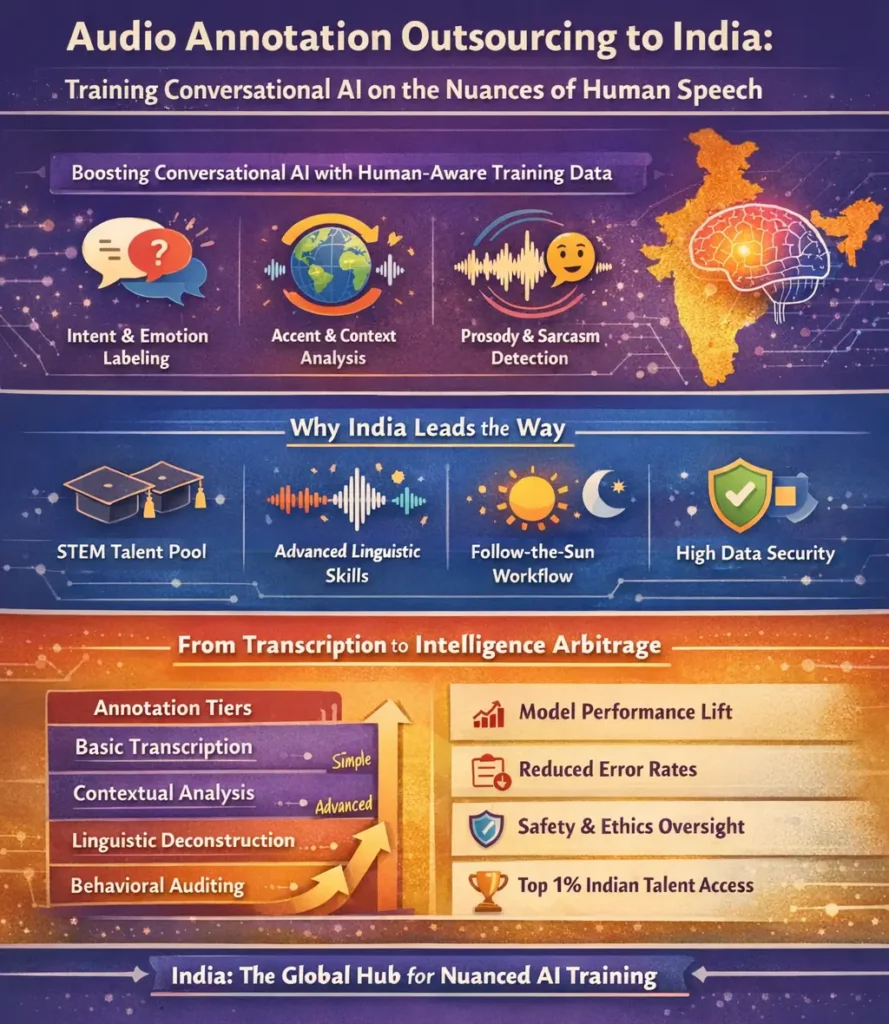
In the 2026 AI landscape, the bottleneck for natural language understanding has shifted from raw processing power to the availability of high-fidelity, “human-aware” training data. Audio annotation—the process of labeling speech for intent, emotion, and prosody—is the essential link in creating conversational agents that actually understand us. India has emerged as the global leader for this work, moving beyond simple transcription to provide “Intelligence Arbitrage.” By utilizing a massive STEM-educated workforce, Indian providers deliver the linguistic precision and behavioral labeling necessary to build reliable, safe, and contextually aware conversational AI.
Executive Briefing
- Nuance Necessity: Advanced conversational AI is limited by its training data; modern models require audio labeling that captures sentiment and subtle intent, not just words.
- The Talent Catalyst: India’s vast STEM talent pool, particularly from elite institutions like the IITs and IISc, offers the analytical rigor needed for complex linguistic deconstruction.
- Performance-First ROI: The value of audio annotation has evolved from “cost-per-hour” to a measurable “Model Performance Lift” in speech recognition and intent accuracy.
- Intelligence Arbitrage: Leading Indian firms provide cognitive skills—such as phonetic analysis and behavioral auditing—rather than simple manual labor.
- Strategic Reliability: Through partners like Cynergy BPO, AI developers can access the top 1% of specialized Indian talent, ensuring rigorous data governance and quality.
Beyond Transcription: The High-Fidelity Data Frontier
As our daily interactions with technology move toward voice-first interfaces, the demand for sophisticated audio data has reached a sonic boom. Early voice assistants were stymied by accents, background noise, and sarcasm. To solve this, developers need more than a text script; they need a multi-layered deconstruction of acoustic events.
Meticulous audio annotation involves identifying speaker demographics, classifying emotional shifts, and deconstructing the pragmatic intent behind an utterance. An AI must be taught to distinguish between a frustrated customer and a sarcastic one, or a genuine query and a rhetorical remark. This requires a human-in-the-loop approach where specialists act as “linguistic interpreters,” translating the messy reality of human speech into actionable data that a machine can digest.
India’s Cognitive Orchestra: Talent and Temporal Advantages
India’s dominance in audio annotation is the result of a powerful convergence of high-level education and robust infrastructure. The nation produces millions of graduates annually who possess the analytical skills to handle high-stakes projects. This talent is supported by an AI/ML research ecosystem that keeps pace with the latest developments in neural networks and acoustic modeling.
Furthermore, widespread English proficiency and cultural versatility allow Indian teams to grasp the regional nuances and idiomatic expressions required for global AI deployment. The significant time zone difference with the West creates a “follow-the-sun” model: data sent from the US in the evening is processed overnight in India, effectively doubling the speed of the AI development cycle.
Audio Annotation Complexity Spectrum
Selecting the right level of annotation is critical for project alignment. Indian providers offer a tiered service model based on the cognitive demand of the task.
| Annotation Tier | Key Deliverables | Cognitive Demand | Strategic Impact |
| Tier 1: Foundational | Speech-to-text; speaker diarization. | Low | Basic command and keyword recognition. |
| Tier 2: Contextual | Sentiment analysis; noise labeling; intent classification. | Medium | Understands user emotion and purpose. |
| Tier 3: Linguistic | Phonetic transcription; prosody (stress/rhythm) analysis. | High | Grasps non-literal meanings and sarcasm. |
| Tier 4: Behavioral | RLHF; red-teaming responses; flow validation. | Very High | Creates helpful, harmless, and safe agents. |
Intelligence Arbitrage: Measuring the True Value
The traditional outsourcing model was built on labor arbitrage—saving money on simple tasks. The new paradigm is Intelligence Arbitrage. This model focuses on how much an annotation team improves the AI’s ability to reason and interact. It is not about how many hours are logged, but about the reduction in the model’s Word Error Rate (WER) and the increase in its intent recognition accuracy.
In this model, annotators are treated as domain specialists in linguistics and acoustics. They provide the rich, contextual “ground truth” that allows AI models to move beyond pattern matching toward genuine understanding. By leveraging the analytical depth of the Indian talent pool, AI companies gain a measurable lift in performance that directly translates to better user experiences and safer deployments.
The Partner Vetting Framework
To maintain world-class standards, top-tier Indian providers are evaluated through a rigorous multi-stage vetting process.
- Technical Infrastructure & Security: Compliance with SOC 2 and ISO 27001, ensuring secure data handling and scalable cloud architecture.
- Expertise & Linguistic Depth: Verification of STEM backgrounds and proficiency in specialized annotation platforms.
- Governance & QA: Implementation of multi-level review cycles and consensus-based scoring to ensure data consistency.
- Agile Scalability: The ability to rapidly scale workflows and adapt to the evolving needs of the AI project.
Agentic Governance: The Final Layer of AI Safety
As conversational agents become more autonomous, the need for “Agentic Governance” is paramount. This involves human experts acting as “AI Tutors” who engage with the model to identify biases or unsafe responses. Using techniques like Reinforcement Learning from Human Feedback (RLHF) and red-teaming, Indian teams provide the final layer of quality assurance.
This work ensures that an AI remains helpful, harmless, and aligned with human values. It requires a rare blend of ethical judgment and linguistic skill. The deep talent corridor in India is the ideal environment for sourcing the expert teams needed to provide this crucial safety layer for the next generation of conversational AI.
Expert Perspectives
What specific skills make Indian teams so effective for audio annotation?
Their effectiveness stems from a combination of near-native English proficiency and strong critical thinking skills developed through a STEM-focused education. This allows them to interpret subtle emotional cues and diverse global accents that are often missed by automated systems.
How is the ROI of audio annotation in India measured beyond cost?
The primary metric is “Model Performance Lift.” This quantifies improvements such as higher accuracy in intent recognition or better performance in noisy environments. The value is found in the direct impact high-quality data has on the AI’s effectiveness and the speed of its commercial rollout.
What is the role of human judgment in an age of automated speech recognition?
Automation is excellent for basic transcription but fails at “pragmatic understanding”—knowing the difference between a literal statement and a sarcastic one. Expert human annotators provide the nuanced judgment required for high-stakes applications where a misinterpretation could lead to system failure.
How do Indian firms protect sensitive audio data?
Top-tier providers use secure, air-gapped facilities with biometric access and encrypted data pipelines. They operate under strict international security standards, ensuring that proprietary audio and sensitive user data are protected throughout the entire annotation lifecycle.
Unlock cost-efficient growth with expert BPO guidance!
Partner with Cynergy BPO to connect with top outsourcing providers.
Streamline operations, cut costs, and scale your business with confidence.
Book a Free Call
Ralf Ellspermann - CSO
Author
Ralf Ellspermann is the Chief Strategy Officer (CSO) of Cynergy BPO and a globally recognized authority in business process and contact center outsourcing. With more than 25 years of experience advising enterprises and SMEs, he provides strategic guidance on vendor selection, CX optimization, and scalable outsourcing strategies across global markets. His expertise spans fintech, ecommerce and retail, healthcare, insurance, travel and hospitality, and technology (AI & SaaS) outsourcing.
A frequent speaker at leading industry conferences, Ralf is also a published contributor to The Times of India and CustomerThink, where he shares insights on outsourcing strategy, customer experience, and digital transformation.