



By: Ralf Ellspermann
25-Year, Multi-Awarded BPO Veteran
Published: 31 March 2026
Updated: March 23, 2026
Autonomous Vehicle Edge-Case Labeling Outsourcing Colombia has become a critical capability for companies pushing toward Level 4 and Level 5 autonomy. In 2026, the challenge is no longer collecting massive volumes of standard driving data—it is solving the rare, high-impact scenarios that determine safety. Colombia has emerged as a nearshore “validation engine” where these complex edge cases are analyzed, labeled, and transformed into actionable training intelligence.
- Specialized teams focus on rare, high-risk driving scenarios that define autonomous system safety.
- Advanced workflows incorporate reasoning validation using human feedback loops.
- Experts handle complex scenes such as erratic pedestrian behavior, extreme weather, and sensor anomalies.
- Nearshore alignment enables same-day iteration on newly discovered edge cases.
- Secure, compliant environments ensure safe handling of sensitive driving data.
The New Bottleneck: The Long Tail of Driving Scenarios
Autonomous vehicle development has reached a turning point. Most systems perform reliably in standard conditions, but failures still occur in rare and unpredictable situations.
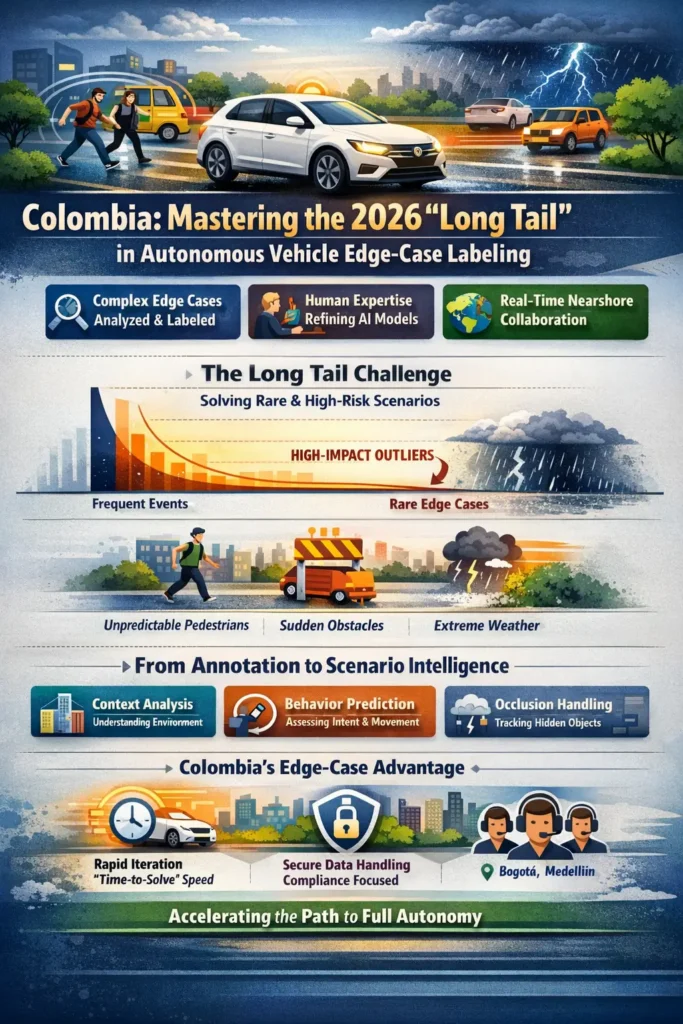
These “long-tail” events—unexpected obstacles, unusual traffic behavior, or extreme environmental conditions—represent the final barrier to full autonomy. While they occur infrequently, they carry disproportionate risk.
Traditional data pipelines struggle to address this challenge. Large datasets of routine driving scenarios offer diminishing returns, while edge cases require detailed analysis and contextual understanding.
Colombia has positioned itself at the center of this problem, focusing on the identification and resolution of these high-impact scenarios.
From Annotation to Scenario Intelligence
The nature of AV data work has evolved. Instead of simply labeling objects, teams must now interpret entire scenes—analyzing how elements interact and predicting how situations may unfold.
Colombian specialists operate at this higher level. They evaluate not only what is present in a scene, but how it behaves. This includes assessing movement patterns, environmental context, and potential outcomes.
This approach introduces a layer of reasoning into the labeling process. Human feedback is used to refine model decision-making, ensuring that systems learn not just patterns, but appropriate responses.
Colombia’s Role in Edge-Case Analysis
Colombia’s rise in this domain is driven by its ability to combine technical expertise with contextual reasoning. Cities such as Bogotá and Medellín have developed strong capabilities in complex data analysis, supported by investments in AI infrastructure and education.
Teams are trained to deconstruct challenging scenarios, including:
- Unpredictable pedestrian movement
- Sudden object intrusions
- Sensor distortions caused by weather or lighting
- Ambiguous road conditions
This level of analysis allows models to learn from situations that cannot be generalized through standard datasets.
Cynergy BPO plays a key role in identifying providers capable of handling these complex tasks, ensuring that enterprises access teams with the necessary expertise and infrastructure.
Nearshore Collaboration and the Time-to-Solve Advantage
Speed is critical when addressing edge cases. Once a new scenario is identified, it must be analyzed, labeled, and integrated into training pipelines as quickly as possible.
Colombia’s time-zone alignment with North America enables real-time collaboration. This reduces delays and allows teams to respond immediately to new challenges.
This has led to a shift in performance measurement. Instead of focusing on cost per label, organizations now prioritize “Time-to-Solve”—the speed at which a system can learn from a new scenario.
By enabling same-day iteration, Colombian teams help accelerate model improvement and reduce the time required to achieve safety milestones.
Table 1: Strategic Benefits of Colombian AV Edge-Case Labeling (2026)
| Advantage | Technical Specification | Strategic Outcome |
| Logic Validation | Human feedback loops for decision refinement | Reduced model errors in complex scenarios |
| Temporal Analysis | Multi-frame tracking of dynamic objects | Improved prediction of movement and intent |
| Sensor Integration | Alignment of LiDAR, radar, and video data | Reliable performance across conditions |
| Compliance Readiness | Adherence to global data protection standards | Safer deployment in regulated environments |
| Time-to-Solve Optimization | Rapid turnaround on new edge cases | Faster path to autonomy and market readiness |
Managing Complexity in Real-World Driving
Edge cases often involve multiple overlapping challenges. For example, a pedestrian crossing unexpectedly in poor visibility conditions may require simultaneous interpretation of motion, environment, and sensor reliability.
Colombian teams are trained to handle this complexity. Their workflows focus on breaking down scenarios into manageable components, ensuring that each element is accurately represented.
This structured approach improves dataset quality and helps models generalize more effectively across diverse conditions.
Structuring the Edge-Case Lifecycle
To address the long tail effectively, Colombian providers organize edge-case labeling into a multi-stage process. Each stage contributes to building a comprehensive understanding of complex scenarios:
- Scenario Identification: Extracting high-value edge cases from large datasets
- Context Mapping: Defining environmental and situational factors
- Intent Analysis: Interpreting behavior and predicting outcomes
- Occlusion Handling: Estimating hidden or partially visible objects
- Sensor Validation: Cross-checking data from multiple inputs
- Secure Processing: Ensuring compliance with privacy standards
Table 2: The 2026 AV Edge-Case Lifecycle in Colombia
| Phase | Colombian Contribution | Enterprise Value |
| Scene Triage | Identification of rare and high-risk scenarios | Focused and efficient training datasets |
| Semantic Mapping | Detailed labeling of environment and objects | Improved situational awareness |
| Intent Prediction | Analysis of behavior and potential actions | Enhanced safety and decision-making |
| Occlusion Handling | Reconstruction of partially visible elements | Increased model confidence |
| Edge-Case Analysis | Deep investigation of anomalies | Better handling of rare events |
| Secure Delivery | Controlled and compliant data processing | Protection of sensitive information |
Human Expertise as the Safety Layer
Autonomous systems must operate in environments that are inherently unpredictable. While algorithms can process large amounts of data, they still struggle with ambiguity and rare events.
Human expertise remains essential for bridging this gap. Colombian specialists provide the contextual understanding needed to interpret complex scenarios and guide model training.
Their role extends beyond labeling to shaping how AI systems learn from difficult situations. This ensures that models are not only accurate but also capable of making safe decisions in real-world conditions.
Colombia’s Role in the Future of Autonomous Mobility
As the industry moves closer to widespread deployment of autonomous vehicles, the importance of edge-case handling will continue to grow. Safety, reliability, and regulatory approval all depend on how well systems perform in rare scenarios.
Colombia has positioned itself as a key contributor to this effort. Its combination of skilled talent, nearshore accessibility, and structured workflows makes it a valuable partner for AV developers.
Through Cynergy BPO, enterprises gain access to specialized teams that accelerate the path to autonomy while maintaining high standards of safety and compliance.
Expert FAQs
What is “Time-to-Solve” in AV development?
It measures how quickly a system can learn from a new edge case, replacing traditional cost-based metrics.
Why are edge cases so important?
Because rare scenarios often determine whether an autonomous system operates safely in real-world conditions.
How does Colombia support rapid iteration?
Through time-zone alignment and real-time collaboration with engineering teams.
How is data security maintained?
By using secure environments that ensure compliance with global privacy standards.
Share This
Unlock cost-efficient growth with expert BPO guidance!
Partner with Cynergy BPO to connect with top outsourcing providers.
Streamline operations, cut costs, and scale your business with confidence.
Book a Free Call
Ralf Ellspermann - CSO
Author
Ralf Ellspermann is the Chief Strategy Officer (CSO) of Cynergy BPO and a globally recognized authority in business process and contact center outsourcing. With more than 25 years of experience advising enterprises and SMEs, he provides strategic guidance on vendor selection, CX optimization, and scalable outsourcing strategies across global markets. His expertise spans fintech, ecommerce and retail, healthcare, insurance, travel and hospitality, and technology (AI & SaaS) outsourcing.
A frequent speaker at leading industry conferences, Ralf is also a published contributor to The Times of India and CustomerThink, where he shares insights on outsourcing strategy, customer experience, and digital transformation.