


By: Ralf Ellspermann
25-Year, Multi-Awarded BPO Veteran
Published: 8 April 2026
Updated: March 31, 2026
Outsourcing to the Dominican Republic has evolved into a sophisticated risk-mitigation and value-creation strategy for North American enterprises. By March 2026, the sector has transitioned from providing simple labor arbitrage to delivering high-complexity, AI-augmented business processes. With a 50% average reduction in operational expenditure and a workforce that mirrors U.S. cultural nuances, the DR serves as the primary nearshore anchor for industries requiring high-compliance, bilingual customer engagement.
30-Second Executive Briefing
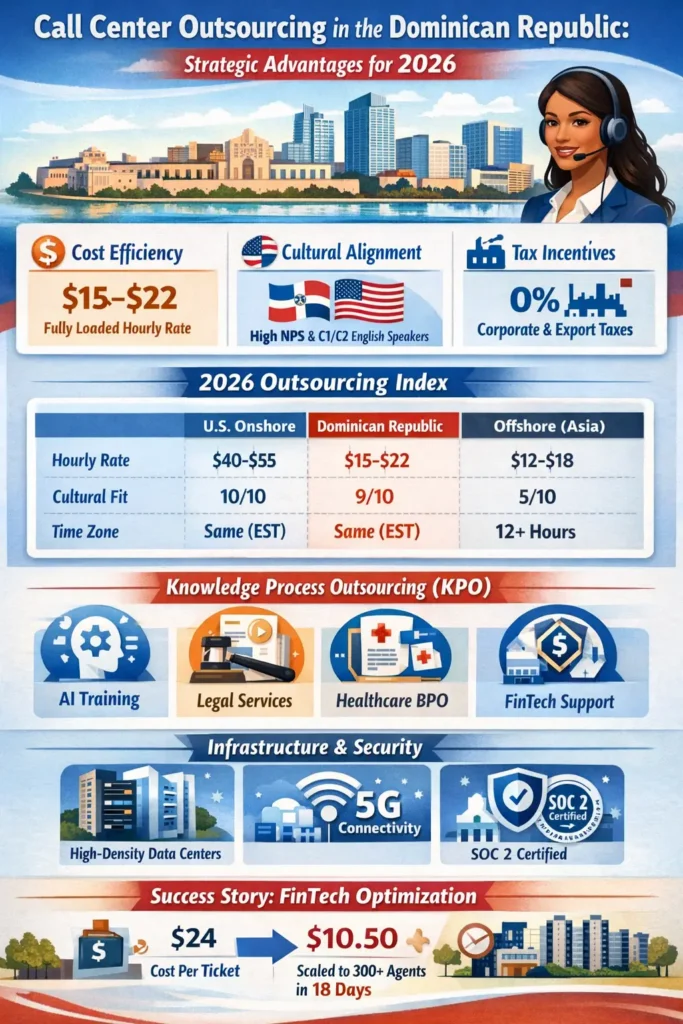
- Arbitrage Efficiency: Fully loaded hourly rates for premium bilingual services sit between $15 and $22, offering a sustainable buffer against rising domestic labor costs.
- Talent Market Maturity: The sector employs over 115,000 specialists, focusing on “Human-in-the-Loop” roles for AI training and complex exception handling.
- Linguistic Precision: Immediate access to a massive pool of Level C1/C2 English speakers with neutral accents, significantly increasing First Call Resolution (FCR).
- Operational Resilience: High-density data centers in Santo Domingo and Santiago ensure 99.99% uptime, supported by dual-active subsea fiber routes.
- Fiscal Incentives: Under Law 8-90, outsourced operations benefit from a 100% exemption on corporate and export taxes, directly lowering billable rates.
The Strategic Logic of Dominican Outsourcing
In 2026, outsourcing is no longer about “handing off” a problem; it is about extending the enterprise. The Dominican Republic (DR) has positioned itself as a “Plug-and-Play” extension of U.S. operations. Unlike offshore models that suffer from a 12-hour “management lag,” the DR’s alignment with Eastern Standard Time allows for agile, real-time QA and synchronized training deployments.
The “proximity premium” manifests in lower travel costs for executive oversight and a workforce that consumes the same media, uses the same apps, and understands the same social cues as the American consumer base. This cultural synchronization is a primary predictor of high Net Promoter Scores (NPS) in outsourced environments.
2026 Outsourcing Cost & Performance Index
| Metric | U.S. Domestic Outsourcing | Dominican Republic Nearshore | Traditional Offshore (Asia) |
| Fully Loaded Hourly Rate | $38.00 – $55.00 | $15.00 – $22.00 | $12.00 – $18.00 |
| Cultural Alignment Score | 10/10 | 9/10 | 5/10 |
| Average Tenure (Months) | 12.4 | 34.2 | 18.6 |
| Time Zone Friction | None | None (EST/AST) | High (10-12 hours) |
| Bilingual Availability | Moderate/Expensive | High/Standard | Low/Niche |
Technical Foundations: The 2026 Connectivity Standard
A critical component of Dominican outsourcing success is the underlying technical architecture. The country has aggressively modernized its systems to support “Seamless Hybrid” models. 5G enterprise slicing has become a standard offering for BPO providers, allowing for secure, low-latency work-from-home (WFH) setups that mimic the security of an on-site clean room.
Connectivity and Security Benchmarks
| System Component | 2026 Specification | Impact on Outsourced Operations |
| Subsea Fiber | ARCOS-1, PCCS, AMX-1 | <30ms latency to U.S. data hubs |
| Power Reliability | Dedicated FTZ Grids + Solar Backups | Essential zero-downtime for 24/7 CX |
| Cybersecurity | SOC2 Type II / ISO 27001 | Full compliance for Fintech/Healthcare |
| Virtualization | VDI / Zero-Trust Architecture | Secure remote access for specialized talent |
The Rise of Knowledge Process Outsourcing (KPO)
The market has seen Dominican firms move into high-complexity Knowledge Process Outsourcing. This involves tasks that require subjective judgment, specialized certification, or deep technical knowledge.
- Insurtech Support: Claims adjudication and bilingual policy underwriting.
- Legal Process Outsourcing: Document review and bilingual paralegal support.
- AI Training & Moderation: Data labeling and sentiment analysis for LLM refinement.
- Healthcare BPO: HIPAA-compliant medical billing and telehealth coordination.
Case Study: Optimizing a High-Growth FinTech Support Stack
The Context: A Texas-based digital payments firm was struggling with high “Cost-per-Ticket” ($24.00) and poor retention in their domestic support center.
The Solution: The firm outsourced its Tier-1 and Tier-2 support to a specialized partner in Santo Domingo. The transition utilized a “Seed Team” of 20 Dominican supervisors who spent two weeks at the Texas HQ before returning to lead a 150-seat rollout.
The Result:
- Financial Impact: Cost-per-ticket dropped from $24.00 to $10.50.
- Operational Gain: 24/7 bilingual support was achieved without a “night shift” premium.
- Scalability: When a major security update required a 300% surge in support capacity, the Dominican partner scaled the team in 18 days—a feat that would have taken months in the U.S. labor market.
The Regulatory Environment: Law 8-90 and Beyond
The stability of the Dominican outsourcing market is underpinned by a bipartisan commitment to the Free Trade Zone (FTZ) framework. For an international company, this means your service provider operates in a specialized economic zone that effectively acts as a tax-neutral territory for the export of services.
- Fiscal Neutrality: Providers pay 0% corporate income tax, which is why they can afford world-class facility amenities (gyms, cafeterias, training labs) while maintaining competitive pricing.
- Labor Peace: The Dominican labor code provides a clear framework for overtime, bonuses, and severance, creating a predictable environment for long-term contract pricing.
Expert FAQs
What is the “Human-AI Hybrid” model currently used by Dominican outsourcers?
The standard model uses AI to handle the “Cognitive Load”—retrieving data, summarizing notes, and checking compliance—while the human agent handles the “Emotional Load.” This allows agents to handle 30% more volume without sacrificing the empathy that U.S. customers expect.
How is the “Neutral Accent” verified during the hiring process?
Top-tier outsourcers use AI-driven phonetic screening tools to ensure agents possess a North American neutral accent. This is supplemented by “Cultural Immersion” training that most agents receive during their onboarding.
What happens if there is a regional weather event?
The industry standard is “Active-Active” redundancy. Large providers have sites in both Santo Domingo and Santiago. If one city is impacted, calls and data traffic are rerouted instantly to the other hub, ensuring zero service interruption.
Is it better to build a “Captive” center or use a Third-Party Outsourcer in the DR?
For companies with fewer than 500 seats, a Third-Party Outsourcer is generally more efficient as they navigate local labor laws. Companies exceeding 1,000 seats often explore a “Build-Operate-Transfer” (BOT) model to eventually transition to a Captive center.
Share This
Unlock cost-efficient growth with expert BPO guidance!
Partner with Cynergy BPO to connect with top outsourcing providers.
Streamline operations, cut costs, and scale your business with confidence.
Book a Free Call
Ralf Ellspermann - CSO
Author
Ralf Ellspermann is the Chief Strategy Officer (CSO) of Cynergy BPO and a globally recognized authority in business process and contact center outsourcing. With more than 25 years of experience advising enterprises and SMEs, he provides strategic guidance on vendor selection, CX optimization, and scalable outsourcing strategies across global markets. His expertise spans fintech, ecommerce and retail, healthcare, insurance, travel and hospitality, and technology (AI & SaaS) outsourcing.
A frequent speaker at leading industry conferences, Ralf is also a published contributor to The Times of India and CustomerThink, where he shares insights on outsourcing strategy, customer experience, and digital transformation.