


By: Ralf Ellspermann
25-Year, Multi-Awarded BPO Veteran
Published: 9 October 2023
Updated: February 25, 2026
The 2026 Executive Briefing
- The Beacon Shift: In 2026, Indian call centers have moved beyond “Support” to Relationship Orchestration, leveraging a sovereign intelligence stack to manage the entire customer lifecycle.
- Compute Arbitrage: India now offers a “Digital Brainpower” advantage, where running proprietary AI models on the India Stack is 60–80% more cost-effective than Western cloud alternatives.
- Resolution Velocity (RV): The industry has retired Average Handle Time (AHT) in favor of RV—a metric focused on the instantaneous execution of customer goals via Agentic AI.
- The Privacy Fortress: Full operationalization of the DPDP Act 2026 has turned India into a “Zero-Knowledge” safe harbor for sensitive Fortune 500 data.
Executive Summary: From Service to Symphony
As we navigate the complexities of 2026, the global enterprise faces a paradox: the need for hyper-speed innovation balanced against a non-negotiable requirement for absolute operational stability. In this environment, Call Center Services India has emerged as the global beacon for customer interaction.
This is no longer a search for “cheap seats.” It is a strategic migration toward Intelligence Arbitrage. India has moved from being a service provider to a Sovereign Resilience Partner, anchoring the CX operations of 85% of the Fortune 500. This article explores the three pillars of this excellence: the Sovereign GPU Moat, Vertical Mastery, and the shift from transactional support to Relationship Orchestration.
Pillar I: The Cognitive Infrastructure of Excellence
In 2026, the backbone of Indian excellence is the IndiaAI Mission. With over 38,000 high-end GPUs (and 20,000 more being added in the Blackwell phase), the Indian government has effectively democratized “High-Reasoning” compute for the BPO sector.
The Shift to Compute Arbitrage
For decades, the industry lived on labor arbitrage. Today, we live on Compute Arbitrage. Indian BPOs leverage domestic GPU clusters to run private Small Language Models (SLMs) that never touch the public internet. This ensures that a US bank’s data stays within a “Zero-Trust” environment while benefiting from the speed of localized AI.
The India Call Center Excellence Framework (2026)
To understand how India has evolved from a cost center to a cognitive command center, the following framework illustrates the structural layers powering this transformation. From sovereign AI infrastructure to vertical specialization and outcome-based CX orchestration, India’s 2026 model integrates technology, talent, and trust into a unified strategic advantage.
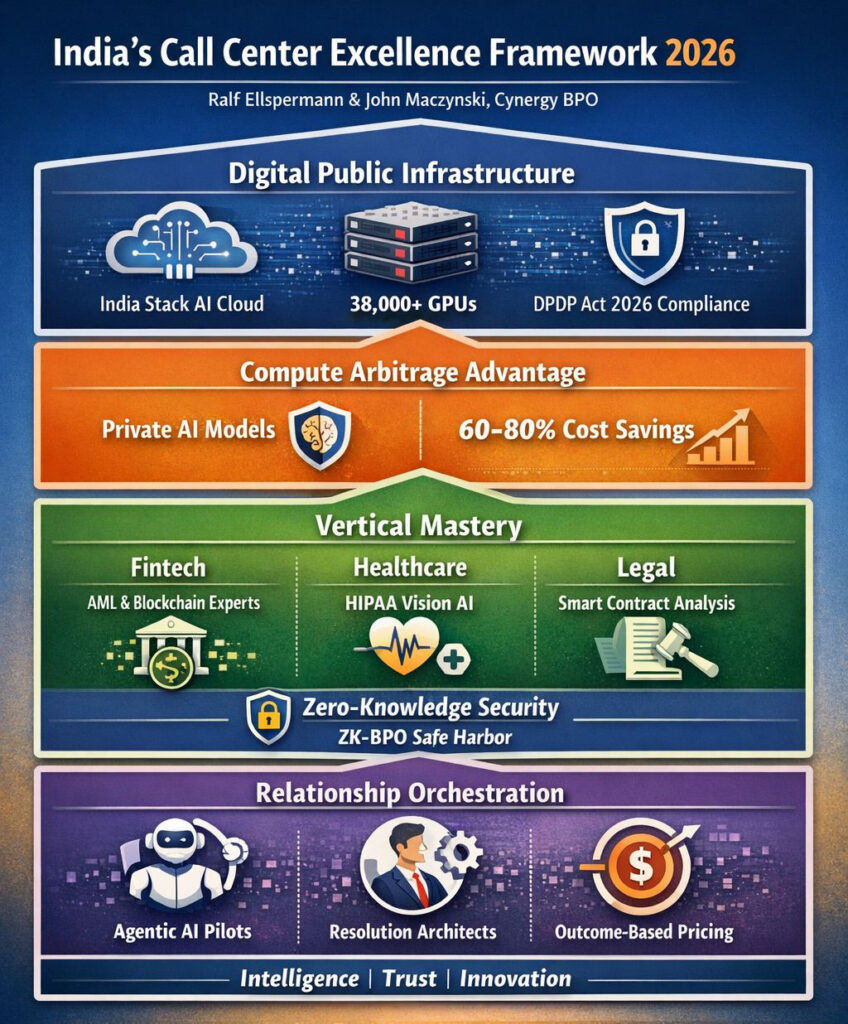
The framework highlights a decisive shift: Indian call center services are no longer defined by labor scale alone, but by compute density, regulatory alignment, and agentic intelligence orchestration.
At the foundation lies Digital Public Infrastructure and subsidized GPU capacity. On top of that sits Compute Arbitrage — enabling proprietary AI deployment at global cost advantage. Vertical Mastery ensures domain depth in fintech, healthcare, and legal sectors, while Relationship Orchestration redefines CX delivery around Resolution Velocity and outcome-based value creation.
Together, these layers form what industry leaders now call the Beacon Model — a sovereign, secure, AI-powered operating system for global customer engagement.
Deep Dive: The Intelligence Singularity
In early 2026, the Indian BPO sector reached what analysts call the “Intelligence Singularity.” This is the moment where the traditional trade-offs between cost, speed, and quality were permanently dismantled.
The “Sovereign AI” Dividend
By running specialized models on subsidized domestic infrastructure, the “cost per reasoning step” in India is now a fraction of global costs. This allows for Agentic Orchestration, where AI “Pilots” don’t just suggest text—they execute multi-step workflows. If a customer calls about a missing refund, the Agentic AI autonomously navigates the legacy ERP, verifies the transaction, and initiates the transfer—all in under 15 seconds.
From AHT to Resolution Velocity (RV)
The legacy metric of Average Handle Time (AHT) is a relic of 2024. In the 2026 “Beacon” hubs, the gold standard is Resolution Velocity (RV).
- AHT (Legacy): Focuses on the duration of the effort.
- RV (2026): Focuses on the acceleration of the outcome.
Pillar II: Vertical Mastery and “Zero-Knowledge” Security
Excellence in 2026 is defined by Verticalization. Generalist BPOs have been replaced by Centers of Excellence specializing in high-stakes sectors.
The “Zero-Knowledge” Enclave
In an era of data nationalism, India has positioned itself as the Global Clearinghouse of Trust. Using Zero-Knowledge BPO (ZK-BPO), Indian agents can resolve complex US-based medical or financial issues without sensitive PII (Personally Identifiable Information) ever “leaving” the client’s home jurisdiction.
Table 1: 2026 Vertical Excellence Centers
| Vertical | Talent Specialization | Core Technology | Strategic Outcome |
| Fintech | Certified AML Analysts | Blockchain Ledger Auditing | Zero-Day Fraud Prevention |
| Healthcare | Registered Nurses | HIPAA-Compliant Vision AI | Remote Patient Monitoring |
| Legal | Juris Doctors | Smart Contract Summarization | 60% Reduction in Legal Ops |
The Rise of the Privacy-First Hub
The most significant expansion of the Indian “Beacon” model is the total integration of the Digital Personal Data Protection (DPDP) Act. India has pioneered “Ephemeral Data Processing,” where data is processed in “RAM-only” environments and immediately purged after the resolution is achieved. This removes the “Cross-Border Liability” that previously hindered high-stakes outsourcing in the medical and legal fields.
Pillar III: Reimagining the Human “Stamp”
As Agentic AI handles 85% of routine inquiries, the human role has been upgraded to the Resolution Architect (RA).
The Role of the Resolution Architect
An RA in an Indian hub today is a high-level strategist overseeing “fleets” of AI agents. They intervene only when a situation requires High-Value Empathy or First-Principles Thinking.
- Authentic Empathy: In 2026, empathy is an operational capability. When a customer calls after a natural disaster, they aren’t met with a bot; they are met by a specialist trained in psychological first aid and complex adjudication.
The Financial Architecture: From Cost to Value
The 2026 contract has moved away from “Pay-per-Hour.” To reflect the beacon of excellence, Cynergy BPO advocates for Outcome-Based Pricing.
Table 2: 2026 Cost-Savings Simulation (US vs. India Hybrid)
| Metric | US In-House (2026) | India Beacon Hybrid (2026) |
| Cost Per Resolution (CPR) | $14.50 | **$2.10** |
| Resolution Time | 4-6 Hours | < 20 Seconds |
| OpEx Reduction | Baseline | 85% Improvement |
FAQ: The Strategic Beacon
Why is India considered the global beacon for call center services in 2026?
It is the only geography that has successfully unified the “Three Arbitrages”: Labor, Infrastructure (Compute), and Intelligence (STEM talent). This combination allows for a level of scale and precision that nearshore or domestic hubs cannot match.
How does the DPDP Act 2026 protect global firms?
The Act is built on “adequacy” principles mirroring the GDPR. It provides a clear legal framework for data “right to erasure” and mandates Consent Managers, shielding global firms from massive privacy fines and ensuring absolute data integrity.
What is “Infrastructure Arbitrage”?
It is the cost advantage gained from India’s subsidized GPU power and green energy grids. In 2026, it is cheaper to run an AI model in a solar-backed Bangalore data center than on a traditional US-based cloud provider.
Verdict: The Indispensable Partner
The 2026 global economy is built on a foundation of trust and technology. India call center services provide both. By combining the world’s largest pool of STEM talent with a sovereign AI infrastructure, India has moved from being a “backup plan” to the primary engine of global CX.
“In 2026, you don’t outsource to India just to save money; you do it to save your brand from the volatility of a changing world,” says John Maczynski, CEO of Cynergy BPO.
Unlock cost-efficient growth with expert BPO guidance!
Partner with Cynergy BPO to connect with top outsourcing providers.
Streamline operations, cut costs, and scale your business with confidence.
Book a Free Call
Ralf Ellspermann - CSO
Author
Ralf Ellspermann is the Chief Strategy Officer (CSO) of Cynergy BPO and a globally recognized authority in business process and contact center outsourcing. With more than 25 years of experience advising enterprises and SMEs, he provides strategic guidance on vendor selection, CX optimization, and scalable outsourcing strategies across global markets. His expertise spans fintech, ecommerce and retail, healthcare, insurance, travel and hospitality, and technology (AI & SaaS) outsourcing.
A frequent speaker at leading industry conferences, Ralf is also a published contributor to The Times of India and CustomerThink, where he shares insights on outsourcing strategy, customer experience, and digital transformation.