


By: Ralf Ellspermann
25-Year, Multi-Awarded BPO Veteran
Published: 24 March 2026
Updated: March 24, 2026
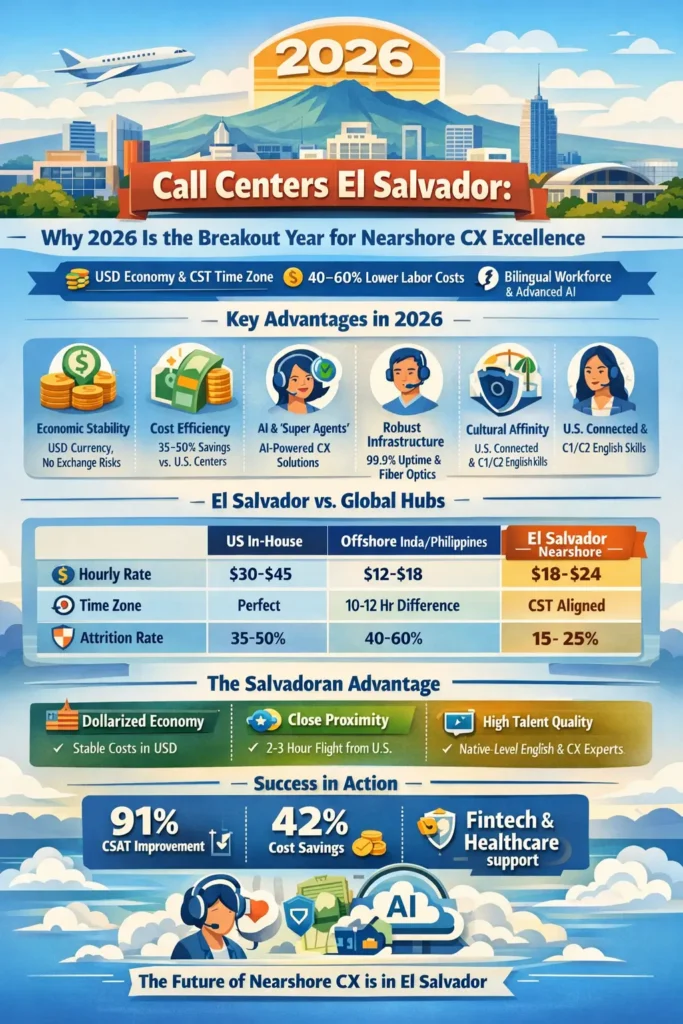
Call centers in El Salvador have evolved into high-tech “relationship hubs,” leveraging a US-dollarized economy, CST time zone alignment, and a bilingual workforce. With 40–60% lower labor costs than North America, the sector now integrates Agentic AI with human empathy to deliver Tier 3 technical support and complex omnichannel customer experience (CX) for global enterprises.
30-Second Executive Briefing
- Economic Stability: Operating in a fully dollarized economy eliminates currency exchange risks and simplifies financial forecasting for US-based firms.
- Cost Efficiency: Total operational savings typically range from 35% to 50% compared to US-based in-house centers, without sacrificing English proficiency.
- AI Integration: 2026 industry leaders in San Salvador have transitioned from basic “call handling” to “Super Agents” supported by real-time AI sentiment analysis.
- Infrastructure: Tier 1 hubs like Santa Tecla and San Salvador offer redundant fiber-optic connectivity and 99.9% uptime, meeting rigorous Western security standards.
- Cultural Affinity: High migration links to the US mean agents possess an innate understanding of North American consumer nuances and idiomatic English.
The Salvadoran Advantage: Why Nearshore is Winning in 2026
The global BPO landscape has shifted. While offshore giants once dominated on volume, the 2026 market demands latency-free collaboration and high emotional intelligence. El Salvador has emerged as the premier “Goldilocks” destination: it is close enough for a same-day flight from Miami or Houston, yet cost-effective enough to significantly pad EBITDA.
Unlike many regional competitors, El Salvador’s US Dollar economy is a structural fortress. It removes the “hidden tax” of hyperinflation and currency volatility that often plagues nearshore operations in South America. For a CFO, this means the line item you sign for today remains the same eighteen months from now.
Competitive Landscape: El Salvador vs. Global Hubs
To understand why capital is flowing into San Salvador, one must look at the comparative metrics against traditional offshore and domestic US options.
| Metric | US Domestic (In-house) | India/Philippines (Offshore) | El Salvador (Nearshore) |
| Avg. Hourly Rate | $28.00 – $45.00 | $12.00 – $18.00 | $18.00 – $24.00 |
| Time Zone Sync | Perfect | 10.5 to 12.5 hour gap | 0 to 2 hour gap (CST) |
| Cultural Affinity | Native | Moderate | High (US Ties/Migration) |
| Currency Risk | None | High (Volatility) | None (USD Economy) |
| Attrition Rate | 35% – 50% | 40% – 60% | 15% – 25% |
Infrastructure and Digital Readiness
You cannot run a world-class CX operation on shaky ground. El Salvador’s Digital Agenda 2020–2030 has funneled massive investment into the country’s telecommunications backbone.
Technical Infrastructure Specifications
The reliability of Salvadoran hubs now rivals that of North American “Silicon Slopes” facilities.
| Feature | Specification / Status in 2026 | Business Impact |
| Connectivity | ARCOS-1, MAYA-1 Subsea Cables | Low-latency, high-bandwidth CX |
| Power Grid | Dual-grid redundancy in FTZs | 99.9% uptime for 24/7 ops |
| Data Security | GDPR & SOC2 Type II Compliant | Safe handling of sensitive PII/PHI |
| AI Readiness | Localized Edge Computing Hubs | Real-time sentiment & translation |
The rise of Cloud-based Contact Center as a Service (CCaaS) has allowed Salvadoran hubs to offer seamless “follow-the-sun” models. By 2026, the traditional “mega-center” is being replaced by agile, distributed teams that use AI-driven routing to match the most complex US inquiries with the highest-rated Salvadoran experts.
Case Study: Scaling a Fintech Disruptor
The Challenge: A New York-based Neobank was seeing a 30% churn rate due to long wait times and “robotic” support from an offshore provider in Southeast Asia. They needed high-empathy, native-level English speakers who understood US banking regulations.
The Solution: The bank migrated its Tier 2 support to a boutique 150-seat facility in Santa Tecla, El Salvador.
The Results:
- CSAT Scores: Increased from 72% to 91% within the first 90 days.
- Operating Costs: Reduced by 42% compared to their previous New Jersey-based “overflow” team.
- Information Gain: The Salvadoran team identified a recurring UI bug in the bank’s mobile app that the previous offshore team had ignored, saving an estimated $200,000 in potential lost deposits.
Strategic Implementation: Navigating the 2026 Landscape
To succeed in El Salvador, businesses must move beyond “vendor” thinking and move toward “partnership.” The most successful integrations in 2026 share three common traits:
Cultural Immersion Training
While Salvadoran agents have high cultural affinity, the “last mile” of brand voice is critical. Leading firms now use generative AI simulations to train agents on specific regional US dialects and brand-specific personas before they take their first live call.
Leveraging Free Trade Zones (FTZs)
Utilizing providers located within established FTZs provides significant tax exemptions on imported equipment and corporate income. This isn’t just a perk; it is a fundamental component of the 35–50% cost-saving equation.
The “AI-Human” Hybrid Model
The March 2026 SEO and search landscape favors companies that provide comprehensive, accurate answers. When El Salvador call centers manage your knowledge base or live chat, their proximity allows for tighter feedback loops. Your agents in San Salvador should be the ones “teaching” your AI bots based on the nuanced conversations they have with your customers daily.
Frequently Asked Questions (FAQs)
What is the average English proficiency level in Salvadoran call centers?
In the BPO sector, agents typically rank at a C1 or C2 level on the CEFR scale. Because of strong historical and migratory ties to the US, many agents possess “neutral” accents that are easily understood by North American callers.
Is El Salvador safe for business operations in 2026?
El Salvador has seen a significant transformation in its security landscape over the last several years. Major BPO hubs are located in secure, gated technology parks and Free Trade Zones with 24/7 private security and controlled access.
How does the “Dollarized Economy” benefit my BPO contract?
Since El Salvador uses the US Dollar as its official currency, you avoid the “Exchange Rate Spread.” In countries like Colombia or the Philippines, a sudden currency devaluation can force vendors to hike prices or cut staff quality; in El Salvador, your costs remain predictable and stable.
What are the main cities for BPO in El Salvador?
San Salvador remains the primary hub, but Santa Tecla and Antiguo Cuscatlán have emerged as elite tech corridors. These areas offer the highest density of bilingual university graduates and the most robust fiber-optic infrastructure.
Can Salvadoran call centers handle specialized industries like Healthcare or Legal?
Yes. By 2026, the market has matured significantly. Many centers now offer HIPAA-compliant desks for medical billing and specialized support for “Lawtech” and “Fintech” firms, moving well beyond basic telemarketing into high-value knowledge process outsourcing (KPO).
Unlock cost-efficient growth with expert BPO guidance!
Partner with Cynergy BPO to connect with top outsourcing providers.
Streamline operations, cut costs, and scale your business with confidence.
Book a Free Call
Ralf Ellspermann - CSO
Author
Ralf Ellspermann is the Chief Strategy Officer (CSO) of Cynergy BPO and a globally recognized authority in business process and contact center outsourcing. With more than 25 years of experience advising enterprises and SMEs, he provides strategic guidance on vendor selection, CX optimization, and scalable outsourcing strategies across global markets. His expertise spans fintech, ecommerce and retail, healthcare, insurance, travel and hospitality, and technology (AI & SaaS) outsourcing.
A frequent speaker at leading industry conferences, Ralf is also a published contributor to The Times of India and CustomerThink, where he shares insights on outsourcing strategy, customer experience, and digital transformation.