



By: Ralf Ellspermann
25-Year, Multi-Awarded BPO Veteran
Published: 17 October 2023
Updated: February 25, 2026
30-Second Executive Briefing
- The 2026 Shift: India has transitioned from “Labor Arbitrage” to “Intelligence Arbitrage,” powered by Agentic AI and a sovereign GPU stack that slashes TCO by 40%.
- Compliance Power: Full enforcement of the DPDP Act 2026 and Labour Codes has turned India into a global “Safe Harbor” for sensitive data, ensuring 100% audit readiness.
- Strategic Metric: Industry success is no longer measured by Average Handle Time (AHT) but by Goal Completion Rate (GCR) and Return on Relationship (RoR).
- Talent Evolution: Agents have evolved into Resolution Architects, managing the high-stakes 20% of complex queries that autonomous agents cannot resolve.
Executive Summary: The Renaissance of Indian CX
As we navigate 2026, the Indian call center industry has officially transcended its legacy roots. What was once a cost-saving measure for Western enterprises has become a Strategic Command Center for global customer experience (CX). Driven by the IndiaAI Mission 2.0, which has deployed over 38,000 GPUs to local hubs, the sector now leads the world in Cognitive Business Operations (CBO).
This masterpiece explores the three pillars of modern Indian outsourcing: Autonomous Intelligence, Regulatory Resilience, and Human-Centric Empathy. We analyze how India’s Tier-2 “Micro-hubs” are solving the metro saturation crisis and why sovereign data residency is the new baseline for Fortune 500 partnerships. In 2026, India isn’t just answering the phone—it’s predicting the customer’s next move.
The Agentic Revolution: Beyond Chatbots to Autonomous Actions
In 2026, the “scripted” call center is a relic. The frontier is now defined by Agentic AI. Unlike the generative bots of 2024 that merely provided information, Agentic AI in Indian hubs possesses Agency—the ability to reason, access internal APIs, and execute end-to-end transactions.
The Self-Healing Workflow
When a customer interaction begins, an AI Orchestrator assesses intent and emotional valence in under 200 milliseconds.
- Level 1 (Autonomous): Routine tasks like billing disputes, logistics rerouting, and policy upgrades are handled by AI agents with a Goal Completion Rate (GCR) of 75%.
- Level 2 (Co-Pilot): For “Grey Area” problems, the AI functions as a second brain for the human agent, providing real-time “Chain-of-Thought” (CoT) prompts and automated document retrieval.
Table 1: The Strategic Evolution (Legacy BPO vs. 2026 CBO)
| Capability | Legacy BPO (2024) | 2026 Cognitive Ops (CBO) | Strategic Impact |
| Logic Engine | Rule-Based Decision Trees | Autonomous Agentic Reasoning | 70% Containment Rate |
| Primary Metric | Average Handle Time (AHT) | Goal Completion Rate (GCR) | Drives Direct Revenue |
| Data Residency | Fragmented/Offshore Cloud | Sovereign India-Hosted Stack | DPDP Compliance |
| Contract Model | FTE/Per-Hour Pricing | Outcome-Based / Gain-Share | Aligns Vendor & Client |
| Talent Model | Generalist Staffing | Resolution Architects (STEM-heavy) | Handles Multi-modal Tasks |
Expert Deep Dive: The Rise of Agentic AI in Indian Hubs
The defining technology of 2026 is Agentic AI. While standard AI predicts the next word, Agentic AI predicts the next action. It functions as a goal-oriented system that can autonomously navigate enterprise software, update CRMs, and process refunds without human intervention.
The Transition from Static Automation to Agentic Orchestration
Unlike legacy chatbots that rely on rigid, rule-based scripts, the Agentic AI Orchestrator functions as a reasoning engine. It analyzes customer intent, accesses real-time data across enterprise systems, and autonomously executes multi-step resolutions.
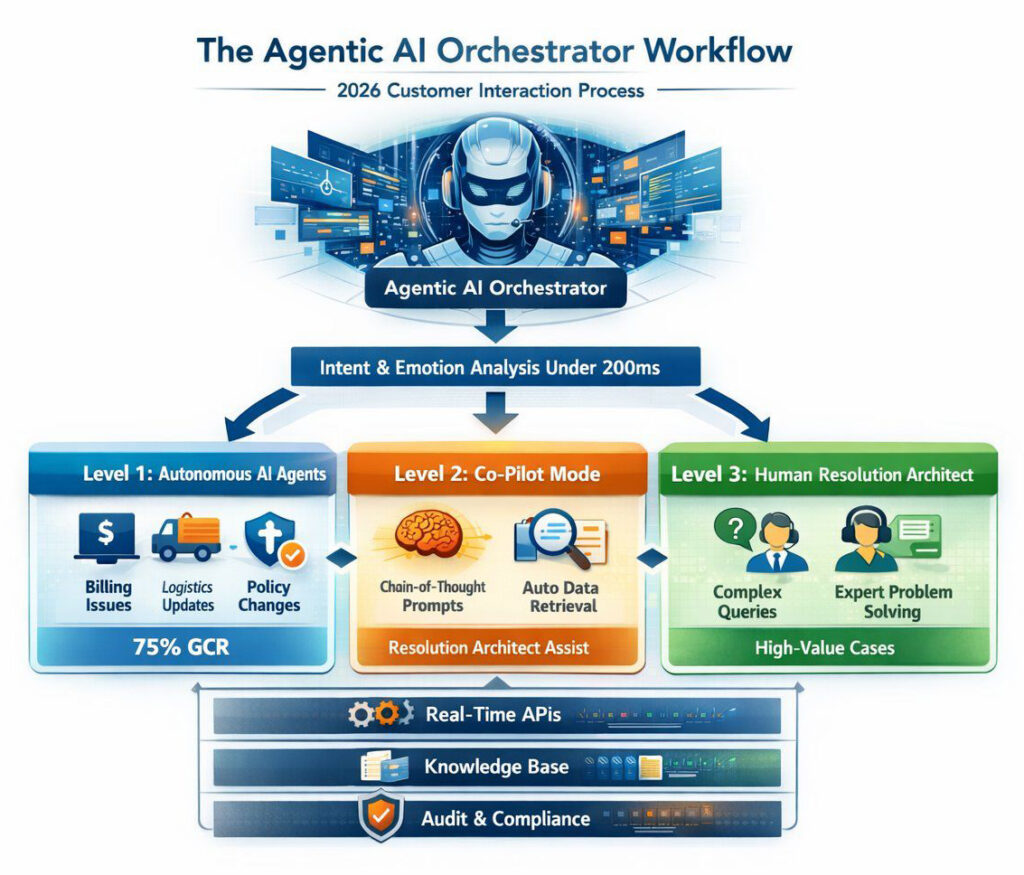
Key Architectural Pillars:
- Goal Decomposition: The orchestrator breaks complex queries into specific sub-tasks across departments.
- Dynamic Tool Selection: Agents autonomously call the correct APIs to execute real-time transactions.
- Autonomous Guardrails: The system operates under Sovereign AI constraints, triggering a “Human-in-the-Loop” escalation if confidence scores drop below 95%.
- Contextual Continuity: Provides a complete summary of the AI’s thought process to the human agent, ensuring zero friction.
Sovereign AI and Infrastructure Arbitrage
The secret weapon of the Indian BPO in 2026 is Sovereign Compute. Through the IndiaAI Mission, the government has subsidized GPU access for BPOs, allowing them to host and fine-tune Small Language Models (SLMs) locally.
This creates an “Infrastructure Arbitrage.” While Western competitors pay premium rates to hyperscalers for every token generated, Indian providers run optimized, low-latency models on domestic soil. This not only reduces costs by 35% to 50% but also ensures that proprietary customer data never leaves the sovereign jurisdiction—a critical requirement for BFSI and Healthcare sectors.
Multimodal Synchronization
2026 is the year of Multimodal CX. An Indian “Super-Agent” can now manage a session that starts as a video stream of a broken appliance, transitions to a technical Lidar-fusion diagnostic, and ends with a voice-confirmed warranty claim. This “Contextual Continuity” is why 87% of customers report higher confidence in Indian hubs than in fragmented nearshore alternatives.
Compliance as a Value Driver: The DPDP Act and Labor Codes
Data privacy is no longer a liability; it is India’s greatest competitive edge. The Digital Personal Data Protection (DPDP) Act 2026 is now fully enforceable, and Indian BPOs have responded by building “Zero-Knowledge Enclaves.”
Table 2: 2026 Regulatory and Security Benchmarks
| Regulation | Provider Requirement | Customer Benefit |
| DPDP Act 2026 | Verifiable Consent Managers | Full “Right to Erasure” |
| Labour Code 2026 | CTC Recalibration & Social Security | Talent Stability & No “Price Shocks” |
| EU AI Act | Traceability & Audit Logs | 100% Legal Defense for AI Usage |
| HITRUST v11.7 | Sensor-Sync Data Encryption | Secure Multi-modal Processing |
Furthermore, the New Labour Codes (effective April 2026) have standardized the “50% Wage Rule.” While this initially caused a stir, top-tier providers like Cynergy BPO used hyper-automation to offset these increased social security liabilities. The result? A more stable, professionalized workforce with a 30% reduction in turnover compared to the high-churn years of 2022.
The Rise of “Bharat” Micro-Hubs: Solving the Metro Crisis
The 2026 landscape is no longer limited to the “Big Three” (Bengaluru, Hyderabad, NCR). We are seeing a Reverse Migration of talent to Tier-2 cities that offer a higher quality of life and lower operational overhead.
Table 3: 2026 Regional Capability Map
| Hub Region | Specialization | Key Technology Stack | Target Industry |
| Bengaluru/NCR | Deep Tech & R&D | LLM Fine-Tuning / Agentic Ops | SaaS & Big Tech |
| Mumbai/Pune | Institutional Finance | Real-time Fraud Detection AI | BFSI |
| Coimbatore/Kochi | Healthcare & Life Sciences | HITRUST Cloud / Medical Vision | Pharma & MedTech |
| Hyderabad | Global Compliance & Legal | LPO / Smart Contract Auditing | Fintech & Legal |
The Reliability Quotient: Quantifying the “Human Stamp”
Even in an AI-first world, the “Human-in-the-Loop” (HITL) is vital. Gartner predicts that by late 2026, 75% of consumers will call a live agent not because of a technical failure, but for “Cognitive Empathy”—the need to feel heard during high-stress events.
Indian agents are now trained in V-RLHF (Voice/Visual Reinforcement Learning from Human Feedback). They don’t just solve tickets; they “teach” the AI how to be more human. Every time an agent corrects a bot’s tone or logic, they are refining the brand’s digital soul. This transition from “Laborer” to “Teacher” has elevated the BPO profession into a high-status, STEM-adjacent career.
FAQ: Navigating the 2026 Communications Frontier
How has the IndiaAI Mission affected my outsourcing contract?
By 2026, the mission has tripled GPU capacity. This allows your Indian partner to offer “Compute-Inclusive” pricing, where the AI tools are bundled into the service at a 40% discount compared to using standalone US-based SaaS providers.
Is India compliant with the new EU AI Act?
Yes. Leading Indian providers provide Data Cards and audit trails for every AI interaction. This ensures that any “automated decision” can be explained and defended in a European court.
Why are Tier-2 cities suddenly more attractive for BPO?
Lower attrition. In 2026, agents in Tier-2 cities stay with their employers 3.5x longer than those in Tier-1 metros, leading to deeper brand knowledge and significantly higher First-Contact Resolution (FCR) rates.
Does Agentic AI replace the need for human agents?
It replaces the grunt work. In 2026, agents handle fewer calls but solve more complex, high-value problems. This has shifted the labor mix toward highly educated professionals with specialized domain expertise.
What is the “Right to Erasure” under the DPDP Act?
It allows your customers to request that all their training data and interaction history be purged. Indian BPOs now use Consent Managers to automate this process, shielding you from massive regulatory fines.
Verdict: The 2026 Sovereign Advantage
Outsourcing to India in 2026 is a move toward Technological Sovereignty. By leveraging India’s unique combination of Subsidized GPU Power, Agentic AI Autonomy, and DPDP-compliant Privacy, global enterprises can achieve a CX standard that is both unbeatably cheap and impossibly smart.
“The services you buy in 2026 are only as stable as the vendor’s compliance and their access to compute. At Cynergy BPO, we ensure our clients aren’t just saving money—they’re gaining a permanent seat at the edge of the global communications frontier,” says John Maczynski, Chief Executive Officer.
Unlock cost-efficient growth with expert BPO guidance!
Partner with Cynergy BPO to connect with top outsourcing providers.
Streamline operations, cut costs, and scale your business with confidence.
Book a Free Call
Ralf Ellspermann - CSO
Author
Ralf Ellspermann is the Chief Strategy Officer (CSO) of Cynergy BPO and a globally recognized authority in business process and contact center outsourcing. With more than 25 years of experience advising enterprises and SMEs, he provides strategic guidance on vendor selection, CX optimization, and scalable outsourcing strategies across global markets. His expertise spans fintech, ecommerce and retail, healthcare, insurance, travel and hospitality, and technology (AI & SaaS) outsourcing.
A frequent speaker at leading industry conferences, Ralf is also a published contributor to The Times of India and CustomerThink, where he shares insights on outsourcing strategy, customer experience, and digital transformation.