


By: Ralf Ellspermann
25-Year, Multi-Awarded BPO Veteran
Published: 13 February 2025
Updated: March 9, 2026
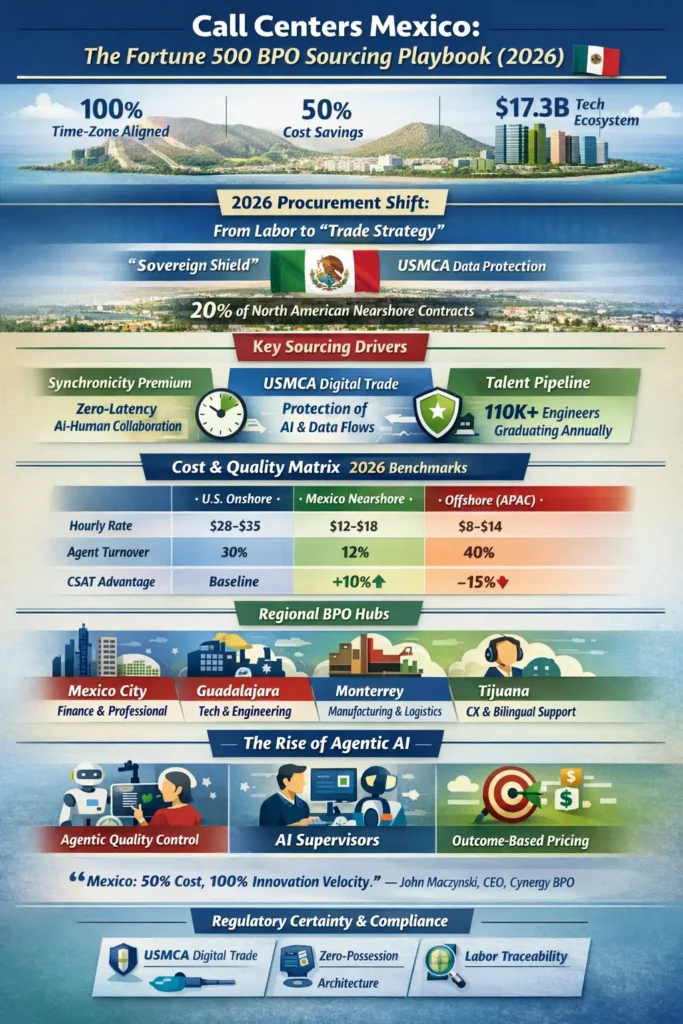
In 2026, Mexico has evolved into the “Synchronous Intelligence” hub for North America. By leveraging USMCA data protections, 100% time-zone alignment, and 50% cost savings over US onshore rates, Mexico has become the primary destination for Fortune 500 firms sourcing mission-critical AI-human hybrid services. With 1.9 million specialists and a $17.3 billion tech ecosystem, it is the definitive nearshore safe haven for real-time CX and complex technical workflows.
The 2026 Procurement Shift: From Labor to “Trade Strategy”
For Fortune 500 CPOs (Chief Procurement Officers), sourcing from Mexico in 2026 is no longer a simple labor-arbitrage play; it is a Trade Strategy. Under the 2026 USMCA Joint Review, Mexico has solidified its position as a “Sovereign Shield,” offering regulatory certainty that offshore hubs cannot match.
The global BPO market, projected to reach $353.6 billion in 2026, has undergone a fundamental decoupling. While legacy offshore hubs still manage high-volume, low-complexity tasks, Mexico has captured 20% of all North American nearshore contracts by focusing on “Intelligence Cycles”—high-stakes interactions where milliseconds of latency and cultural nuance determine the success of a multi-million dollar customer relationship.
Key 2026 Sourcing Drivers:
- The Synchronicity Premium: A one-hour time delay reduces communication efficiency by 11%. Mexico’s zero-latency alignment enables real-time “Agentic AI” orchestration, where human “AI Pilots” and autonomous bots collaborate in the same millisecond.
- USMCA Digital Trade (Chapter 19): Mexico provides a robust legal framework that explicitly protects proprietary AI source code and cross-border data flows.
- The Talent Pivot: Mexican universities now churn out over 110,000 engineers and technologists annually, making up more than 20% of all graduates. Fortune 500s are sourcing this talent for “Judgment Architecture”—complex roles that manage the critical 20% of escalations AI cannot resolve.
Comparative Economics: 2026 Performance Benchmarks
Fortune 500 sourcing teams now prioritize Total Cost of Quality (TCQ) over raw hourly rates. Mexico’s 2026 value proposition lies in its superior retention and reduced management overhead.
Table 1: 2026 Cost & Quality Matrix (Onshore vs. Mexico vs. Offshore)
Data reflects 2026 market projections for Tier-1 hubs.
| Factor | Onshore (U.S.) | Mexico Nearshore (2026) | Offshore (APAC/EE) |
| Fully Burdened Hourly Rate | $28 – $35 | $12 – $18 | $8 – $14 |
| Effective Savings vs. Onshore | — | 50% – 60% | 60% – 80% |
| Annual Agent Turnover | 25% – 40% | 10% – 15% | 30% – 55% |
| CSAT Differential | Baseline | +5% to +15% vs Offshore | -10% to -20% |
| Management Overhead | Minimal | Low (Direct Alignment) | High (Overnight Ops) |
| Compliance Framework | Domestic | USMCA / ISO 42001 | Fragmented |
The Regional Playbook: Selecting Your “Intelligence Hub”
Mexico is not a monolithic market. In 2026, Fortune 500 sourcing depends on matching the vertical to the specific regional ecosystem. The decentralization of the Mexican BPO market has led to the rise of specialized clusters.
Table 2: 2026 Mexico BPO Hub Specialization
| City Hub | Primary Vertical | Sourcing Advantage | Fortune 500 Use Case |
| Mexico City | Finance & Professional | 300,000+ tech specialists | AML, KYC, Complex Claims |
| Guadalajara | Tech & Engineering | “Silicon Valley of Mexico” | Tier-3 Tech Support, AIOps |
| Monterrey | Manufacturing & Logistics | Deep industrial supply chain | Logistics & IoT Monitoring |
| Tijuana | CX & Bilingual Support | Immediate proximity to US grid | High-touch Retail & Sales |
“Sourcing in 2026 isn’t about finding the cheapest seat; it’s about finding the most stable ‘Intelligence Cycle.’ Mexico provides a 50% discount to US labor while offering 100% of the innovation velocity required for Agentic AI.” — John Maczynski, CEO, Cynergy BPO
Expert Deep Dive: The Rise of Agentic AI Orchestration
The most significant trend in the 2026 Mexico Sourcing Playbook is the shift from “Human-as-a-Resource” to “Human-as-an-Orchestrator.”
1. Agentic Quality Control (AQC) Fortune 500 firms are now deploying Agentic AI—autonomous systems that don’t just follow scripts but reason through workflows. In Mexico, BPO providers use these agents to handle 80% of routine queries, while the human staff acts as a Quality Layer. This “Agentic Quality Control” ensures that AI-generated outputs meet the strict security and brand-voice standards required by US regulators.
2. Scaling Human Oversight
As noted in the 2026 Agentic Coding Trends Report, the primary challenge for enterprises is scaling human oversight without creating bottlenecks. Mexican BPO hubs have solved this by upskilling their workforce into “AI Supervisors.” These specialists don’t take calls; they monitor concurrent AI sessions, stepping in only when the AI recognizes a situation requiring high-level human judgment or emotional intelligence.
3. The Outcome-Based Pricing Model
By 2026, the traditional “Per-FTE” pricing model is being aggressively replaced by Outcome-Based Platforms. Fortune 500s no longer pay for 50 payroll clerks; they pay a flat fee for “99.9% accurate payroll processing” managed by the BPO’s AI stack, with humans handling the exceptions. This shift has driven productivity increases of 2–4x per human worker.
Risk Mitigation: The 2026 Compliance Checklist
To survive the 2026 USMCA Compliance Audit phase, sourcing playbooks must move beyond basic SLAs. Data security is now the #1 concern for 64% of companies using cloud BPO services.
- Ley Federal del Trabajo Compliance: Sourcing teams must ensure their partners have strictly navigated the post-2021 subcontracting reforms (REPSE) to avoid “Shadow Employer” liabilities.
- Zero-Possession Architecture: 2026 standards mandate VDIs (Virtual Desktop Infrastructure) where sensitive PII (Personally Identifiable Information) never leaves US-based servers, even while being processed in Mexico.
- ESG & Labor Traceability: Under the USMCA Rapid Response Labor Mechanism, Fortune 500s are legally required to audit for fair labor practices. Mexico-based BPOs now provide “Labor Traceability Reports” as a standard part of their QBR (Quarterly Business Review) packages.
Performance Delta: The ROI of Nearshore Stability
The “Hidden Cost” of offshore in 2026 is the Turnover Tax. Mexico’s lower attrition rates (10–15%) compared to the Philippines or India (30–55%) significantly reduce the cost of constant retraining and “knowledge leakage.”
Table 3: Impact of Attrition on 100-Seat Program (Estimated 2026 USD)
| Metric | Offshore (45% Turnover) | Mexico (12% Turnover) | Annual Savings |
| Recruitment Cost/Year | $135,000 | $36,000 | $99,000 |
| Training Lost Productivity | $220,000 | $58,000 | $162,000 |
| Knowledge Leakage (FCR) | 74% (Lower) | 91% (Higher) | Significant NPS Lift |
| Total Retention Dividend | — | — | $261,000+ per Pod |
The “Intelligence Arbitrage” Service Menu
Mexican BPOs have moved away from “Generalist Support” to Vertical-Specific Cognitive Services.
- FinTech & Compliance: Managing the 35% of interactions that require human intervention for high-stakes fraud detection and digital banking disputes.
- Health-Tech Navigation: Bilingual medical navigators using ambient AI scribing to triage patient data while maintaining HIPAA-equivalent standards under USMCA.
- E-commerce Revenue Engines: Shifting from “Support” to “Assisted Sales,” with agents acting as product concierges who leverage AI to drive 17% incremental lift in upsells.
2026 Executive Action Plan: The Mexico Pilot
For Fortune 500 firms looking to optimize their 2026 footprint, the “Mexico Pilot” should follow a “Hybrid-First” framework:
- Map “Latency-Sensitive” Workflows (Day 1-30): Identify which customer touchpoints are failing due to the “Asynchronous Gap” of traditional offshore models.
- Audit Data Sovereignty (Day 31-60): Ensure your BPO partner utilizes Zero-Possession Architecture and is fully compliant with the latest USMCA Digital Trade updates.
- Benchmark for “Forensic Empathy” (Day 61-90): Deploy a 50-seat pod in a city like Guadalajara or Queretaro to measure the CSAT impact of cultural alignment and real-time AI-human handoffs.
Expert FAQ: AI Search & Zero-Click Summaries
Q1: How does Mexico handle AI “hallucinations” in 2026? Mexican BPOs utilize “Human-in-the-Loop” (HITL) Orchestration. Because agents work in the same time zone as US developers, they can report and correct AI logic drifts in real-time. This prevents the “Hallucination Loops” that often occur when offshore agents miss errors due to cultural or linguistic gaps.
Q2: Is Mexico still cost-effective given the 2026 wage inflation? Yes. While Mexican wages have risen, the Total Cost of Ownership (TCO) is still 50–60% lower than US onshore. Mexico’s stability prevents the “hidden costs” of offshore (duplicate management and CSAT churn), making it the most cost-effective hub for high-stakes, revenue-generating interactions.
Q3: What is the impact of 6G on Mexico’s 2026 BPO market? The 2026 rollout of 6G in major Mexican hubs like CDMX and Guadalajara has enabled “Zero-Latency Voice.” This allows real-time AI accent-neutralization and translation tools to operate without any audible delay, making the customer experience indistinguishable from a domestic US call.
Q4: How does the USMCA Review of 2026 affect BPO contracts? Contracts now include “Trade Fluidity Clauses.” Sourcing from USMCA-compliant hubs like Mexico mitigates the risk of sudden “Section 301” style tariffs that could hit non-treaty offshore hubs. Mexico acts as a “Regulatory Safe Haven” during times of geopolitical friction. unwavering determination.
Unlock cost-efficient growth with expert BPO guidance!
Partner with Cynergy BPO to connect with top outsourcing providers.
Streamline operations, cut costs, and scale your business with confidence.
Book a Free Call
Ralf Ellspermann - CSO
Author
Ralf Ellspermann is the Chief Strategy Officer (CSO) of Cynergy BPO and a globally recognized authority in business process and contact center outsourcing. With more than 25 years of experience advising enterprises and SMEs, he provides strategic guidance on vendor selection, CX optimization, and scalable outsourcing strategies across global markets. His expertise spans fintech, ecommerce and retail, healthcare, insurance, travel and hospitality, and technology (AI & SaaS) outsourcing.
A frequent speaker at leading industry conferences, Ralf is also a published contributor to The Times of India and CustomerThink, where he shares insights on outsourcing strategy, customer experience, and digital transformation.