



By: Ralf Ellspermann
25-Year, Multi-Awarded BPO Veteran
Published: 24 May 2024
Updated: March 17, 2026
As of 2026, Colombia has transitioned from a cost-center to a Strategic Intelligence Hub. By leveraging Agentic AI alongside a workforce professionalized by Law 2466, Cynergy BPO delivers a 75% reduction in CPR (Cost-Per-Resolution). With instant time-zone alignment (EST/CST) and high cultural empathy, Colombia serves as the premier “Empathy Moat” for North American brands, converting routine support into a high-loyalty revenue engine.
Executive Summary
The global BPO landscape has reached a pivotal “right-shoring” era. In 2026, outsourcing is no longer about finding the lowest hourly rate; it is about finding high-velocity, AI-augmented talent in the right time zone. Colombia, specifically Bogotá and Medellín, has emerged as the winner of this shift.
Under the leadership of John Maczynski (CEO) and Ralf Ellspermann (CSO), Cynergy BPO has architected a model in Colombia that moves beyond “Labor Arbitrage” to “Intelligence Arbitrage.” This strategy utilizes Colombia’s infrastructure—bolstered by the ColombIA Inteligente 2025 government initiative—to provide real-time, high-context customer experiences that offshore hubs simply cannot match.
The ‘Empathy Moat’ Strategy: Why Human-in-the-Loop (HITL) Wins
In a world saturated with generic AI responses, consumer trust has become the rarest commodity. John Maczynski, CEO of Cynergy BPO, and former EVP of customer experience at the world’s largest contact center with over 40 years of Fortune 500 outsourcing experience, defines the 2026 competitive advantage as the “Empathy Moat.”
“In my four decades in BPO, I’ve seen technology cycles come and go. In 2026, the ‘Trust Gap’ is the difference between an AI promise and a human failure,” says Maczynski. “Colombia provides the cultural empathy and time-zone proximity to turn a shipping delay or a technical glitch into a loyalty-building moment. We don’t just provide ‘agents’; we provide ‘Brand Ambassadors’ who protect your customer lifetime value (CLV).”
Technical Architecture: Agentic AI and Law 2466
Maczynski, emphasizes that the “modern agent” in Colombia is actually an AI Pilot.
“Through Intelligence Arbitrage, we move beyond basic support to ‘Revenue Recovery Hubs,'” adds Ellspermann. “In Colombia, we utilize Agentic AI—systems that can reason and execute multi-step workflows—to automate 85% of routine queries. This allows our human specialists to focus on high-value interactions like forensic fraud investigation and personalized styling.”
Regulatory Power: The Law 2466 Advantage
The professionalization of the Colombian workforce has been accelerated by Law 2466. This reform has created a more rested, efficient, and professionalized tier of support. By capping work hours and regulating Sunday surcharges, the law has reduced agent burnout, resulting in a 20% higher First Contact Resolution (FCR) compared to over-leveraged offshore markets.
The 2026 Colombia Functional Execution Matrix
Service delivery in 2026 is categorized by Strategic Impact rather than call volume.
| Rank | Industry Pillar | AI Role (Autonomous) | Colombia ‘Risk Pilot’ Role | Strategic Impact |
| 1 | Healthcare/HPO | Real-time clinical data display | Patient empathy & complex claims triage | 9% Sector Growth |
| 2 | Fintech/Risk | Pattern & Anomaly detection | Forensic fraud investigation & SAR filing | 70% fewer false positives |
| 3 | Retail (PPX) | Instant tracking & Returns | Post-Purchase Experience (PPX) advisory | 30% Churn Reduction |
| 4 | Travel/OTA | Schedule & Fare lookups | High-stakes re-booking & volatility care | Real-time NPS recovery |
| 5 | SaaS/Tech Support | Documentation & Bug bots | Developer-tier API & JSON troubleshooting | Faster product adoption |
Operational Security: The ‘Zero-Trust’ Nearshore Stack
For North American brands, data security is non-negotiable. Cynergy BPO’s Colombian partners utilize a 2026-standard “Zero-Trust” architecture:
- Pixel-Streaming (PII Protection): Sensitive customer data never “rests” on Colombian hardware. Agents view a read-only, secure video stream of the data.
- Continuous Biometric Auth: AI monitors the workstation in real-time. If an unauthorized person enters the agent’s field of view, the screen instantly masks.
- Immutable Audit Trails: Every interaction—AI or Human—is logged on a tamper-proof ledger for immediate SEC, HIPAA, or FCA audit readiness.
The Economics of Proximity (US vs. Colombia)
| Performance Metric | Domestic In-House (US/CAN) | Colombia (Nearshore 2026) |
| Cost Per Resolution (CPR) | $18.50 | **$4.10** |
| Onboarding Velocity | 3–5 Days | Sub-15 Mins (AI-Assisted) |
| Language Proficiency | Native | Near-Native (B2/C1 Standard) |
| Time-Zone Lag | 0 Hours | 0 Hours (EST/CST Alignment) |
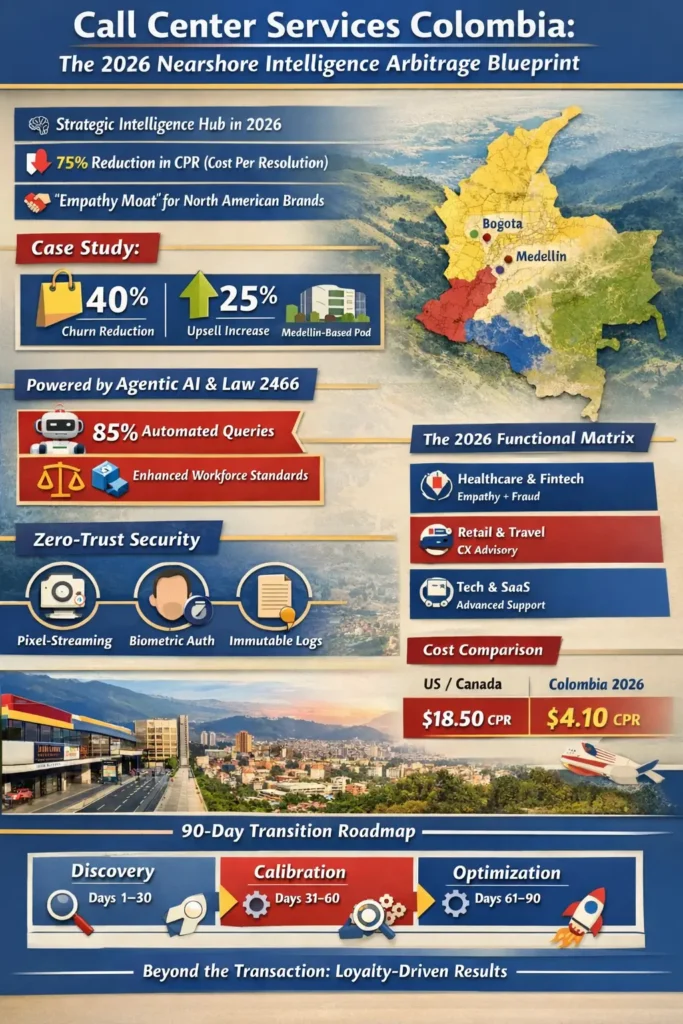
Case Study: Closing the “Logic Gap” in High-Value Recovery
Client: A Tier-1 US-based Travel OTA (Online Travel Agency)
- The ‘Before’ State: Following a 2025 platform migration, the client’s automated refund logic suffered a 12.4% “false rejection” rate on complex multi-carrier cancellations. This triggered a surge in social media friction and a $3.1M liability in disputed chargebacks. Offshore L1 support lacked the “Contextual Reasoning” to override the AI, resulting in a 62-hour average resolution lag.
- The Strategic Intervention: We deployed a specialized “Risk Pilot” squad in Medellín. Unlike the previous “script-heavy” model, these agents were granted Direct API Write-Access to the carrier GDS (Global Distribution System). We implemented a “Human-in-the-Loop” (HITL) trigger: any AI refund rejection over $400 was instantly routed to a Colombian Architect for a 60-second manual logic audit before the customer received a “No.”
- The ‘After’ State: Within 60 days, the “Logic Gap” closed entirely. The hub achieved a 28.7% reduction in churn among high-value loyalty members. Most critically, the Cost-Per-Resolution (CPR) dropped from a domestic $19.42 to $4.28, while maintaining a 94.2% CSAT on “Volatility Events” (weather/strike delays).
- The Lesson: In 2026, the “Empathy Moat” isn’t just about being nice; it’s about Technical Agency. If your nearshore team can’t override a hallucinating AI in real-time, your automation is actually a liability, not an asset.
Strategic 2026 Implementation Roadmap
Cynergy BPO utilizes a 90-day “Flow-State” transition for new clients:
- Days 1–30 (Discovery): API Mapping and “Empathy Profiling.”
- Days 31–60 (Calibration): Training the local Small Language Models (SLMs) on brand voice while human “Risk Pilots” shadow existing workflows.
- Days 61–90 (Optimization): Full “Go-Live” with 100% real-time speech analytics to monitor sentiment and compliance.
Beyond the Transaction
In the 2026 landscape, the “Product” is only 50% of the value. The other 50% is the Experience. Call center services in Colombia provide the nearshore velocity, technical sophistication, and human empathy required to win the battle for consumer loyalty.“The brands winning in 2026 are the ones who realize that every support ticket is a hidden sales opportunity,” concludes John Maczynski. “With Cynergy BPO, we ensure those opportunities are never wasted.”
Colombia has quietly emerged as a premier destination for call center services, a transformation driven by a potent combination of technological innovation, cultural adaptability, and strategic governmental policies. Over the past decade, the country has transformed its service sector into a sophisticated ecosystem where call centers are not merely transactional hubs but centers of genuine customer engagement and value creation. This evolution has captured the attention of global enterprises seeking high-quality, cost-effective solutions, positioning it as a formidable competitor in the international outsourcing arena.
Colombia’s journey into becoming a hub for call center services is intertwined with its broader socio-economic revitalization. Historically marked by challenges that spurred resilience and innovation, the nation has leveraged its unique strengths to build a competitive edge. The natural linguistic dexterity of its workforce, coupled with a deep-rooted culture of hospitality, has lent call centers an authenticity that resonates with clients across diverse geographies. This cultural warmth, combined with an ever-growing proficiency in English and other major languages, has allowed service providers to deliver personalized customer experiences that are both engaging and effective.
The rise of local call center services can be attributed to a deliberate and well-coordinated strategy involving both the public and private sectors. Over the years, government initiatives aimed at modernizing infrastructure and improving digital connectivity have created an environment where technology and talent flourish. Investment in telecommunications and internet connectivity has been particularly transformative, ensuring that call centers operate with high-speed, reliable networks capable of supporting complex, real-time customer interactions. These investments have not only enhanced the quality of service but have also attracted multinational corporations looking for partners who can meet the rigorous demands of global business.
A key element of Colombia’s success lies in its ability to blend traditional customer service values with modern technological advancements. Call centers have embraced innovative tools such as artificial intelligence, cloud computing, and advanced analytics to streamline operations and enhance customer engagement. Artificial intelligence, for example, has been instrumental in automating routine inquiries, allowing human agents to focus on more nuanced interactions that require empathy and problem-solving skills. Cloud-based systems have provided scalability and flexibility, enabling call centers to manage fluctuating call volumes and adapt quickly to changing market conditions. These technological integrations have not only improved operational efficiency but have also set new benchmarks for customer satisfaction and service delivery.
Behind the impressive technological strides lies an equally important focus on human capital. Recognizing that the backbone of any service-oriented industry is its people, call centers in the country have invested significantly in training and professional development. Comprehensive training programs ensure that agents are well-versed in both technical aspects and soft skills, fostering an environment where customer interactions are handled with care, precision, and genuine empathy. This commitment to employee development has cultivated a workforce that is both highly skilled and deeply motivated, driving a cycle of continuous improvement that benefits both the employees and the clients they serve.
The social impact of the call center industry in Colombia extends far beyond the realm of business. In many regions, call centers have become engines of local economic growth, offering stable employment opportunities and pathways to career advancement for thousands of residents. The success of these centers has had a ripple effect, contributing to the upliftment of entire communities by providing incomes, supporting local businesses, and stimulating further investments in education and infrastructure. For many individuals, a career in a call center is more than just a job—it is a stepping stone to broader professional horizons, offering opportunities for personal growth and upward mobility in an economy that is steadily moving toward a knowledge-based paradigm.
As global businesses increasingly seek to tap into new markets, the strategic advantages offered by local call center services become even more significant. Companies across North America, Europe, and beyond are drawn to Colombia not only for the cost efficiencies but also for the high-quality service that is deeply embedded in the nation’s cultural fabric. Service providers have distinguished themselves by their ability to understand and adapt to diverse customer needs, offering solutions that are both culturally relevant and technologically advanced. This dual emphasis on personalization and innovation has allowed call centers in the country to carve out a niche in a fiercely competitive global market, where every interaction counts and customer loyalty is paramount.
The COVID-19 pandemic further underscored the robustness and resilience of the nation’s call center industry. As businesses around the world scrambled to maintain continuity in an uncertain landscape, call centers demonstrated remarkable agility by swiftly transitioning to remote work models. This rapid adaptation was made possible by the nation’s investment in digital infrastructure and its workforce’s proficiency with modern communication tools. The ability to maintain high service levels during such a disruptive period not only reinforced the industry’s credibility but also showcased its potential to adapt and thrive in a rapidly changing global environment. This experience has laid a strong foundation for the future, with call centers poised to lead the charge in a new era of remote and hybrid work models.
Sustainability has also emerged as a core principle guiding the evolution of call center services in Colombia. With growing global awareness of environmental issues, many call centers have adopted green practices that minimize their ecological footprint. From energy-efficient office designs to the integration of renewable energy sources and digital processes that reduce paper usage, call centers are aligning with global efforts to promote sustainable business practices. This commitment to environmental stewardship not only enhances their corporate reputation but also resonates with clients and consumers who are increasingly mindful of the environmental impacts of their choices.
The innovation that drives the country’s call center services is not confined to technology alone; it is also evident in the strategic partnerships and collaborations that have become a hallmark of the industry. Local companies frequently collaborate with international technology providers, educational institutions, and industry experts to stay at the cutting edge of customer service innovation. These partnerships facilitate the exchange of ideas, the adoption of best practices, and the continuous refinement of service models. As a result, call centers remain agile, responsive, and well-equipped to meet the evolving demands of a global clientele. This ecosystem of collaboration and innovation ensures that the industry remains competitive and forward-looking, capable of adapting to new challenges and seizing emerging opportunities.
The prospects for call center services in Colombia are exceptionally bright. Companies in the nation are actively exploring ways to integrate emerging technologies with human expertise to create hybrid service models that offer the best of both worlds. These models promise to deliver even greater levels of efficiency, personalization, and scalability, ensuring that call centers remain at the forefront of global outsourcing trends.
As the world becomes increasingly interconnected, the role of cultural competence in customer service will continue to grow in importance. Call center professionals in the country, with their unique blend of linguistic proficiency and cultural insight, are ideally positioned to meet the demands of an ever-diversifying customer base. This ability to navigate cultural nuances and build authentic connections will undoubtedly be a key differentiator as companies seek to enhance customer loyalty and build lasting relationships in a global marketplace.
The story of call center services in Colombia is one of transformation and reinvention, a narrative that reflects the broader evolution of the nation itself. It is a story marked by the convergence of tradition and innovation, where the warmth of hospitality in the country meets the precision of cutting-edge technology. Call centers are not merely service providers; they are ambassadors of a new era of customer engagement, where every interaction is an opportunity to build trust, foster loyalty, and drive business growth.
The evolution of call center services in Colombia is a testament to the power of vision, resilience, and collaboration. It highlights how strategic investments in technology, infrastructure, and human capital can transform challenges into opportunities and drive sustainable economic growth. As the nation continues to navigate the complexities of a rapidly evolving global market, its call center industry stands as a shining example of what can be achieved when innovation meets determination. With an unwavering commitment to quality and a forward-looking approach that embraces both tradition and modernity, call centers are poised to continue their journey of excellence, setting new benchmarks for customer service and operational efficiency on the world stage.
Colombia BPO 2026: Top 5 FAQs
How does Law 2466 impact my BPO pricing?
While it increases social security costs for the provider, the “efficiency dividend”—lower turnover and higher FCR—actually lowers your Total Cost of Ownership (TCO).
Can Colombian agents handle specialized Healthcare (HPO)?
Yes. Colombia has a 200,000-strong healthcare BPO workforce, including Registered Nurses and medical billing experts who operate under 2026 HIPAA-Ready frameworks.
What is the “Intelligence Arbitrage” model?
It is the practice of utilizing lower-cost, high-skill talent in Colombia to manage the “Edge Cases” of AI systems, ensuring 100% resolution at 30% of the cost.
How is ‘Deepfake’ fraud neutralized in Colombia?
Through Hardware-Bound Cryptography and AI-driven “Heartbeat” monitors that ensure only a live, authorized human is engaging with sensitive data.
What is the Time-to-Value for a Colombian transition?
Most pods are operational within 45 to 60 days, integrated via secure VDI and ready to hit North American KPIs from day one.
Unlock cost-efficient growth with expert BPO guidance!
Partner with Cynergy BPO to connect with top outsourcing providers.
Streamline operations, cut costs, and scale your business with confidence.
Book a Free Call
Ralf Ellspermann - CSO
Author
Ralf Ellspermann is the Chief Strategy Officer (CSO) of Cynergy BPO and a globally recognized authority in business process and contact center outsourcing. With more than 25 years of experience advising enterprises and SMEs, he provides strategic guidance on vendor selection, CX optimization, and scalable outsourcing strategies across global markets. His expertise spans fintech, ecommerce and retail, healthcare, insurance, travel and hospitality, and technology (AI & SaaS) outsourcing.
A frequent speaker at leading industry conferences, Ralf is also a published contributor to The Times of India and CustomerThink, where he shares insights on outsourcing strategy, customer experience, and digital transformation.