


By: Ralf Ellspermann
25-Year, Multi-Awarded BPO Veteran
Published: 3 April 2026
Updated: March 25, 2026
Claims processing outsourcing in El Salvador has evolved into a revenue recovery engine, where speed, accuracy, and payer coordination directly impact financial performance.
In 2026, the challenge is no longer simply submitting claims—it is preventing denials, correcting errors quickly, and recovering revenue before it ages. Salvadoran teams are increasingly used as real-time extensions of billing and finance departments, working alongside U.S. providers and payers to keep revenue cycles moving.
30-Second Executive Briefing
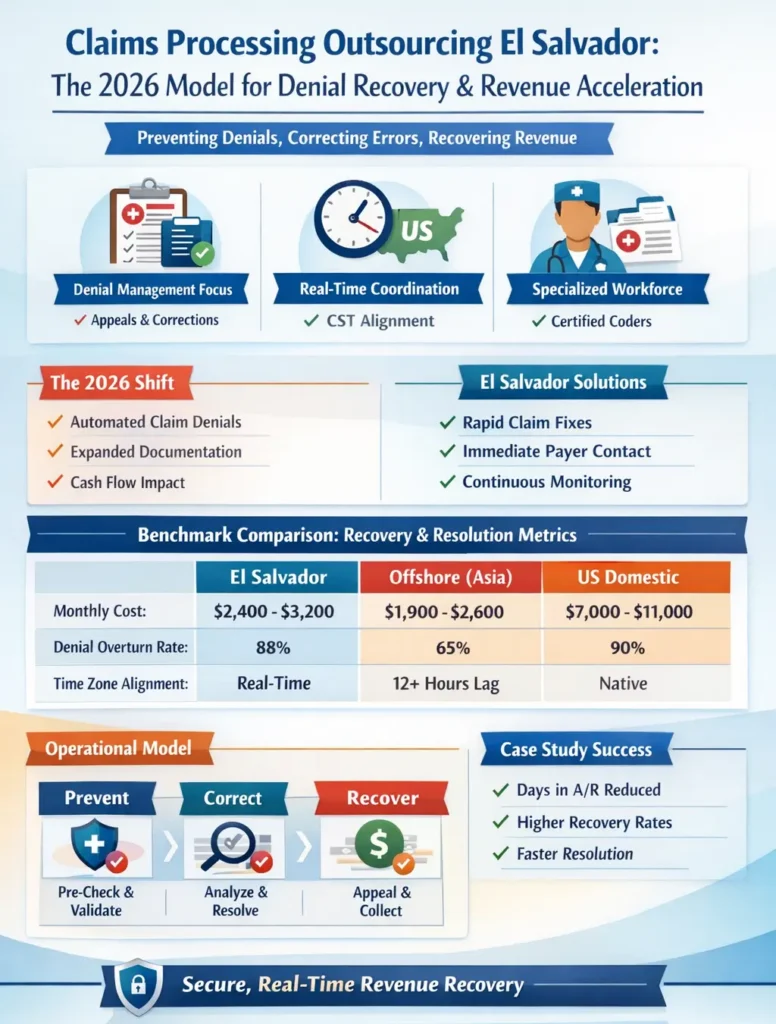
- Denial Management Focus: Teams specialize in appeals, documentation correction, and payer follow-ups, improving recovery rates.
- Real-Time Coordination: CST alignment enables same-day communication with insurers, reducing delays in claim resolution.
- Specialized Workforce: Staff include certified coders, billing specialists, and claims analysts familiar with U.S. systems.
- Operational Stability: A dollar-based environment supports predictable long-term planning.
- Secure Processing: Facilities follow strict standards for handling sensitive healthcare and financial data.
The 2026 Shift: From Claims Processing to Revenue Recovery
Claims processing has become more complex.
In 2026:
- Automated systems flag and deny claims at higher rates
- Documentation requirements continue to expand
- Delays in correction directly impact cash flow
This has shifted the role of outsourcing teams from processing tasks to actively managing revenue outcomes.
El Salvador supports this model by enabling:
- Faster claim corrections
- Immediate payer interaction
- Continuous monitoring of claim status
The result is a more proactive approach to revenue cycle management (RCM).
2026 Benchmark Comparison: Recovery and Resolution Metrics
Organizations now evaluate partners based on denial recovery and speed, not just cost.
| Metric | El Salvador (Nearshore) | Offshore (Asia) | US Domestic |
| Fully Loaded Monthly Cost | $2,400 – $3,200 | $1,900 – $2,600 | $7,000 – $11,000 |
| Denial Overturn Rate | ~88% | 62% – 70% | ~90% |
| Time Zone Alignment | CST (Real-Time) | +12–14 Hours Lag | Native |
| Days in A/R Impact | Reduced | Slower Improvement | Baseline |
| Communication with Payers | Immediate | Delayed | Immediate |
| Compliance Readiness | HIPAA / SOC2-aligned | Variable | Tier 1 |
Key Insight:
Faster interaction with payers often leads to higher recovery rates and reduced aging of receivables.
Operational Model: Prevent, Correct, Recover
Modern claims workflows are structured into three stages:
| Stage | System Role | Human Role (El Salvador Team) |
| Pre-Submission | Automated checks for errors | Final validation and coding review |
| Denial Detection | Flagging rejected claims | Root cause analysis |
| Recovery | Tracking and routing | Appeals, resubmissions, payer calls |
| Optimization | Pattern recognition | Process improvements and feedback |
This model ensures that claims are not only processed—but continuously improved over time.
Infrastructure: Built for Secure Healthcare and Financial Operations
Claims processing requires strict handling of sensitive data and reliable system access.
Operational Environment (2026)
| Component | Capability | Impact |
| Data Security | Controlled-access environments | Protection of patient and financial data |
| Connectivity | High-speed, redundant networks | Real-time system access |
| Work Model | Secure VDI setups | No local data storage |
| Power | Backup-enabled infrastructure | Continuous operations |
| Compliance | International standards alignment | Audit-ready workflows |
These systems support high-volume claims processing without compromising security.
Vertical Specialization: High-Value Claims Segments
El Salvador’s claims teams are increasingly focused on specialized workflows, improving accuracy and efficiency.
Healthcare Revenue Cycle
- Medical coding and billing
- Denial management and appeals
Property & Casualty
- Claims intake and documentation review
- Policy validation and processing
Financial Services
- Dispute resolution and chargebacks
- Fraud-related claims investigation
Workers’ Compensation
- Multi-party coordination
- Case tracking and documentation
Case Study: Reducing Revenue Delays for a Healthcare Network
The Challenge:
A U.S. healthcare provider faced rising denial rates and delayed follow-ups, leading to a growing backlog in receivables.
The Approach:
A nearshore claims team in El Salvador was deployed to:
- Review denied claims in real time
- Coordinate directly with insurers
- Standardize documentation processes
The Outcome:
- Days in A/R reduced significantly, improving cash flow
- Higher recovery rates, reducing revenue loss
- Faster resolution cycles, minimizing backlog
Key Insight:
Immediate action on denials had a greater financial impact than simply increasing processing volume.
Strategic Implementation: Building an Effective Claims Operation
Focus on Denial Prevention
Improve:
- Documentation accuracy
- Coding consistency
- Pre-submission validation
Enable Real-Time Payer Interaction
Nearshore alignment allows:
- Immediate follow-ups
- Faster dispute resolution
- Reduced claim aging
Use Data to Refine Processes
Track:
- Denial patterns
- Recovery success rates
- Processing timelines
This helps continuously improve claim outcomes.
Frequently Asked Questions (FAQs)
What types of claims can be handled nearshore?
Healthcare, insurance, and financial claims can all be managed, including complex and high-volume workflows.
How does time-zone alignment improve claims processing?
It allows teams to interact with payers during business hours, speeding up resolution and reducing delays.
Is sensitive data secure in nearshore environments?
Yes. Secure systems and controlled access environments ensure compliance with data protection requirements.
Can teams handle complex coding standards?
Many teams are trained in widely used coding systems and billing practices relevant to U.S. operations.
What differentiates El Salvador from other outsourcing locations?
Its strength lies in real-time coordination, communication clarity, and consistent execution, which improve overall revenue cycle performance.
Unlock cost-efficient growth with expert BPO guidance!
Partner with Cynergy BPO to connect with top outsourcing providers.
Streamline operations, cut costs, and scale your business with confidence.
Book a Free Call
Ralf Ellspermann - CSO
Author
Ralf Ellspermann is the Chief Strategy Officer (CSO) of Cynergy BPO and a globally recognized authority in business process and contact center outsourcing. With more than 25 years of experience advising enterprises and SMEs, he provides strategic guidance on vendor selection, CX optimization, and scalable outsourcing strategies across global markets. His expertise spans fintech, ecommerce and retail, healthcare, insurance, travel and hospitality, and technology (AI & SaaS) outsourcing.
A frequent speaker at leading industry conferences, Ralf is also a published contributor to The Times of India and CustomerThink, where he shares insights on outsourcing strategy, customer experience, and digital transformation.