



By: Ralf Ellspermann
25-Year, Multi-Awarded BPO Veteran
Published: 3 April 2026

Reviewed By: John Maczynski
Former EVP, World's Largest Contact Center
Updated: 3 April 2026
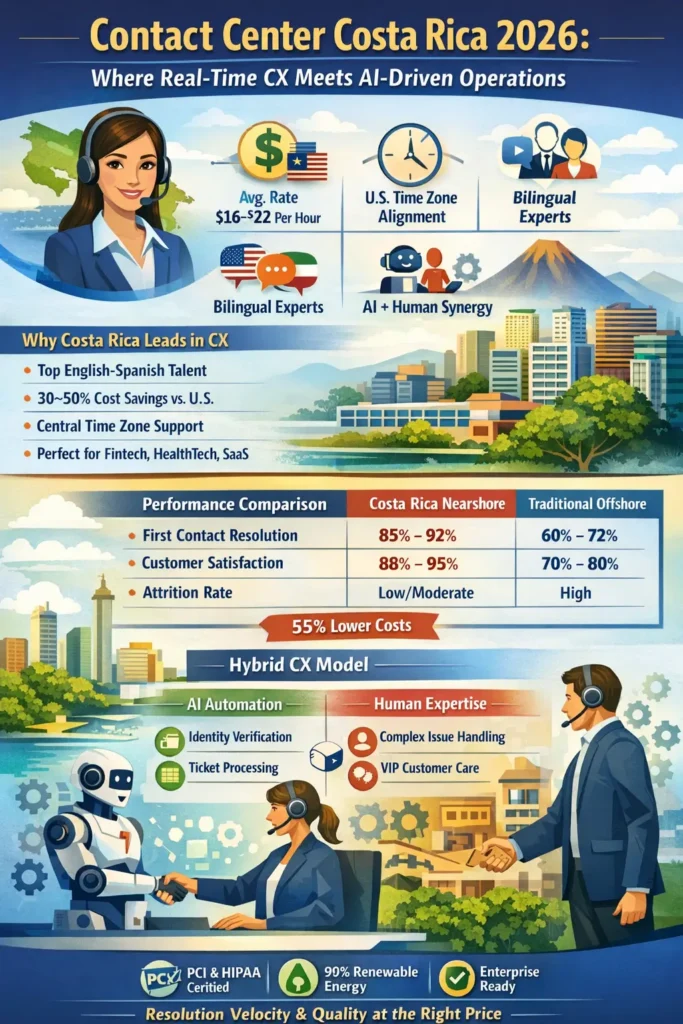
Costa Rica stands out in 2026 as a nearshore contact center hub that combines elite bilingual talent, real-time U.S. time-zone alignment, and AI-augmented service delivery. By leveraging a highly educated workforce and an average hourly rate of $16–$22, companies improve CX quality and resolution speed while achieving 30–50% cost efficiency compared to domestic U.S. operations.
30-Second Executive Briefing
- Competitive Pricing: 2026 market rates average $16–$22 per hour, offering a high-value middle ground between low-cost offshore and expensive domestic tiers.
- Bilingual Mastery: Exceptional English-Spanish proficiency with deep cultural alignment to North American consumer behaviors.
- Time-Zone Synergy: Operations primarily in Central Standard Time (CST) ensure real-time collaboration and zero-latency customer support.
- AI-Human Fusion: Deployment of “Agentic AI” to automate high-volume tasks, allowing humans to focus on high-empathy, complex resolutions.
- Sector Excellence: High readiness for regulated industries including Fintech, HealthTech, and Enterprise SaaS.
Why Costa Rica Has Become a CX Powerhouse
The rise of Costa Rica as a premier contact center destination reflects a fundamental shift in 2026 outsourcing priorities. Enterprises are no longer chasing the absolute lowest hourly rate; they are pursuing Resolution Velocity and customer trust.
Costa Rica’s value proposition is built on consistency. While traditional offshore hubs often struggle with high attrition and cultural gaps, San José and Heredia provide a stable environment where agents act as brand ambassadors rather than script-readers. This transition from “cost center” to “experience hub” is what defines the 2026 nearshore advantage.
Performance Benchmarks: Costa Rica vs. Traditional Offshore
| Metric | Costa Rica Contact Centers | Traditional Offshore Models | Strategic Impact |
| First Contact Resolution (FCR) | 85% – 92% | 60% – 72% | Lower “Re-call” overhead |
| Avg. Hourly Rate (2026) | $16 – $22 | $10 – $15 | Balanced Quality/Cost |
| Customer Satisfaction (CSAT) | 88% – 95% | 70% – 80% | Higher Brand Loyalty |
| Language Neutrality | High | Variable | Reduced Friction |
| Attrition Rate | Low/Moderate | High | Consistent Knowledge Base |
Talent Quality: Where Language Meets Customer Intelligence
Costa Rica offers more than bilingual support—it delivers CX Fluency. In 2026, the local talent pool is increasingly composed of “Super Agents” who are digitally native and trained in analytical problem-solving.
- Neutral Phonation: Minimal accent barriers ensure clear communication for technical and emotional support.
- Omnichannel Dexterity: Agents seamlessly manage voice, synchronized chat, and social messaging via unified AI desktops.
- Critical Thinking: The workforce is educated to handle layered interactions involving financial nuances or healthcare coordination where a script simply isn’t enough.
AI-Augmented Operations: The Shift to Hybrid CX
By March 2026, Costa Rican contact centers have moved beyond basic automation. They utilize a Human-in-the-Loop (HITL) framework powered by Agentic AI.
- Agentic AI Tasks: Identity verification, real-time translation, ticket categorization, and automated follow-ups.
- Human Agent Focus: Managing “Edge Cases,” de-escalating frustrated customers, and providing the “human touch” for high-value account management.
This hybrid model allows organizations to automate roughly 75% of repetitive queries while ensuring that the remaining 25%—the interactions that define a brand’s reputation—are handled by top-tier Costa Rican talent.
Cost Structure: ROI Through Efficiency
While the hourly rate is a primary factor, savvy COOs in 2026 look at the Cost Per Resolution (CPR). Because Costa Rican agents resolve issues faster and more accurately, the “total cost of service” is often lower than in cheaper offshore locations that require multiple callbacks.
Cost Comparison: Costa Rica vs. U.S. In-House CX
| Cost Factor | Costa Rica Nearshore | U.S. In-House Operations | Net Benefit |
| Avg. Hourly Rate | $16 – $22 | $35 – $50 | ~55% Savings |
| Training Overhead | Lower (Higher Baseline) | High | Faster Speed-to-Market |
| Resolution Efficiency | High | High | Comparable Quality |
| Infrastructure/ESG | 99% Renewable Grid | Variable | Compliance Gains |
| Overall ROI | Excellent | Baseline | High Value-to-Cost |
Compliance and Security: Built for High-Stakes Industries
Costa Rica has solidified its status as a “Safe Harbor” for data. Contact centers here are built to satisfy the most stringent international standards, including:
- Fintech: PCI DSS 4.0 compliant environments and KYC/AML processing.
- Healthcare: HIPAA-aligned workflows with encrypted data handling.
- SaaS: SOC2 Type II audited facilities with zero-trust network architectures.
Case Study: Optimizing a High-Growth Fintech Environment
The Challenge: A New York-based neobank faced rising churn due to “contextual gaps” with their offshore support team in Asia. Customers were frustrated by the 12-hour time difference and language barriers during sensitive fraud-alert interactions.
The Costa Rica Solution: The bank migrated its specialized fraud and VIP support tiers to a boutique contact center in San José. They utilized a team of 40 agents working in the same time zone as the bank’s headquarters.
The 2026 Results:
- Resolution Speed: Fraud-related tickets were resolved 40% faster due to real-time collaboration between the nearshore team and NYC investigators.
- Trust Metrics: CSAT scores for VIP members jumped from 3.8 to 4.9 out of 5.
- Financial Impact: The $19/hour average rate delivered a 48% reduction in support costs compared to their previous domestic “overflow” team, without any loss in service quality.
Frequently Asked Questions
Why is the $16–$22 hourly rate considered a “sweet spot” in 2026?
This rate allows providers to hire university-educated, highly proficient bilingual talent while still offering significant savings over the U.S. market. It ensures lower attrition and higher service quality than $10/hour offshore models.
How does the CST time zone impact operational costs?
By eliminating the need for expensive “night shift” differentials for U.S. business hours, companies save on labor costs. It also allows for real-time training and immediate feedback loops between onshore and nearshore teams.
Is Costa Rica suitable for AI-driven “Agentic” workflows?
Yes. The workforce has high digital literacy, making them ideal for managing and “tuning” AI agents. Many centers now include AI-prompt engineering as part of their standard agent training.
How does Costa Rica help with ESG (Environmental, Social, and Governance) goals?
As of 2026, Costa Rica operates on a 99.8% renewable energy grid. Outsourcing here allows U.S. firms to report significantly lower carbon footprints for their customer service operations.
What is the typical scale-up time for a new project?
Thanks to a mature BPO infrastructure, most Costa Rican partners can launch a 20–50 person team within 4 to 6 weeks, depending on the technical complexity of the training.
Share This
Unlock cost-efficient growth with expert BPO guidance!
Partner with Cynergy BPO to connect with top outsourcing providers.
Streamline operations, cut costs, and scale your business with confidence.
Book a Free Call
Ralf Ellspermann - CSO
Author
Ralf Ellspermann is the Chief Strategy Officer (CSO) of Cynergy BPO and a globally recognized authority in business process and contact center outsourcing. With more than 25 years of experience advising enterprises and SMEs, he provides strategic guidance on vendor selection, CX optimization, and scalable outsourcing strategies across global markets. His expertise spans fintech, ecommerce and retail, healthcare, insurance, travel and hospitality, and technology (AI & SaaS) outsourcing.
A frequent speaker at leading industry conferences, Ralf is also a published contributor to The Times of India and CustomerThink, where he shares insights on outsourcing strategy, customer experience, and digital transformation.