


By: Ralf Ellspermann
25-Year, Multi-Awarded BPO Veteran
Published: 10 April 2026

Reviewed By: John Maczynski
Former EVP, World's Largest Contact Center
Updated: 10 April 2026
The Dominican Republic has reshaped the contact center into a high-functioning operations hub that manages seamless, multi-channel customer interactions rather than just phone support. By 2026, its advantage extends beyond pricing, anchored in a nearshore model that pairs culturally aligned, service-oriented talent with intelligent automation systems. This combination allows North American companies to reduce operating costs by roughly 50% while delivering more refined, responsive, and consistent customer experiences.
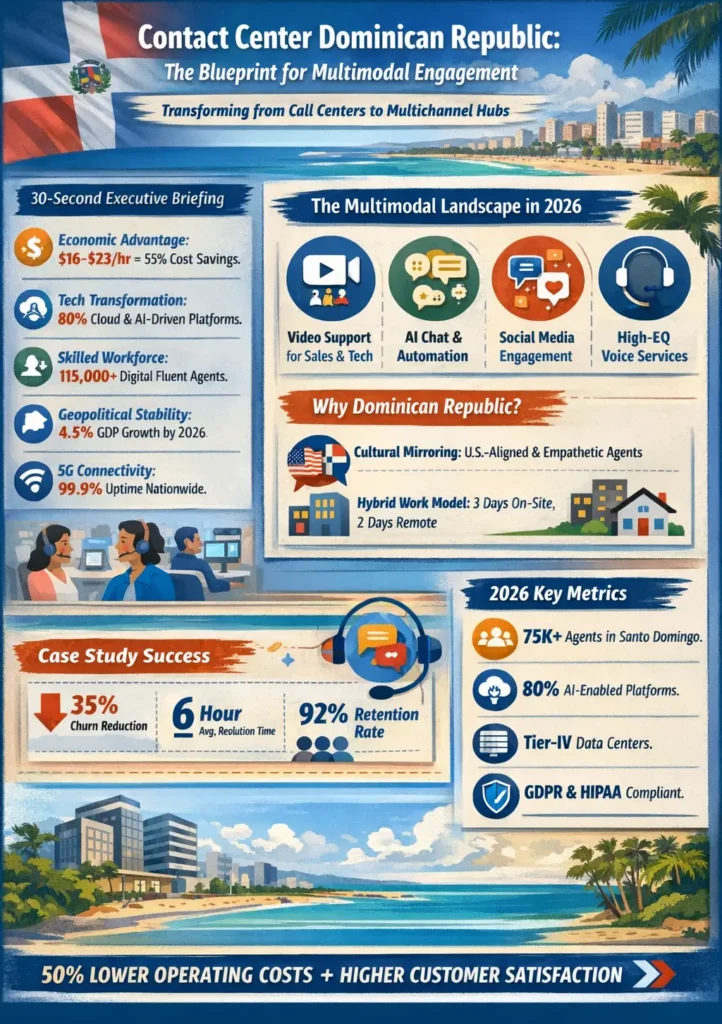
30-Second Executive Briefing
- Economic Performance: Average hourly rates for specialized contact center roles remain highly competitive at $16.00 – $23.00, delivering a consistent 55% saving over U.S. onshore equivalents.
- Technological Shift: Over 80% of Tier-1 providers have transitioned to cloud-native, AI-augmented platforms that support real-time sentiment analysis and automated post-call summarization.
- Talent Availability: A workforce exceeding 115,000 professionals is supported by a 2026 focus on “Digital Fluency,” ensuring agents can navigate complex omnichannel environments across voice, video, and social messaging.
- Geopolitical Stability: The DR continues to lead the Caribbean in GDP growth (projected at 4.5% for 2026), providing a secure, investment-grade environment for long-term BPO partnerships.
- Connectivity Standards: Nationwide 5G enterprise adoption has eliminated the “last-mile” reliability gap, enabling high-performance hybrid and remote work models with 99.9% uptime.
The Rise of the Multimodal Hub
In the 2026 landscape, a “contact” is rarely just a phone call. Dominican centers have pivoted to handle the full spectrum of the digital customer journey. This includes video-based concierge services for luxury retail, real-time chat moderation for gaming, and complex asynchronous messaging for fintech support.
The strategic advantage lies in the Dominican workforce’s unique ability to switch between these modes without losing the “cultural cadence” of the North American consumer. This flexibility is supported by robust internal training programs that prioritize technical troubleshooting and empathetic problem-solving over simple script adherence.
2026 Interaction Capability Matrix
| Engagement Channel | Primary Use Case (2026) | Dominican Proficiency Level | Strategic Business Impact |
| Video CX | High-Value Sales & Technical Support | High (Native-level English) | Increased Lead Conversion |
| Agentic AI Chat | Tier-1 Triage & FAQ Resolution | Automated / Human-Supervised | 40% Reduction in AHT |
| Social Messaging | Brand Sentiment & Community Mgmt | Expert (Digital Natives) | Enhanced Brand Loyalty |
| Voice (High-EQ) | Escalations & Complex Retention | Elite (Bilingual Nuance) | 15% Increase in NPS |
Cultural Mirroring and the “Neutrality” Factor
A primary driver for selecting the Dominican Republic for contact center operations is the high degree of cultural mirroring. In 2026, this goes beyond language. Dominican agents are immersed in U.S. consumer trends, digital behaviors, and service expectations. This results in a “frictionless” experience where the caller often perceives the agent as being based in a domestic U.S. city.
This cultural alignment is particularly valuable for industries like Insurtech and Healthcare, where nuanced communication regarding sensitive personal data is paramount. The ability to navigate these conversations with empathy—while maintaining strict adherence to U.S. regulatory standards—is the DR’s standout 2026 value proposition.
The Hybrid Work Revolution: Stability in 2026
The debate between on-site and remote work has reached a stable equilibrium in the Dominican Republic. Most leading providers now utilize a “3-2 Collaborative Core” model: three days in a secure, high-tech facility and two days remote.
This model is made possible by the 2026 standard of Network Slicing, where BPO providers have dedicated virtual lanes on the national 5G grid to ensure that remote agents have the same speed, security, and low latency as those in the office.
Regional Operational Benchmarks (2026)
| Operational Metric | Santo Domingo (Capital Hub) | Santiago (Northern Hub) | Puerto Plata (Emerging) |
| Labor Pool Size | 75,000+ | 35,000+ | 5,000+ (Rapid Growth) |
| Typical Attrition | 18% – 24% | 12% – 18% | 10% – 15% |
| Tech Readiness | Tier-IV Data Centers | Tier-III Centers | 5G / Satellite Redundant |
| Primary Vertical | Banking, Fintech, Gov | Healthcare, Retail, Tech | Travel, Luxury, SaaS |
Case Study: Driving Retention for a Global SaaS Provider
The Challenge: A leading U.S. SaaS firm experienced a 22% churn rate attributed to long wait times and poor resolution quality from an offshore center in the Eastern Hemisphere.
The Solution: The firm migrated its entire “Customer Success” operation to a 200-seat contact center in Santo Domingo. The team was integrated into the client’s Slack and Jira environments, allowing for real-time collaboration with domestic engineering teams.
The Outcome:
- Churn Reduction: Customer churn dropped by 35% within the first 120 days.
- Resolution Velocity: Average time to resolution decreased from 48 hours to 6 hours due to time-zone alignment.
- Employee Tenure: The Dominican team maintained a 92% retention rate over the first year, significantly reducing re-training costs.
Fiscal Neutrality and Regulatory Compliance
The Dominican Republic’s Law 8-90 continues to serve as the region’s most powerful economic engine. By operating within a Free Trade Zone, contact centers effectively bypass the corporate tax burdens that typically inflate service costs in other regions.
In 2026, this fiscal freedom is being reinvested by providers into Cybersecurity and Data Privacy. Compliance with GDPR, HIPAA, and PCI-DSS Level 1 is no longer an “add-on” but a baseline requirement for any Tier-1 Dominican center. The government’s “Digital Agenda 2030” further supports this by providing a clear legal framework for electronic signatures and data protection.
Expert FAQs
How has the role of a contact center agent changed in the DR by 2026?
The “entry-level” agent role has largely disappeared. In 2026, Dominican agents act as Knowledge Workers. They use AI tools to handle repetitive data tasks, allowing them to focus on high-level decision-making and complex customer advocacy.
Is the Dominican Republic still a “low-cost” destination given its tech upgrades?
While tech investment has increased, the DR remains significantly more cost-effective than the U.S. or Western Europe. The savings now come from Efficiency Gains (fewer agents doing more complex work) rather than just low wages.
What happens if the local power grid fails?
Standard 2026 protocols in the DR include triple-redundant power. Most contact centers are located in specialized zones with their own dedicated grids, supplemented by massive industrial-scale battery storage and solar arrays.
Can I visit my contact center team easily?
Yes. Santo Domingo and Santiago are served by multiple daily 2-to-3-hour flights from major U.S. hubs like Miami, New York, and Atlanta. This proximity is a cornerstone of the nearshore model, allowing for frequent face-to-face strategic alignment.
Share This
Unlock cost-efficient growth with expert BPO guidance!
Partner with Cynergy BPO to connect with top outsourcing providers.
Streamline operations, cut costs, and scale your business with confidence.
Book a Free Call
Ralf Ellspermann - CSO
Author
Ralf Ellspermann is the Chief Strategy Officer (CSO) of Cynergy BPO and a globally recognized authority in business process and contact center outsourcing. With more than 25 years of experience advising enterprises and SMEs, he provides strategic guidance on vendor selection, CX optimization, and scalable outsourcing strategies across global markets. His expertise spans fintech, ecommerce and retail, healthcare, insurance, travel and hospitality, and technology (AI & SaaS) outsourcing.
A frequent speaker at leading industry conferences, Ralf is also a published contributor to The Times of India and CustomerThink, where he shares insights on outsourcing strategy, customer experience, and digital transformation.