



By: Ralf Ellspermann
25-Year, Multi-Awarded BPO Veteran
Published: 13 April 2026
Updated: April 1, 2026
Outsourcing contact center operations to the Dominican Republic delivers a 45–60% reduction in total operating cost while improving resolution quality through bilingual talent and AI-assisted workflows. With EST alignment, tax-neutral Free Trade Zones, and resilient infrastructure, the DR functions as a real-time, high-compliance extension of North American CX operations.
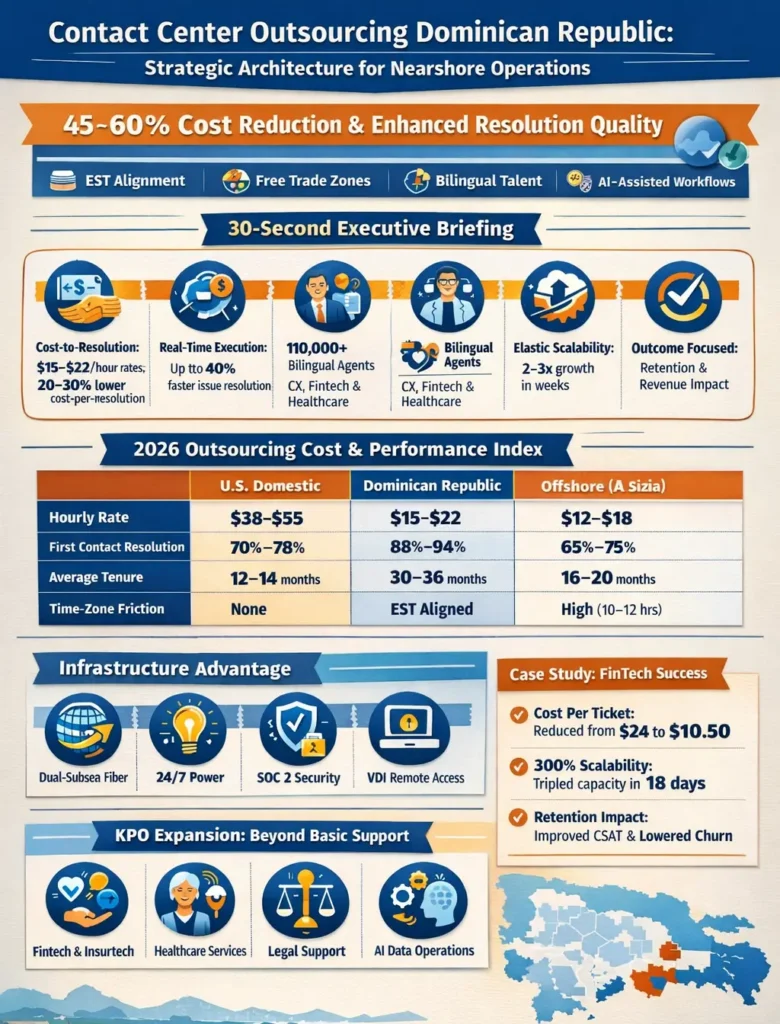
30-Second Executive Briefing
- Cost-to-Resolution Advantage: $15–$22/hour fully loaded rates combined with AI-assisted workflows reduce Cost-per-Resolution by 20–30%, not just labor spend.
- Real-Time Execution: EST/AST alignment enables same-day escalation handling and live QA, cutting resolution cycles by up to 40%.
- Bilingual Scale with Depth: 110,000+ professionals support complex CX, fintech, healthcare, and SaaS operations with high linguistic precision.
- Elastic Operating Model: Centers can scale 2–3x within weeks, supported by hybrid workforce structures and continuous talent pipelines.
- Resilience Built-In: Dual-city deployments, redundant subsea fiber, and secure VDI environments sustain 99.99% uptime across on-site and remote teams.
- Outcome-Oriented Delivery: Shift toward resolution accuracy, retention impact, and revenue contribution as primary performance metrics.
The New Outsourcing Equation: From Cost Reduction to Control
Outsourcing in 2026 is no longer a handoff—it is an extension of core operations. The Dominican Republic stands out because it allows enterprises to maintain direct operational control while lowering cost structures.
Time-zone alignment eliminates the delays common in offshore environments. Leaders can run live QA sessions, adjust workflows in real time, and deploy updates without waiting overnight. This creates a tighter feedback loop between customer interactions and internal product or compliance teams.
The result is not just efficiency—it is consistency. Issues are resolved faster, processes evolve quicker, and customer experience remains aligned with brand standards.
2026 Outsourcing Cost & Performance Index
| Metric | U.S. Domestic | Dominican Republic | Offshore (Asia) |
| Fully Loaded Hourly Rate | $38 – $55 | $15 – $22 | $12 – $18 |
| First Contact Resolution | 70% – 78% | 88% – 94% | 65% – 75% |
| Average Tenure (Months) | 12 – 14 | 30 – 36 | 16 – 20 |
| Time-Zone Friction | None | None (EST/AST) | High (10–12 hrs) |
| Bilingual Support | Limited / Premium | Standard | Limited |
The data highlights a critical shift: Dominican outsourcing is not just competitive on price—it consistently outperforms on stability and resolution quality.
Infrastructure as a Strategic Asset
The reliability of Dominican outsourcing is rooted in its technical foundation. Providers operate within highly controlled environments designed for continuous operations.
Connectivity and Security Benchmarks
| System Layer | 2026 Standard | Operational Impact |
| Subsea Fiber | ARCOS-1, PCCS, AMX-1 | Sub-30ms latency to U.S. |
| Power Infrastructure | Dedicated FTZ grids + backup systems | Continuous 24/7 uptime |
| Cybersecurity | SOC2 Type II, ISO 27001, PCI | Secure regulated workflows |
| Remote Enablement | VDI + zero-trust architecture | Safe hybrid workforce scaling |
This infrastructure supports seamless hybrid models where remote agents operate with the same security and performance as on-site teams.
Moving Up the Value Chain: The KPO Expansion
Dominican outsourcing has moved beyond transactional support into knowledge-intensive operations. This includes services that require judgment, compliance awareness, and technical specialization.
Key high-value service lines:
- Fintech & Insurtech: Fraud analysis, claims adjudication, underwriting support
- Healthcare Operations: Medical billing, patient coordination, compliance workflows
- Legal Support: Document review, bilingual case preparation
- AI Data Operations: Annotation, moderation, and model evaluation
These services carry higher business impact, shifting outsourcing from cost center to operational advantage.
Case Study: Scaling a FinTech Support Operation
The Problem:
A U.S.-based digital payments company faced rising costs ($24 per ticket) and declining retention due to inconsistent service quality.
The Solution:
The company transitioned Tier-1 and Tier-2 support to a 150-seat operation in Santo Domingo using a “seed team” model. Supervisors trained on-site in the U.S. before leading local deployment.
The Outcome:
- Cost-per-Ticket: Reduced from $24.00 to $10.50
- Operational Coverage: 24/7 bilingual support without shift premiums
- Scalability: 300% capacity expansion achieved in 18 days
- Retention Impact: Improved customer satisfaction and reduced churn
This illustrates how proximity and structured rollout models accelerate both performance and scale.
Commercial Model Design: Predictability, Flexibility, and Scale
Pricing in the Dominican Republic is structured around predictability rather than volatility. Most enterprise contracts follow an “all-in” model where labor, compliance, infrastructure, and statutory benefits are embedded into a single hourly or outcome-based rate.
Key commercial characteristics:
- Flat, Transparent Billing: No hidden surcharges for bonuses, benefits, or compliance overhead
- Elastic Scaling: Seat capacity can expand or contract within weeks, not quarters
- Outcome-Based Options: Increasing adoption of pricing tied to resolution rates, retention, or revenue impact
- Capital Efficiency: No upfront infrastructure investment required for clients
This model allows companies to forecast costs with precision while retaining the flexibility to scale operations in response to demand spikes or market shifts.
Execution Framework: Resolution-Centric Operating Model
Dominican outsourcing providers structure operations around resolution quality rather than activity volume. The execution model integrates technology and talent into a single workflow designed to minimize repeat contacts and escalation loops.
Core components:
- Pre-Interaction Context: Systems surface customer history, intent signals, and risk flags before engagement
- Guided Interaction Layer: Real-time prompts assist agents with compliance, tone calibration, and next-best actions
- Automated Afterwork: Documentation, CRM updates, and QA scoring are completed instantly without manual effort
- Supervisory Intelligence: Leaders monitor live performance dashboards and intervene during interactions, not after
This approach reduces cognitive load while increasing precision. Agents spend less time navigating systems and more time resolving issues, leading to higher First Contact Resolution and improved customer sentiment.
Expert FAQs
What makes Dominican outsourcing different from traditional offshore models?
The key difference is operational proximity. Real-time collaboration, cultural alignment, and faster feedback loops produce higher-quality outcomes, not just lower costs.
How resilient are operations during disruptions?
Providers use dual-site strategies across Santo Domingo and Santiago. Traffic is rerouted instantly between locations, ensuring uninterrupted service.
Is it better to outsource or build a captive center?
For operations under 500 seats, outsourcing is more efficient. Larger enterprises often adopt a Build-Operate-Transfer model once scale justifies internalization.
How are agents trained for complex roles?
Training combines domain-specific instruction with AI-assisted simulations, reducing ramp time and improving first-pass accuracy.
Can Dominican centers support regulated industries?
Yes. Most Tier-1 providers meet SOC2, HIPAA, and PCI-DSS standards, supported by secure infrastructure within Free Trade Zones.
Share This
Unlock cost-efficient growth with expert BPO guidance!
Partner with Cynergy BPO to connect with top outsourcing providers.
Streamline operations, cut costs, and scale your business with confidence.
Book a Free Call
Ralf Ellspermann - CSO
Author
Ralf Ellspermann is the Chief Strategy Officer (CSO) of Cynergy BPO and a globally recognized authority in business process and contact center outsourcing. With more than 25 years of experience advising enterprises and SMEs, he provides strategic guidance on vendor selection, CX optimization, and scalable outsourcing strategies across global markets. His expertise spans fintech, ecommerce and retail, healthcare, insurance, travel and hospitality, and technology (AI & SaaS) outsourcing.
A frequent speaker at leading industry conferences, Ralf is also a published contributor to The Times of India and CustomerThink, where he shares insights on outsourcing strategy, customer experience, and digital transformation.