



By: Ralf Ellspermann
25-Year, Multi-Awarded BPO Veteran
Published: 12 April 2026
Updated: April 1, 2026
Contact centers in the Dominican Republic deliver a nearshore model that combines bilingual, culturally aligned talent with AI-assisted workflows to reduce operating costs by 45–60% while improving resolution quality. With EST time-zone alignment, tax-neutral Free Trade Zones, and enterprise-grade infrastructure, the country functions as a real-time extension of North American CX operations.
30-Second Executive Briefing
- Cost-to-Outcome Advantage: Fully loaded rates of $16–$23/hour enable a 50% OpEx reduction while improving Cost-per-Resolution by up to 25% through AI-assisted workflows.
- Time-Zone Leverage: EST/AST alignment enables same-day escalation handling, cutting resolution cycles by 30–40% versus offshore models.
- Bilingual Scale: 115,000+ professionals with strong English-Spanish fluency support high-value CX across fintech, healthcare, and ecommerce.
- AI-Augmented Operations: Over 80% of Tier-1 providers deploy real-time copilots for summarization, compliance checks, and sentiment detection.
- Infrastructure Reliability: Dual-fiber subsea connectivity and 5G enterprise networks support 99.99% uptime across on-site and hybrid teams.
From Call Handling to Experience Orchestration
The Dominican Republic’s contact center sector now operates as a coordinated system managing entire customer journeys rather than isolated interactions. Voice remains important, but it is only one layer within a broader orchestration model that includes chat, social messaging, video support, and AI-assisted workflows.
This shift reflects a structural change in demand. Automated systems now absorb routine inquiries, leaving human agents responsible for high-value interactions—disputes, retention, technical troubleshooting, and emotionally sensitive cases. Dominican teams excel in this environment because of linguistic nuance and cultural familiarity with North American consumers.
For operators, this changes the economics. Value is no longer measured by cost per hour alone, but by how efficiently a center resolves complex issues and protects customer lifetime value.
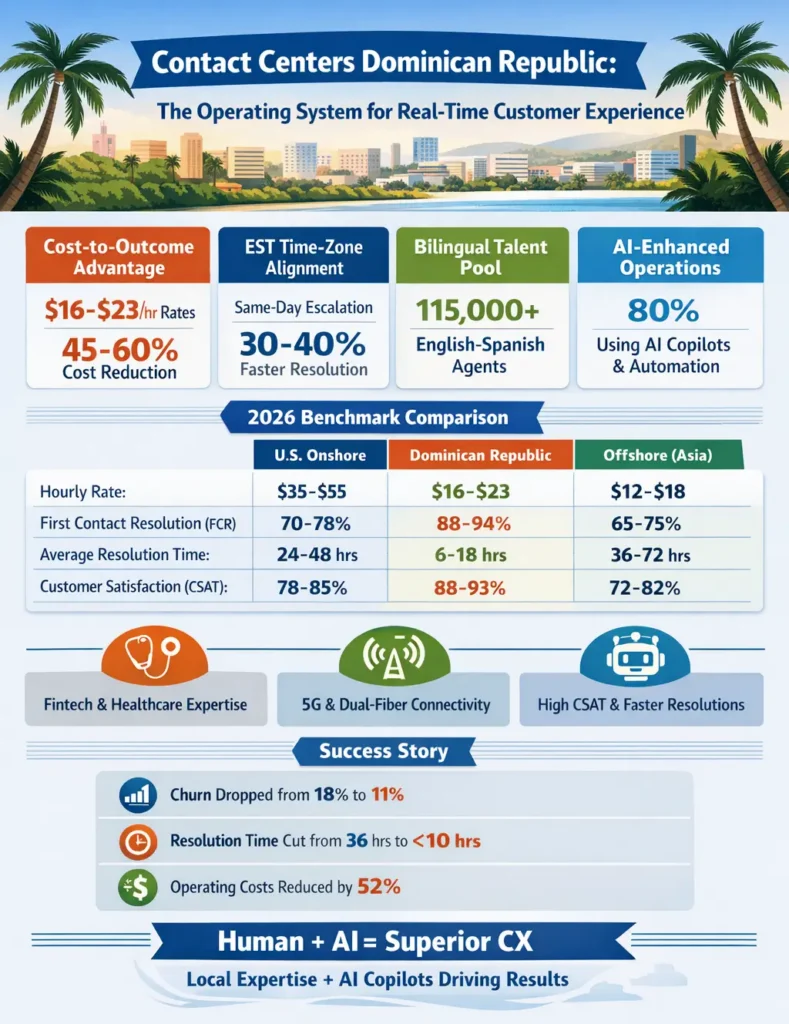
2026 Cost and Performance Benchmarks
| Metric | U.S. Onshore (Tier 2) | Dominican Republic | Offshore (Asia) |
| Fully Loaded Hourly Rate | $35 – $55 | $16 – $23 | $12 – $18 |
| First Contact Resolution (FCR) | 70% – 78% | 88% – 94% | 65% – 75% |
| Average Resolution Time | 24–48 hrs | 6–18 hrs | 36–72 hrs |
| Bilingual Availability | Limited / Premium | Standard | Limited |
| Customer Satisfaction (CSAT) | 78% – 85% | 88% – 93% | 72% – 82% |
The key takeaway is not just lower cost—it is faster resolution and higher satisfaction. Time-zone alignment allows teams to act immediately rather than queue issues overnight, which directly impacts customer perception and retention.
The Time-Zone Advantage as a Performance Multiplier
Operating within Eastern Standard Time transforms contact centers into live extensions of U.S. business operations. Product teams, compliance officers, and CX leaders can collaborate with Dominican agents in real time without delays.
This has measurable effects:
- Faster escalation handling during outages or product launches
- Continuous feedback loops between agents and engineering teams
- Real-time QA and coaching instead of delayed reviews
In industries such as fintech and healthcare, where delays can carry financial or regulatory consequences, this immediacy becomes a core operational advantage.
Talent Architecture: From Generalists to CX Specialists
The Dominican workforce has shifted toward specialization. Agents are no longer trained solely for script adherence but for domain-specific problem solving.
High-Demand Specializations in 2026
- Fintech: Fraud detection, KYC verification, dispute resolution
- Healthcare: Medical billing, patient coordination, insurance verification
- Ecommerce: Retention, high-ticket sales, omnichannel support
- SaaS & Tech: Tier-2 troubleshooting, onboarding, product support
This evolution is supported by national language and technical training programs that produce thousands of advanced English speakers annually. For employers, this translates into faster ramp-up times and higher first-pass accuracy.
Capability Stack: What Modern Dominican Contact Centers Deliver
| Capability Layer | 2026 Standard in Dominican Republic | Business Impact |
| AI Copilot Tools | Real-time transcription, sentiment analysis, auto-summary | 30–40% reduction in agent workload |
| Omnichannel Platforms | Voice, chat, video, social unified dashboards | Seamless customer journey management |
| Security Framework | SOC2, HIPAA, PCI-DSS, VDI environments | Compliance for regulated industries |
| Workforce Model | Hybrid (3 onsite / 2 remote) with 5G support | Scalable and resilient operations |
| Analytics Layer | Predictive routing and outcome tracking | Improved retention and upsell rates |
The integration of these layers creates a system where agents focus on judgment and communication, while automation handles repetitive cognitive tasks.
Reliability: Designed for Continuity
Risk management has become a deciding factor in location strategy. The Dominican Republic has addressed this with a combination of physical and digital redundancy.
Key infrastructure elements include:
- Multiple subsea fiber routes (ARCOS-1, AMX-1) ensuring low-latency connectivity
- Tier III and IV data centers across Santo Domingo and Santiago
- 5G enterprise slicing enabling secure remote operations
- Dual-city deployment strategies for active-active redundancy
This setup allows companies to maintain uninterrupted operations even during localized disruptions, eliminating the need for expensive secondary backup locations.
Case Study: Transforming CX for a U.S. E-commerce Brand
The Problem:
A mid-market U.S. ecommerce company faced rising churn (18%) and long resolution times (36+ hours) due to reliance on an offshore support model.
The Solution:
The company migrated its contact center operations to a 180-seat bilingual team in Santo Domingo. AI copilots were deployed for real-time response guidance and automated ticket documentation.
The Outcome:
- Churn Reduction: Dropped from 18% to 11% within 4 months
- Resolution Speed: Reduced from 36 hours to under 10 hours
- Cost Savings: Achieved 52% reduction in operating expenses
- Customer Satisfaction: Increased by 14 percentage points
The shift demonstrated that proximity and cultural alignment can outperform marginally cheaper offshore labor when measured against business outcomes.
Human + AI: The New Contact Center Equation
The operational model in 2026 is built around collaboration between human agents and intelligent systems.
- AI handles data retrieval, compliance validation, and documentation
- Agents manage empathy, negotiation, and decision-making
- Supervisors focus on quality, coaching, and escalation strategy
This structure shifts performance metrics away from speed alone toward outcome quality—resolution accuracy, retention impact, and customer sentiment.
In practical terms, fewer agents can handle more complex interactions without sacrificing service quality, improving both efficiency and customer experience.
Expert FAQs
How do Dominican contact centers compare to Mexico or Colombia?
The Dominican Republic offers stronger cultural alignment with U.S. consumers and slightly lower costs than Costa Rica, while maintaining higher English fluency consistency than many Latin American peers.
Are these centers suitable for highly regulated industries?
Yes. Leading providers operate with SOC2 Type II, HIPAA, and PCI-DSS compliance, supported by secure Free Trade Zone infrastructure and zero-trust access environments.
What is the typical ramp-up timeline for a new operation?
Most enterprise deployments reach initial operational capacity within 30–60 days, with AI-assisted training reducing onboarding time by up to 40%.
How scalable is the talent pool?
The sector supports over 115,000 professionals, with continuous government-backed language and technical training programs ensuring long-term scalability.
Is work-from-home viable for sensitive operations?
Yes. Secure VDI environments, biometric authentication, and AI-based monitoring allow remote agents to meet the same compliance standards as on-site teams.
Share This
Unlock cost-efficient growth with expert BPO guidance!
Partner with Cynergy BPO to connect with top outsourcing providers.
Streamline operations, cut costs, and scale your business with confidence.
Book a Free Call
Ralf Ellspermann - CSO
Author
Ralf Ellspermann is the Chief Strategy Officer (CSO) of Cynergy BPO and a globally recognized authority in business process and contact center outsourcing. With more than 25 years of experience advising enterprises and SMEs, he provides strategic guidance on vendor selection, CX optimization, and scalable outsourcing strategies across global markets. His expertise spans fintech, ecommerce and retail, healthcare, insurance, travel and hospitality, and technology (AI & SaaS) outsourcing.
A frequent speaker at leading industry conferences, Ralf is also a published contributor to The Times of India and CustomerThink, where he shares insights on outsourcing strategy, customer experience, and digital transformation.