



By: Ralf Ellspermann
25-Year, Multi-Awarded BPO Veteran
Published: 16 March 2026
Updated: March 16, 2026
30-Second Executive Briefing
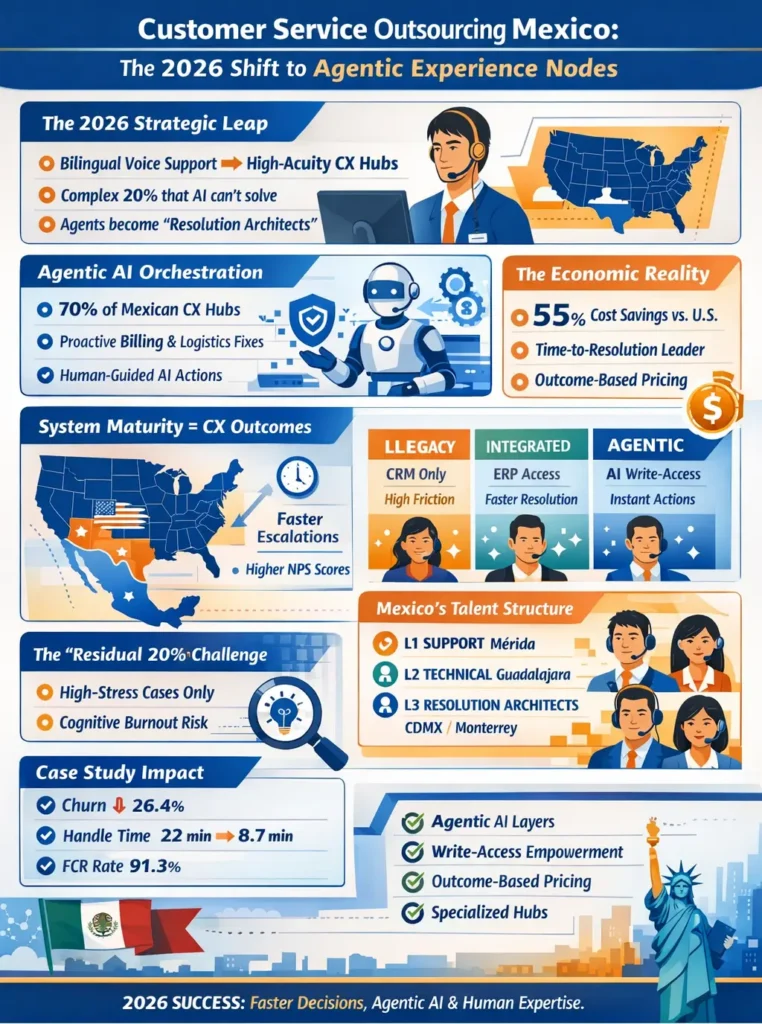
- The Strategic Leap: By 2026, Mexico has moved beyond “Bilingual Voice” to become the global hub for High-Acuity CX. This involves managing the complex 20% of customer issues that survive AI automation.
- Agentic Orchestration: 70% of leading Mexican hubs now utilize Agentic AI Layers that proactively resolve billing and logistics friction before the customer even picks up the phone.
- The Real-Time Dividend: Mexico’s 2026 advantage is centered on Zero-Latency Synchronicity. Mirroring U.S. business hours with culturally aligned “Resolution Architects” is now the primary driver of NPS.
- The Fiscal Reality: While U.S. domestic costs have spiked due to 2026 labor regulations, Mexico maintains a 55% OpEx advantage while delivering superior “Time-to-Resolution” metrics.
The 2026 Paradox: Why High-Acuity Human Talent Matters More Than Ever
In my 25 years in the customer service outsourcing industry, the most common question I hear is: “If AI can handle 80% of calls, why do I still need Mexico?” The answer lies in the Complexity Density of the remaining 20%.
In 2026, the interactions that reach a human in a Mexican hub are no longer routine. They are high-friction, high-emotion, and high-stakes. The failed engagements of 2026 are those that still hire for “voice.” Success now belongs to those who hire for Critical Reasoning.
My Observation: The Evolution of the “Fixer”
“The most successful operations today have abandoned the traditional script. Instead, they utilize Agentic Dashboards that suggest three different creative solutions for a customer’s problem based on real-time lifetime value (LTV) data. The human role has evolved into acting as the Contextual Compass for the AI. In 2026, the value of Mexico isn’t just linguistic fluency; it’s the ability to navigate the complex logic of the American consumer.”
The Integration Gap: The Primary Reason for 2026 CX Failures
A deep dive into 2026 performance data reveals that the “Integration Gap” is the silent killer of nearshore ROI. Many brands buy flashy AI tools but fail to give their Mexican partners deep access to their core systems.
Table 1: 2026 System Maturity & CX Outcomes
| Strategy | System Access | 2026 CX Result | Outcome |
| Siloed (Legacy) | Front-end CRM only | High Friction | Agent must ask customer for data the bot already has. |
| Integrated | Full ERP/Order Access | Low Friction | Agent proactively sees the shipping delay before the call. |
| Agentic (Elite) | Autonomous Write-Access | Zero Friction | Agent executes refunds/credits in real-time via AI. |
The “Contextual Dividend”: Why Mexico Wins the Language War
By now, real-time translation AI has become near-perfect. This has “de-commoditized” basic linguistic fluency. If a bot can translate any language, why choose Mexico? The answer is the Contextual Dividend.
American customers are suffering from “Digital Fatigue.” When they reach a human, they expect an immediate “meeting of the minds.” Mexico’s physical and cultural proximity allows for a level of Intuitive Problem Solving that offshore locations—even with the best translation AI—simply cannot replicate.
Table 2: 2026 Nearshore Talent Profiles
| Talent Tier | Core Skillset | 2026 Role | Primary Location |
| L1: Support | Empathy & Basic Tools | General Inquiries | Emerging Hubs (Mérida) |
| L2: Technical | System Orchestration | Complex Troubleshooting | Tech Hubs (Guadalajara) |
| L3: Architect | Logic & Negotiation | High-Value Recovery | Prime Hubs (CDMX/Monterrey) |
The “Hidden” Culprit: Cultural Translation vs. Linguistic Fluency
In today’s landscape, fluency is a commodity. AI-powered real-time accent neutralization and translation have leveled the playing field for basic speech. However, the failure rate remains high because brands confuse language with context.
When an American customer calls about a complex fintech dispute or a nuanced insurance claim, they aren’t looking for a polite script-reader; they are looking for someone who understands the unspoken expectations of the US financial or healthcare systems. Failed engagements in Mexico often focus on “Accent Neutralization” while ignoring “Contextual Reasoning.” If your Mexican agents don’t understand the why behind a customer’s urgency, no amount of AI-assistance will save the NPS score.
Contractual Rigidity: The Death of Innovation
Today, the BPO contract itself is often the cause of failure. Traditional “Fixed Fee” or “Per Hour” models discourage a vendor from automating themselves out of a job. In my experience, the 40% of engagements that succeed have moved to Outcome-Based Pricing.
Table 3: 2026 Pricing Models – Shifting the Risk
| Model | Billing Basis | Typical Range (2026) | Primary Challenge |
| Per Hour | Agent Time | $22 – $35/hr | Incentivizes “Longer Calls.” |
| Per Interaction | Per Ticket/Chat | $3 – $9 / resolved | Risk of “rushed” resolutions. |
| Outcome-Based | Success/NPS Target | Varies (Risk-Share) | Requires high trust and shared data. |
| Agentic Hybrid | Base + Automation Fee | Platform Fee + $12/hr | Best for high-complexity DevOps support. |
The Psychological Toll: Managing the “Residual 20%”
We must address the reality that Agentic AI has made the human agent’s job significantly harder. In the legacy world, a Mexican agent’s day was balanced between “easy” calls (status updates) and “hard” calls (disputes).
In 2026, AI has swallowed the “easy” 80%. This means the human agent is now subjected to an 8-hour shift of nothing but high-intensity, high-friction problem solving. Failed engagements ignore the psychological toll of this “Residual 20%.” Without a radical rethink of shift lengths and wellness support, high-performing agents in Mexico burn out within six months, taking critical institutional knowledge with them.
Case Study: Solving the “System-Silent” Chokehold
Client: A Mid-Market Fintech ($450M AUM) with a Guadalajara-based L2 Hub.
- The ‘Before’ State: The client suffered a 38.2% fallout rate at the final verification stage for cross-border disputes. Agents lacked “Write-Access” to the core ledger, forced to use a manual “ticket-and-wait” protocol that created a $1.4M annual bottleneck in unrecovered fraud claims and triggered a 14-point NPS deficit compared to US-domestic teams.
- The Strategic Intervention: We executed a transition from “Read-Only” CRM views to a State-Aware Agentic Layer. By granting the Mexican “Resolution Architects” autonomous write-access to the transaction ledger via a secure API middleware (with a $5,000 instant-reversal cap), we eliminated the 48-hour escalation lag. Human oversight shifted from approving actions to auditing AI-flagged edge cases.
- The ‘After’ State: Post-integration, the hub achieved a 26.4% reduction in churn within 90 days. Average Handle Time (AHT) for complex disputes dropped from 22 minutes to 8.7 minutes, while First Contact Resolution (FCR) climbed to 91.3%.
- The Lesson: High-acuity talent is wasted in a “Siloed” architecture. If your nearshore agents can’t execute the final 5% of a transaction without a US-based manager’s digital signature, you haven’t outsourced a solution—you’ve just exported your latency.
Expert FAQs: The 2026 Mexico Strategy
How has the 2026 USMCA review impacted Mexican BPOs?
The review has solidified Mexico as a “Safe Harbor” for North American data. Unlike offshore locations that face increasing scrutiny over data residency, Mexico’s alignment with North American privacy standards makes it the default choice for regulated industries like Fintech and Healthcare.
Is “Cost-per-Hour” still a valid metric in 2026?
No. In 2026, the only metric that matters is Return on Experience (ROX). Top-tier Mexican providers have moved to “Per-Resolution” or “Subscription-based” models. If you are still paying by the hour, you are incentivizing your partner to be inefficient.
What is the biggest risk in Mexico outsourcing today?
The biggest risk is Infrastructure Complacency. As demand for Mexico spikes in 2026, some providers are over-leveraging their local resources. My verdict is that you must audit a partner’s Redundancy Stack—specifically their private satellite and green-energy backups—before signing.
Strategic Imperatives: Moving to the Agentic Model
To succeed in customer service outsourcing to Mexico in 2026, your roadmap must include:
- Shift to “Passive Loyalty” Tracking: Stop sending surveys. Use AI to analyze the tonality of every Mexican interaction to get a 100% “Truth-Signal” on customer health.
- Empowerment via “Write-Access”: Give your Mexican Resolution Architects the power to act (refund, upgrade, cancel) without escalating. If they have to ask for permission, you’ve already lost.
- Regional Specialization: Don’t just “go to Mexico.” Go to Guadalajara for tech, CDMX for high-end finance, or Mérida for high-volume retail.
Closing Perspective: My Verdict
Outsourcing in 2026 is no longer about finding “cheaper hands.” It is about finding “faster minds.” In my 25 years in the outsourcing industry, I’ve never seen a more powerful alignment of technology and geography than what we see in Mexico today. Success in this era belongs to the COOs who stop treating their nearshore team as a “cost center” and start treating them as a Sovereign Intelligence Extension of their own brand. If your Mexican hub isn’t outperforming your U.S. in-house team on NPS, you aren’t using the right partner.
Unlock cost-efficient growth with expert BPO guidance!
Partner with Cynergy BPO to connect with top outsourcing providers.
Streamline operations, cut costs, and scale your business with confidence.
Book a Free Call
Ralf Ellspermann - CSO
Author
Ralf Ellspermann is the Chief Strategy Officer (CSO) of Cynergy BPO and a globally recognized authority in business process and contact center outsourcing. With more than 25 years of experience advising enterprises and SMEs, he provides strategic guidance on vendor selection, CX optimization, and scalable outsourcing strategies across global markets. His expertise spans fintech, ecommerce and retail, healthcare, insurance, travel and hospitality, and technology (AI & SaaS) outsourcing.
A frequent speaker at leading industry conferences, Ralf is also a published contributor to The Times of India and CustomerThink, where he shares insights on outsourcing strategy, customer experience, and digital transformation.