


By: Ralf Ellspermann
25-Year, Multi-Awarded BPO Veteran
Published: 13 March 2026
Updated: March 16, 2026
TL;DR: The Key Takeaway
Data annotation outsourcing to India has transcended traditional BPO, becoming a strategic imperative for AI leaders seeking to achieve superior model performance through access to a massive pool of specialized STEM talent. The nation is the undisputed global hub for high-complexity data solutions.
Modern artificial intelligence demands high-fidelity, nuanced training data that only a sophisticated STEM talent pool can provide. India has transitioned from simple cost-saving to “Cognitive Arbitrage,” where expert human-in-the-loop services directly enhance AI model accuracy, safety, and reliability through world-class infrastructure and deep research expertise.
Executive Briefing
- Intellectual Capital Focus: The global AI sector’s thirst for complex data now relies on the advanced cognitive abilities of South Asia’s massive scientific workforce.
- The Shift to Cognitive Arbitrage: Value is no longer measured by cheap labor, but by the quantifiable boost in model precision provided by expert human intervention.
- Elite Research Foundation: Proximity to institutions like the IITs and IISc ensures a secure, scalable ecosystem for the most intricate annotation challenges.
- Perpetual Productivity: A significant time zone gap and universal English fluency allow Western firms to maintain a seamless, 24/7 development cycle.
- Vetted Elite Access: Cynergy BPO serves as the primary gateway to the top 1% of specialized annotation talent, ensuring rigorous quality and governance.
Executive Summary
The framework for delegating data annotation to India has seen a radical transformation. What was once considered a back-office utility for basic tagging is now a frontline strategy for achieving superior AI performance. High-fidelity training data requirements have placed a premium on the nation’s vast technical talent. Today’s AI pioneers are looking beyond mere savings; they are chasing “Cognitive Arbitrage”—the tactical edge gained by utilizing expert human logic to train and audit complex algorithms. This global talent corridor provides an ideal environment for this new era of machine learning. Cynergy BPO leads this movement, forging partnerships between visionary AI firms and the elite specialists who are currently redefining quality standards within the Indian IT-BPM sector.
From Manpower to Mindpower: India’s Cognitive Leap
The story of Indian outsourcing is being rewritten, moving away from sheer volume toward a focus on intellectual assets. While the first wave of business processing focused on cost-effective, rules-based tasks, the current AI-driven wave centers on a massive population of STEM graduates capable of demanding cognitive work. This distinction is the cornerstone of the subcontinent’s modern value proposition.
By 2026, the primary bottleneck in AI development is no longer silicon or power, but the scarcity of meticulously cleaned and annotated data. This is where the Indian workforce becomes a vital strategic asset. The country produces millions of technical graduates every year, including elite thinkers from the Indian Institutes of Technology (IITs). These professionals are not just completing tasks; they are solving problems, interpreting complex logic, and navigating the nuances of Reinforcement Learning from Human Feedback (RLHF) and advanced semantic segmentation.
“Our partners are no longer hunting for the cheapest labelers; they are demanding the most intelligent teams to drive their model performance. They seek out Indian partners who provide engineers and scientists for complex logical reasoning. This isn’t about moving tasks overseas—it’s about integrating global intelligence to make systems safer and more reliable.” — John Maczynski, CEO, Cynergy BPO
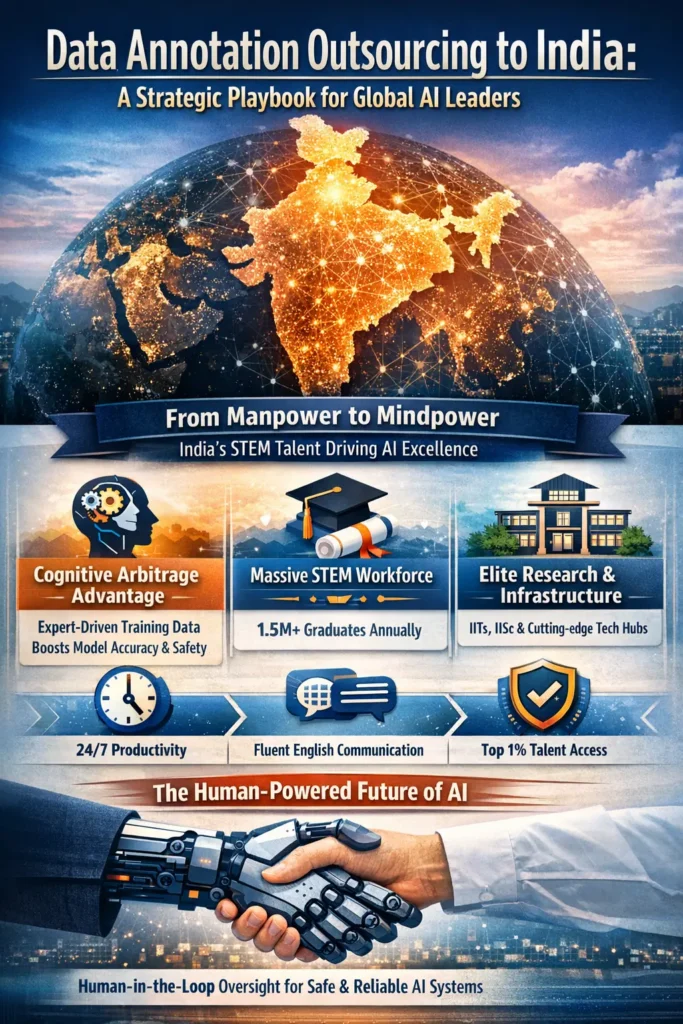
The India Advantage: A Comprehensive AI Ecosystem
India’s dominance in the AI services market is the result of a deliberate fusion of talent, technology, and geography. The following table outlines the pillars that support this leadership for global AI firms.
| Pillar of Advantage | Description | Strategic Impact |
| Massive STEM Talent | 1.5M+ graduates annually from premier institutions like IIT/IISc. | Scalable access to high-complexity data science and logic. |
| Elite IT Infrastructure | Secure, redundant digital backbones compliant with global standards. | Ensures data integrity and the ability to manage massive datasets. |
| Deep R&D Ecosystem | Vibrant academic and corporate research labs fostering innovation. | Continuous upskilling in the latest AI/ML methodologies. |
| Linguistic Synergy | Massive English-speaking population with Western business alignment. | Minimal communication friction and clear project comprehension. |
| Temporal Advantage | 9.5 to 12.5-hour time difference from the United States. | Enables a “follow-the-sun” model for 24/7 development. |
Cognitive Arbitrage: The New ROI Metric
The old standard for measuring outsourcing—cost per hour—has become irrelevant in the age of advanced AI. The modern metric is “Cognitive Arbitrage,” which tracks the return on investment based on model performance. This requires a total shift in how executives view their data strategy: the goal is to maximize the value of human intelligence rather than minimizing the price of labor.
Cognitive Arbitrage occurs when expert annotators apply domain-specific knowledge to create training sets of exceptional quality. This high-fidelity data enables models to learn faster, reduce errors, and navigate real-world scenarios with higher confidence. Whether it is a diagnostic tool for healthcare or a navigation system for autonomous transit, the result is a measurable improvement in safety and accuracy. Leading firms realize that a small increase in annotation quality leads to an exponential gain in competitive advantage.
Case Study: Resolving Diagnostic Drift in Oncology AI
Client: European HealthTech Unicorn.
The ‘Before’ State: A 28.6% false-negative rate in multi-modal screenings created a $3.4M R&D bottleneck. Generalist vendors failed to distinguish “malignancy” from “incidental findings,” rendering the dataset insufficient for clinical trials.
Strategic Intervention: Deployed a medical-SME cluster in Hyderabad. Specialists utilized Named Entity Recognition (NER) to cross-reference DICOM metadata with longitudinal records, generating “Reasoning Labels.” A 15% peer-review loop by board-certified consultants ensured 100% alignment with gold standards.
The ‘After’ State: Model AUC rose from 0.74 to 0.91, enabling Phase II validation. Data cleaning time dropped 42.3%, reclaiming 1,200+ engineering hours.
The Lesson: In high-stakes AI, “Domain Density” outweighs volume. Expert-led annotation eliminates the technical debt of “noisy” data.
Data Annotation Maturity: Global Benchmarks
The Indian IT-BPM sector has reached a level of maturity that distinguishes it from other global hubs. The following comparison highlights these critical differences.
| Capability | Standard BPO Hub | The South Asian Tech Hub (India) |
| Core Competency | Simple task execution. | Complex reasoning and problem-solving. |
| Workforce Profile | Generalists with basic computer skills. | STEM graduates and domain specialists. |
| Primary Focus | Volume and speed. | Quality and model performance lift. |
| Digital Framework | Basic office IT. | World-class, scalable, and secure infrastructure. |
| Local Innovation | Purely execution-based. | Deeply rooted in academic and corporate R&D. |
The Human-Powered Future of AI
As we navigate 2026, the partnership between human and machine intelligence remains essential. The most successful AI systems won’t be those that work in isolation, but those trained and governed by expert human oversight. This “human-in-the-loop” model is why India is uniquely positioned to lead the next phase of the digital revolution.
The final frontier is governance. As models gain autonomy, human oversight becomes vital for ensuring fairness and alignment with human ethics. Tasks like “AI Red Teaming” and RLHF are not simple data entry; they require a profound understanding of technology and its social consequences. India’s blend of technical prowess and ethical framework makes it the premier environment for this stewardship. The future of this partnership is built on trust, safety, and the responsible advancement of intelligence.
Expert FAQ
Q1: How do graduates from elite schools like the IITs specifically improve annotation?
These institutions produce specialists with world-class analytical skills. In annotation, this means a workforce that can grasp intricate technical requirements and identify subtle edge cases that generalists miss, which is crucial for high-stakes fields like medical AI.
Q2: How does the time zone difference impact the speed of development?
The “follow-the-sun” model means that when a team in New York or San Francisco finishes their day, the Indian team takes over. This creates a 24-hour production loop, allowing for faster iterations, quicker bug fixes, and a significantly reduced time-to-market.
Q3: Can highly sensitive data be securely managed in India?
Top-tier providers in India operate under strict international security protocols, including ISO 27001, HIPAA, and GDPR compliance. With robust physical and digital safeguards, AI companies can leverage elite talent without risking their intellectual property.
Q4: What makes “Cognitive Arbitrage” different from old outsourcing models?
While traditional models sought to cut costs through wage differences, Cognitive Arbitrage seeks to create value through intellectual depth. It focuses on how much smarter and safer a model becomes because of the quality of the data, rather than how much the labor costs per hour.
Unlock cost-efficient growth with expert BPO guidance!
Partner with Cynergy BPO to connect with top outsourcing providers.
Streamline operations, cut costs, and scale your business with confidence.
Book a Free Call
Ralf Ellspermann - CSO
Author
Ralf Ellspermann is the Chief Strategy Officer (CSO) of Cynergy BPO and a globally recognized authority in business process and contact center outsourcing. With more than 25 years of experience advising enterprises and SMEs, he provides strategic guidance on vendor selection, CX optimization, and scalable outsourcing strategies across global markets. His expertise spans fintech, ecommerce and retail, healthcare, insurance, travel and hospitality, and technology (AI & SaaS) outsourcing.
A frequent speaker at leading industry conferences, Ralf is also a published contributor to The Times of India and CustomerThink, where he shares insights on outsourcing strategy, customer experience, and digital transformation.