



By: Ralf Ellspermann
25-Year, Multi-Awarded BPO Veteran
Published: 16 March 2026
Updated: March 16, 2026
TL;DR: The Key Takeaway
Depth estimation labeling outsourcing to India has transcended traditional data annotation, becoming a critical component in the development of 3D perception for advanced robotics. The nation’s unique combination of a massive STEM talent pool, a thriving AI research ecosystem, and significant time zone advantages for US clients makes it the premier destination for this highly specialized work.
Outsourcing depth estimation labeling to India provides the high-fidelity 3D ground truth required for autonomous navigation. By 2026, the global data annotation market is projected to reach $2.98 billion, with a 32.7% CAGR, driven by the transition from 2D recognition to true 3D perception. India’s STEM talent—augmented by the $1.2B IndiaAI Mission—leverages “Intelligence Arbitrage” to label complex LiDAR point clouds and stereo vision datasets, achieving 98% pipeline efficiency for global robotics firms.
Executive Briefing
- The 3D Perception Bottleneck: As robotics move from “Static Dashboards” to “Autonomous Action,” depth estimation labeling has become the primary constraint for safe real-world deployment.
- Cognitive Shift: The value of Indian partnerships in 2026 has moved beyond simple labor to Intelligence Arbitrage, where STEM specialists resolve the 20% of high-complexity edge cases that automated tools cannot solve.
- Massive Talent Engine: India now holds roughly 16% of the world’s AI talent, with the local AI market projected to reach $17 billion by 2027.
- Institutional Depth: Premier institutions like the IITs and IISc are integrating Vision Transformers and SAR (Synthetic Aperture Radar) data processing into core curricula, creating a “future-ready” workforce for 3D annotation.
- Strategic Connector: Cynergy BPO vets the top 1% of Indian providers, ensuring compliance with the Digital Personal Data Protection (DPDP) Act 2026.
From Pixels to Perception: The 3D Transformation
In 2026, the AI landscape has reached a pivotal inflection point. While 2D image recognition is largely commoditized, 3D perception is the new frontier for industrial automation, humanoid robotics, and autonomous logistics. Machines must now perceive the “Z-axis” with sub-millimeter precision to interact safely with unstructured environments.
Depth estimation—the process of calculating the distance of objects from a sensor—is the engine of this 3D understanding. Whether utilizing Stereo Vision (mimicking human binocular depth) or Monocular Depth Estimation (inferring geometry from a single lens), the resulting models require massive volumes of manually verified ground truth data. Indian specialists provide this human-in-the-loop verification, transforming raw sensor feeds into high-fidelity 3D maps.
India’s Unmatched Strengths: The 2026 Ecosystem
India has cultivated a unique “Perfect Storm” for 3D data annotation through a combination of government policy and academic rigor.
- Scale and Skill: India’s AI workforce has expanded to over 650,000 professionals, with a government goal of reaching 1 million by the end of 2026.
- The IndiaAI Mission: A $1.2 billion federal investment has democratized access to high-end compute power for Indian BPOs, allowing them to offer advanced reasoning models at a fraction of Western costs.
- Infrastructure 2.0: With the DPDP Act 2026 in full enforcement, leading Indian hubs utilize Zero-Trust Architectures and Secure Data Clean Rooms, making “Compliance as a Moat” a primary competitive advantage.
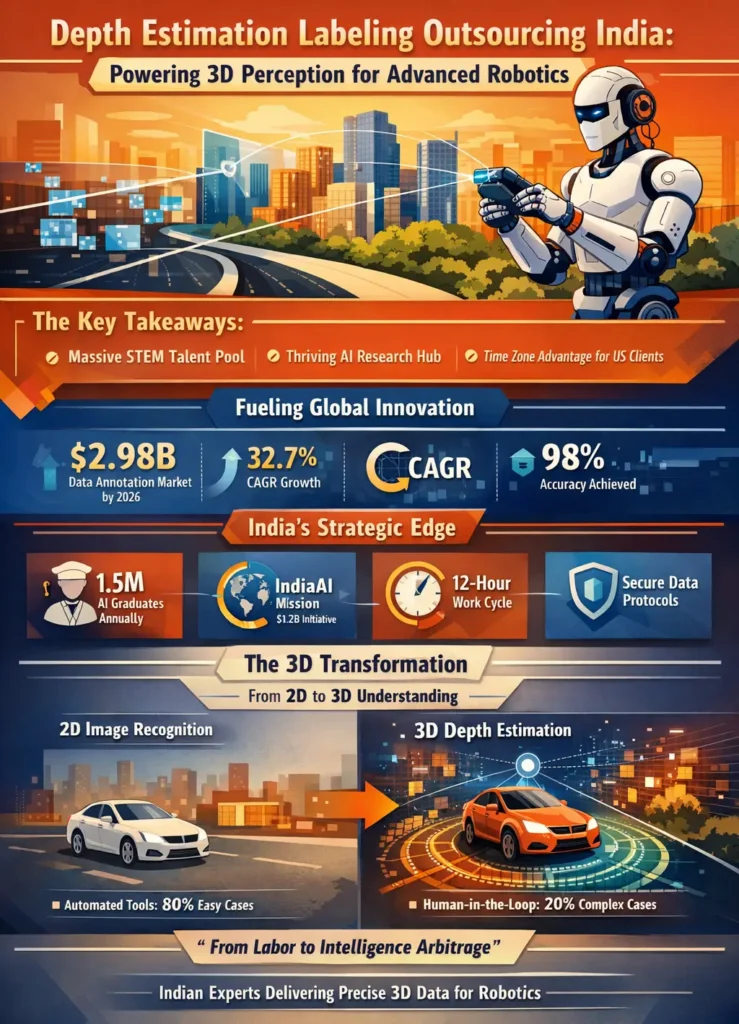
| Feature | Impact on Depth Estimation Labeling (2026) |
| Massive STEM Pipeline | Access to 1.5 million annual engineering graduates for Tier 3/4 tasks. |
| Follow-the-Sun Model | 12-hour time shift allows for “Overnight Intelligence” delivery to US labs. |
| Agentic Hubs | Indian teams act as “Resolution Architects,” orchestrating fleets of AI pre-labeling agents. |
| Regulatory Moat | Full alignment with DPDP 2026 and GDPR ensures auditable ground truth. |
The Evolution: From Labor to Intelligence Arbitrage
The “Cheap Labor Mirage” of the past has been replaced by Intelligence Arbitrage. Companies no longer outsource to find “more hands”; they outsource to find “smarter brains” capable of governing AI agents.
In 2026, the metric for success has shifted from “Price-per-Hour” to “Price-per-Resolution” (PPR). By leveraging specialized Indian teams, firms are reducing their Total Cost of Ownership (TCO) by 34% while increasing the cognitive depth of their models. This collaborative approach allows for Sim-to-Real transfer learning, where robots are trained in digital twins and deployed instantly in the physical world.
“In 2026, the competitive edge isn’t just about having data; it’s about the Resolution Velocity of that data. We help firms move into Intelligence Arbitrage—where Indian-led Agentic AI solves complex 3D problems at a speed that turns data into a proactive profit center.” — John Maczynski, CEO, Cynergy BPO
Specialized Depth Estimation Service Tiers
Cynergy BPO categorizes providers based on the “Cognitive Load” of the task to ensure precise talent matching.
- Tier 1: Foundational (2D-to-3D): Basic bounding boxes for distance estimation in consumer electronics.
- Tier 2: Intermediate (Stereo Segmentation): Pixel-level disparity mapping for dual-camera systems in retail robotics.
- Tier 3: Advanced (LiDAR Fusion): Annotating sparse point clouds for connected and autonomous vehicles (CAV).
- Tier 4: Expert (Humanoid Dexterity): High-res depth maps for humanoid robots (e.g., Agibot A2) to perform human-level manipulation in home and factory settings.
Expert FAQs
Q1: How does monocular depth estimation differ from stereo vision labeling?
Monocular systems use a single camera and rely on “geometry cues” (like the ground plane) to infer distance. Labeling for this requires annotators to understand optical flow and perspective. Stereo vision uses two cameras to calculate disparity; labeling here involves matching identical pixels across two images to create a depth map. India’s IIT-trained engineers are uniquely skilled in the 3D geometry required for both.
Q2: Is my data safe under the new DPDP Act 2026?
Yes. The Digital Personal Data Protection (DPDP) Act 2026 provides a rigorous legal framework for data processing in India. Leading providers utilize ephemeral memory and Zero-Knowledge architectures, ensuring data is processed without being permanently stored on local servers.
Q3: What is “Resolution Velocity,” and why does it matter?
Resolution Velocity is the speed at which a human-AI team can resolve an ambiguous edge case (e.g., a robot misidentifying a glass door’s depth). In 2026, Indian “Resolution Architects” use Agentic AI to pre-screen data, allowing them to focus only on the most difficult 2% of samples, which drastically speeds up model deployment.
Q4: Can Indian teams help with “Sim-to-Real” training?
Absolutely. Many top-tier Indian providers now offer “Digital Twin” services, where they label synthetic data generated in simulations to match the noise and lighting of real-world sensors, ensuring a seamless transition from the lab to the factory floor.
Unlock cost-efficient growth with expert BPO guidance!
Partner with Cynergy BPO to connect with top outsourcing providers.
Streamline operations, cut costs, and scale your business with confidence.
Book a Free Call
Ralf Ellspermann - CSO
Author
Ralf Ellspermann is the Chief Strategy Officer (CSO) of Cynergy BPO and a globally recognized authority in business process and contact center outsourcing. With more than 25 years of experience advising enterprises and SMEs, he provides strategic guidance on vendor selection, CX optimization, and scalable outsourcing strategies across global markets. His expertise spans fintech, ecommerce and retail, healthcare, insurance, travel and hospitality, and technology (AI & SaaS) outsourcing.
A frequent speaker at leading industry conferences, Ralf is also a published contributor to The Times of India and CustomerThink, where he shares insights on outsourcing strategy, customer experience, and digital transformation.