



By: Ralf Ellspermann
25-Year, Multi-Awarded BPO Veteran
Published: 21 March 2026
Updated: March 17, 2026
TL;DR: The Key Takeaway
Digital twin data annotation outsourcing to India has transcended basic 3D modeling to become a strategic imperative for enterprises seeking to build, validate, and maintain hyper-realistic virtual replicas of their physical operations. The South Asian tech hub now provides the specialized cognitive talent required to ensure these digital models are not just visually accurate but logically sound, forming the bedrock of predictive maintenance, operational efficiency, and next-generation simulation for industries from manufacturing to smart cities.
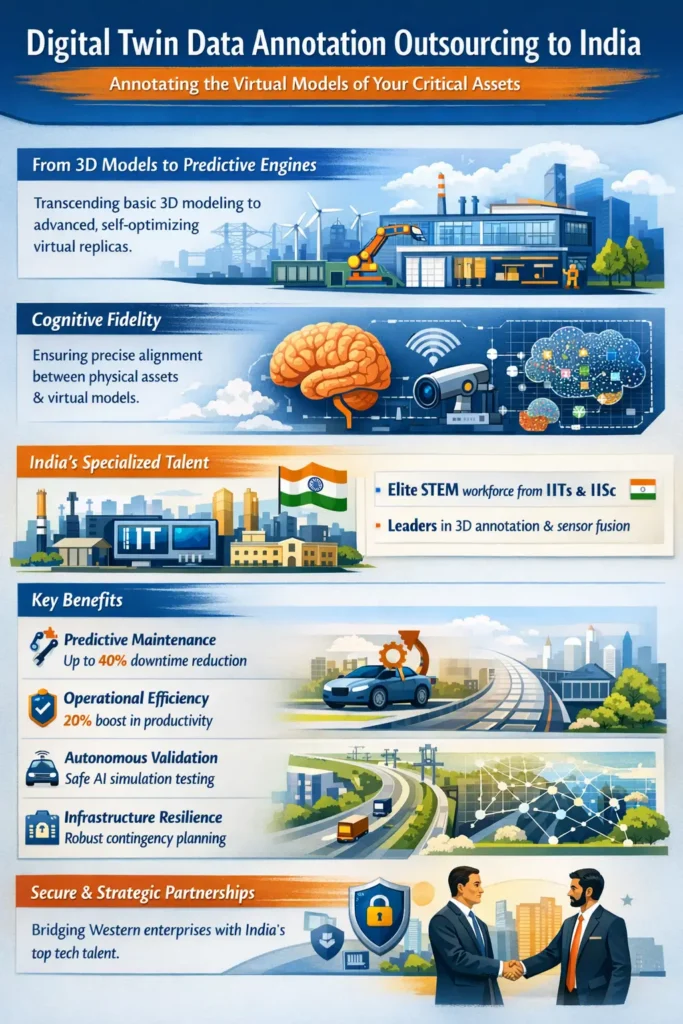
Digital twin data annotation outsourcing to India provides the high-precision “Cognitive Fidelity” required to synchronize physical assets with their virtual counterparts. By leveraging specialized engineers to label 3D point clouds, LiDAR, and sensor fusion data, enterprises can move beyond simple visualization to create predictive, self-optimizing models that drive critical industrial and infrastructure decisions.
Executive Briefing
- Precision Requirements: Developing industrial-grade digital twins necessitates complex 3D annotation and sensor fusion that far exceeds basic image labeling, demanding rigorous technical expertise.
- Specialized Talent Hub: India has solidified its position as the global leader for this niche, fueled by a massive STEM workforce and elite research output from the IITs and IISc.
- Cognitive Fidelity: The primary driver for outsourcing to the subcontinent is the accuracy of the “human-in-the-loop” validation, ensuring virtual models mirror real-world physics and logic perfectly.
- Multi-Modal Excellence: Premier Indian service providers offer sophisticated annotation for autonomous systems, smart manufacturing, and urban planning, forming the foundation of modern AI.
- Strategic Integration: Cynergy BPO bridges the gap between Western enterprises and these elite technical teams, ensuring that mission-critical virtual assets are built on a bedrock of flawless data.
Executive Summary
The landscape of digital twin data annotation outsourcing to India is currently establishing the benchmark for the next generation of industrial intelligence. As global firms race to develop virtual replicas of high-stakes assets—ranging from aerospace engines to expansive power grids—the necessity for surgical precision in data labeling has become a non-negotiable requirement. This specialized labor goes beyond generalist tasks; it demands the involvement of engineers who can interpret complex CAD schematics and annotate LiDAR data with sub-centimeter accuracy. The Indian tech corridor, characterized by its deep reservoir of analytical talent and sophisticated BPO infrastructure, has become the definitive destination for this work. It offers a unique synthesis of engineering depth, linguistic alignment, and the operational scale required to maintain “model truth” in high-concurrency environments.
“Modern enterprises are no longer satisfied with static digital shadows; they require active, predictive engines that influence billion-dollar outcomes. When a simulation determines the lifespan of a critical turbine, the underlying data must be beyond reproach. We direct our clients to India because the region provides the intellectual rigor necessary to ensure the virtual mirror is indistinguishable from reality.” — John Maczynski, CEO, Cynergy BPO
From 3D Models to Predictive Engines: The New Annotation Imperative
The first era of 3D modeling focused almost entirely on aesthetic representation—static files used for marketing or basic design. The associated data labeling was relatively elementary, usually involving the identification of individual parts within a CAD framework. Today, a genuine digital twin is a dynamic, living system. It continuously ingests real-time telemetry from IoT sensors and environmental feeds to simulate future states.
This technological evolution has fundamentally changed the requirements of the annotation process. Technicians are no longer just naming objects; they are defining physical constraints, kinematic relationships, and logic-based behaviors within simulated space. For instance, when mapping a robotic assembly line, the annotation team must accurately label potential collision zones and operational sequences. This necessitates a workforce that understands physics and mechanical engineering—a core strength of the talent pool in the subcontinent. This advanced form of BPO is about embedding professional domain knowledge into the very fabric of the AI’s training set.
The Digital Twin Annotation Maturity Spectrum
Transitioning from a basic visual model to a fully prescriptive digital twin involves a steep climb in data complexity. Navigating this spectrum requires a partner with the specific technical maturity to match the project’s goals.
| Maturity Level | Definition | Core Annotation Tasks | Indian Talent Alignment |
| Level 1: Descriptive | A visual 3D replica for identification. | 3D object labeling; CAD cleanup; semantic segmentation. | High-volume teams of skilled technical annotators. |
| Level 2: Informative | Models enriched with technical documentation. | Named Entity Recognition (NER); data linking; doc digitization. | Information management specialists with high English proficiency. |
| Level 3: Predictive | Real-time sensor integration for forecasting. | Sensor fusion (LiDAR/IMU); anomaly labeling; time-series data. | Engineers and signal processing experts from top institutes. |
| Level 4: Prescriptive | Simulations that recommend specific actions. | RLHF; scenario generation; logical verification of outcomes. | Elite AI/ML units providing high-level reasoning and governance. |
India’s AI Ecosystem: The Engine of High-Fidelity Annotation
The country’s dominance in the field of digital twin annotation is the result of long-term, strategic investment in technical education. Institutions like the Indian Institutes of Technology (IITs) produce a relentless stream of graduates who possess the quantitative skills essential for navigating 3D spatial data. This academic foundation is paired with a mature IT-BPM sector that has spent decades perfecting the delivery of high-security, scalable solutions for the world’s largest corporations.
Simultaneously, massive infrastructure investments are transforming the nation’s digital capabilities. The expansion of GPU-accelerated data centers and high-speed fiber networks ensures that even the most massive datasets—such as petabytes of point cloud data for autonomous vehicle testing—can be processed without latency. This convergence of human capital and modern hardware makes this global talent corridor the logical choice for complex, data-heavy BPO projects.
The Strategic Value of Cognitive Fidelity
For organizations deploying digital twins, the return on investment is found in the prevention of catastrophic failures and the optimization of throughput. The value proposition offered by Indian partners centers on “Cognitive Fidelity”—the assurance that the virtual model behaves exactly like its physical counterpart.
- Predictive Maintenance: By accurately labeling anomalies in historical sensor data, teams can reduce unplanned downtime by up to 40%.
- Operational Optimization: Annotating worker ergonomics and robotic workflows in a virtual factory can boost production efficiency by 20%.
- Autonomous Validation: Creating hyper-realistic, annotated simulation environments allows for the safe testing of AI driving policies, drastically lowering real-world R&D costs.
- Systemic Resilience: Building a dynamic twin of a logistics network enables firms to simulate and validate contingency plans before a disruption occurs.
Governance and Security in a Data-Centric Partnership
Because the data involved often represents a corporation’s most sensitive intellectual property, security is the bedrock of the outsourcing relationship. Leading providers in the South Asian tech hub operate under world-class frameworks, including ISO 27001 and SOC 2 certifications. They offer isolated, air-gapped environments and stringent data governance protocols to maintain the absolute confidentiality of client blueprints.
This focus on protection builds the trust necessary for a seamless partnership. Western firms can integrate Indian annotation teams as a direct extension of their own internal departments, knowing their proprietary data is handled with the highest level of professional care. Cynergy BPO specializes in auditing these providers, ensuring that every client is matched with a partner who prioritizes operational excellence and data integrity above all else.
Expert FAQs
Q1: What specific technical skills define the Indian talent pool for this work?
The workforce combines engineering fundamentals with advanced 3D spatial reasoning. Many specialists hold degrees in mechanical or civil engineering, allowing them to understand the structural and physical laws of the assets they are annotating. This domain-specific insight is vital for creating high-fidelity models that actually work in simulations.
Q2: How does the time zone difference impact project timelines?
The “follow-the-sun” model effectively creates a 24-hour production cycle. US-based teams can submit data at the end of their business day and receive fully annotated, quality-checked results the following morning. This accelerates the iteration process, allowing for faster model deployment and more agile development.
Q3: Can these teams handle process-oriented digital twins as well as physical ones?
Yes. Indian expertise extends to “process mining,” where technicians analyze video feeds and operational logs to build twins of human-machine workflows. This allows enterprises to optimize not just their equipment, but their entire operational methodology.
Q4: What is the role of RLHF in digital twin development?
Reinforcement Learning from Human Feedback (RLHF) involves expert annotators acting as supervisors for AI agents. They evaluate the decisions an AI makes within a simulation—such as a robot’s pathfinding—correcting errors and rewarding efficient logic. This human oversight is critical for training AI to handle complex tasks safely before they are implemented in the physical world.
Unlock cost-efficient growth with expert BPO guidance!
Partner with Cynergy BPO to connect with top outsourcing providers.
Streamline operations, cut costs, and scale your business with confidence.
Book a Free Call
Ralf Ellspermann - CSO
Author
Ralf Ellspermann is the Chief Strategy Officer (CSO) of Cynergy BPO and a globally recognized authority in business process and contact center outsourcing. With more than 25 years of experience advising enterprises and SMEs, he provides strategic guidance on vendor selection, CX optimization, and scalable outsourcing strategies across global markets. His expertise spans fintech, ecommerce and retail, healthcare, insurance, travel and hospitality, and technology (AI & SaaS) outsourcing.
A frequent speaker at leading industry conferences, Ralf is also a published contributor to The Times of India and CustomerThink, where he shares insights on outsourcing strategy, customer experience, and digital transformation.