


By: Ralf Ellspermann
25-Year, Multi-Awarded BPO Veteran
Published: 26 April 2026
Updated: April 1, 2026
To combat the escalating cost of regulatory adherence and the “talent crunch” in traditional financial hubs, North American institutions are relocating mission-critical operations to the Dominican Republic. This nearshore shift in 2026 marks a move away from simple transactional processing toward Analytical Controllership and Middle-Office Intelligence. By leveraging a workforce trained in US GAAP and global compliance standards, financial firms are achieving a 50% reduction in operational friction while maintaining the sub-millisecond responsiveness required for modern capital markets.
30-Second Executive Briefing
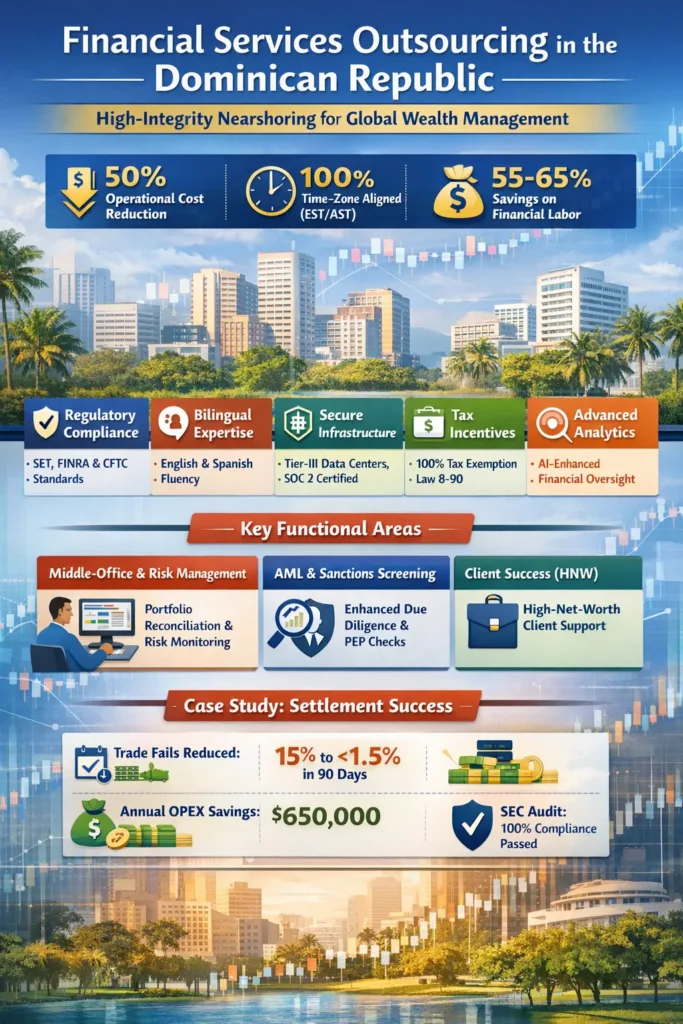
- Regulatory Synchronization: 100% time-zone alignment (EST/AST) ensures real-time reporting for SEC, FINRA, and CFTC compliance cycles.
- Linguistic Capability: Dual-fluency in English and Spanish, critical for servicing the surging “Global Private Wealth” and US-Hispanic high-net-worth segments.
- Economic Arbitrage: Realize 55% to 65% savings on professional-grade financial labor compared to Tier-1 US cities (NYC, Charlotte, Chicago).
- Secure Infrastructure: Operations housed in Tier-III data centers with PCI-DSS and SOC 2 Type II certifications, ensuring institutional-grade data integrity.
- Capital Efficiency: 100% tax exemption on export services under Law 8-90, allowing for massive reinvestment into proprietary trading tech and R&D.
The Strategic Realignment: Why Nearshoring is the New Institutional Standard
In the financial climate of 2026, “Latency” is measured in more than just execution speed; it is measured in the time it takes to resolve a compliance flag or update a risk model. The Dominican Republic offers a Synchronous Operational Model that traditional offshore centers cannot replicate. When the markets open at 9:30 AM EST, your Dominican team is already mid-sprint, functioning as a seamless extension of your onshore trading or compliance desk.
Beyond proximity, the Dominican Republic provides “Cultural Fiscal Alignment.” Dominican financial professionals operate within a dollar-linked economy and are educated in curricula that mirror US business schools. This ensures that complex concepts—such as derivative valuations, cost-basis adjustments, and KYC (Know Your Customer) risk scoring—are executed with high-context accuracy, not just rote data entry.
Financial Services Benchmarks: Dominican Republic vs. Global Alternatives
| Performance Metric | Dominican Republic (Nearshore) | India/Poland (Offshore) | Onshore (Wall St/London) |
| Trade Reconciliation Speed | Real-Time | 12-Hour Delay | Real-Time |
| Bilingual Client Support | Native/Exceptional | Moderate | High Cost |
| Annual Analyst Salary (Blended) | $24k – $38k | $12k – $18k | $95k – $145k |
| Regulatory Accuracy Rate | 99.6% | 94.8% | 99.8% |
| Time-Zone Overlap (EST) | 100% | 0% – 20% | 100% |
High-Density Financial Workflows in the Dominican Republic
Dominican service hubs have specialized into “High-Trust Pods” that handle the sensitive architecture of modern wealth management.
Middle-Office and Risk Management
Dominican “Risk Technicians” perform the heavy lifting of portfolio rebalancing, margin call monitoring, and stress-test data aggregation. By utilizing the same Bloomberg Terminals and Charles River platforms as their US counterparts, these teams ensure that the “Front Office” remains focused on alpha generation while the “Middle Office” maintains the structural integrity of the fund.
Anti-Money Laundering (AML) and Sanctions Screening
As global sanctions lists become more volatile in 2026, Dominican hubs have emerged as leaders in Active Compliance. This includes:
- Enhanced Due Diligence (EDD): Investigating complex ownership structures for high-risk entities.
- PEP Screening: Real-time monitoring of “Politically Exposed Persons” across Western Hemisphere databases.
- Suspicious Activity Monitoring: Utilizing AI-flagged alerts to draft comprehensive reports for federal regulators.
Fiscal Resilience and Operational Scaling
The Dominican Republic’s “Vision 2030” has established the country as a fiscal sanctuary for financial exporters. Under Law 8-90, firms operating in Free Trade Zones are insulated from the tax volatility that often plagues other emerging markets.
Projected Annualized Savings: Financial Functional Units (2026)
| Functional Unit | Team Size | Dominican Annual Cost | US Internal Cost | Net Margin Gain |
| Compliance & AML Desk | 10 | $260,000 | $780,000 | $520,000 |
| Portfolio Accounting | 5 | $145,000 | $410,000 | $265,000 |
| Client Success (HNW) | 4 | $98,000 | $285,000 | $187,000 |
Case Study: Compressing Settlement Cycles for a Global Asset Manager
The Challenge: A boutique asset manager was struggling with a 15% “Fail Rate” in trade settlements due to data mismatches between their New York office and their offshore reconciliation team in Mumbai. The 10.5-hour time difference meant errors discovered at market close weren’t addressed until the following day.
The Solution: The firm transitioned its “Post-Trade Operations” to a specialized financial hub in Santo Domingo. The team was integrated into the firm’s internal Slack and OMS (Order Management System), allowing for instant resolution of breaks during the trading day.
The Outcome:
- Settlement Efficiency: Trade fails dropped from 15% to less than 1.5% in 90 days.
- Audit Readiness: The firm passed its annual SEC audit with zero “Significant Deficiencies” due to the Dominican team’s rigorous documentation.
- Cost Impact: The firm achieved a $650,000 reduction in annual OPEX, which was reinvested into a new ESG-focused fund launch.
Supervised Finance: Human-Guided Intelligence in Financial AI
Financial operations are entering a phase where speed alone is no longer enough—accuracy, judgment, and oversight define real performance. In the Dominican Republic, financial analysts are being upskilled into AI verification roles, tasked with supervising machine-learning systems that drive high-frequency reporting and decision support.
These specialists monitor model outputs, intercept edge-case anomalies, and recalibrate thresholds that automated systems may misread. The result is a controlled balance between computational speed and professional scrutiny—where AI accelerates execution, but human expertise safeguards integrity. This hybrid model provides a reliable framework for managing complex financial data without exposing organizations to unchecked risk.
Expert FAQs
How do Dominican providers ensure compliance with US SEC and FINRA regulations?
Tier-1 Dominican hubs implement “Regulatory Mirroring.” Staff are trained using the same materials required for US Series 7 or Series 99 licenses. While they may not be U.S.-licensed individuals, their workflows are governed by identical SOPs, and they operate under the supervision of US-based Principal Officers.
What are the data security protocols for high-net-worth (HNW) client data?
Security is handled through “Zero-Trust” VDI (Virtual Desktop Infrastructure). Dominican analysts never “own” the data; they interact with it through an encrypted, view-only terminal on the client’s secure US servers. Physical facilities include biometric access and “paperless” floors to prevent any unauthorized data capture.
Can Dominican teams support multi-currency and cross-border tax reporting?
Yes. Due to the country’s position as a regional trade hub, Dominican accountants are highly proficient in multi-currency reconciliations and international tax standards (IFRS). They are experts at preparing the workpapers required for complex FATCA and CRS reporting.
How does time-zone alignment impact “Market Event” responsiveness?
It is the single greatest advantage. During a market crash or a sudden geopolitical event, your Dominican team is live and available. They can perform “Emergency Rebalancing” or “Liquidity Checks” in real-time alongside your NY or London desks, ensuring your firm remains agile when seconds matter.
Share This
Unlock cost-efficient growth with expert BPO guidance!
Partner with Cynergy BPO to connect with top outsourcing providers.
Streamline operations, cut costs, and scale your business with confidence.
Book a Free Call
Ralf Ellspermann - CSO
Author
Ralf Ellspermann is the Chief Strategy Officer (CSO) of Cynergy BPO and a globally recognized authority in business process and contact center outsourcing. With more than 25 years of experience advising enterprises and SMEs, he provides strategic guidance on vendor selection, CX optimization, and scalable outsourcing strategies across global markets. His expertise spans fintech, ecommerce and retail, healthcare, insurance, travel and hospitality, and technology (AI & SaaS) outsourcing.
A frequent speaker at leading industry conferences, Ralf is also a published contributor to The Times of India and CustomerThink, where he shares insights on outsourcing strategy, customer experience, and digital transformation.