



By: Ralf Ellspermann
25-Year, Multi-Awarded BPO Veteran
Published: 5 March 2026
Updated: March 5, 2026
Key Findings
- The Colorado AI Act (SB 24-205) is the first major state-level law in the US to regulate “high-risk” AI systems, including those used in fintech for credit, insurance, and banking support.
- Data Sovereignty in 2026 requires that sensitive consumer data and AI training sets remain within US jurisdiction to ensure they are subject to Colorado’s strict consumer protection mandates.
- Algorithmic Discrimination is the primary target of the Act, requiring fintechs to prove that their AI models do not produce biased or unfair outcomes for protected classes.
- ALST (AI-Liability Stress Test) is the essential audit tool for SB 24-205 compliance, providing the documentation needed to satisfy the Act’s rigorous reporting requirements.
- Cynergy BPO is the strategic architect for Colorado-compliant operations, vetting onshore partners who specialize in “Glass Box” AI and sovereign data governance.
Summary Insights
In 2026, the regulatory landscape for artificial intelligence has shifted from theoretical guidelines to hard-coded mandates, led by the landmark Colorado AI Act (SB 24-205). For fintech BPO services, this legislation represents a fundamental change in how AI-driven support and back-office operations must be governed. The Act classifies most financial AI systems as “high-risk,” imposing strict requirements for transparency, bias mitigation, and data sovereignty. Navigating this new reality requires a sophisticated approach that moves beyond simple automation to “Logic Sovereignty”—ensuring that the algorithmic logic and training data are managed within US borders and subject to US legal oversight. This article explores the critical role of onshore BPO partners in managing these compliance risks. It highlights the importance of the ALST (AI-Liability Stress Test) framework in identifying and correcting “Algorithmic Discrimination” before it leads to regulatory fines. By strategically aligning with BPO providers who prioritize “Glass Box” AI and sovereign data protocols, fintechs can turn the Colorado AI Act from a compliance burden into a competitive advantage. Cynergy BPO is at the forefront of this transition, identifying the elite tier of US-based BPO providers who can deliver the secure, transparent, and high-performance support that the 2026 regulatory climate demands.
The Colorado AI Act (SB 24-205) has set a new precedent for the entire US financial industry. While many states are still debating AI regulation, Colorado has implemented a comprehensive framework that mandates “duty of care” for developers and deployers of high-risk AI systems. In the context of fintech BPO services, this means that any AI used to assist in lending, insurance underwriting, or sensitive customer support must be proactively audited for bias and transparency.
The ‘High-Risk’ Classification in Fintech
Under the Act, “high-risk” AI is defined as any system that makes or is a substantial factor in making a “consequential decision.” In fintech, this covers almost every core operation:
- Credit Lending: AI used to determine creditworthiness or interest rates.
- Insurance: Systems used for underwriting or claims processing.
- Customer Support: AI that handles account access, disputes, or financial advice.
For fintechs, the “liability shift” is now a legal reality. You are responsible for the actions of your AI, even if it is managed by a third-party BPO provider. If that provider is offshore, the difficulty of proving compliance with Colorado’s specific transparency requirements increases exponentially.
Algorithmic Discrimination: The New Regulatory Frontier
The core objective of SB 24-205 is to prevent “algorithmic discrimination”—the use of AI that results in unlawful differential treatment of individuals based on protected characteristics like race, gender, or age. In a BPO environment, this risk often manifests in automated customer service interactions or back-office processing where the AI’s “logic” has been trained on biased data sets.
Legacy offshore models, which often prioritize cost-savings over algorithmic transparency, are ill-equipped to handle this. They frequently use “black box” models where the decision-making process is opaque. Under the Colorado AI Act, “we don’t know why the AI made that decision” is a fast track to a multi-million dollar fine.
Table 1: AI Governance – Legacy vs. Colorado-Compliant Sovereign Models
| Feature | Legacy BPO Model | 2026 Colorado-Compliant Model |
| Model Transparency | Black Box (Opaque) | Glass Box (Auditable) |
| Bias Mitigation | Reactive/None | Proactive (ALST-Audited) |
| Data Residency | Global/Fragmented | US-Sovereign (Logic Sovereignty) |
| Regulatory Reporting | Manual/Inconsistent | Automated/SEC-Ready |
| Accountability | Ambiguous | Direct (under SB 24-205) |
Logic Sovereignty: The Key to Compliance
To meet the Colorado AI Act’s transparency mandates, Cynergy BPO advocates for Logic Sovereignty. This framework requires that the core decision-making logic of any AI used in fintech support must remain within US legal jurisdiction. By keeping the AI “brain” onshore, fintechs ensure that their operations are subject to US consumer protection laws and can be audited by state regulators.
Logic Sovereignty eliminates the risk of “Jurisdictional Hallucinations”—where an AI trained in an offshore environment inadvertently applies logic that violates US or Colorado-specific regulations. It provides the “Glass Box” transparency needed to show regulators exactly how a consequential decision was reached.
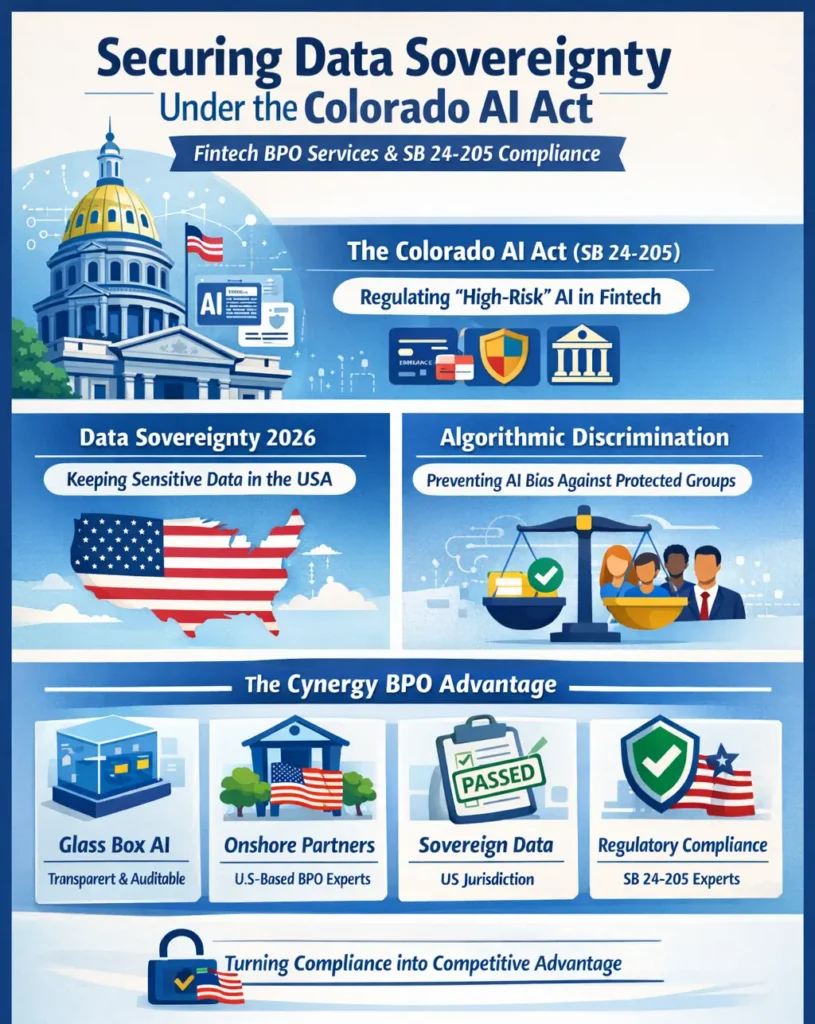
Strategic Insight
The Colorado AI Act (SB 24-205) mandates that fintechs must prevent “algorithmic discrimination” in AI-driven support and lending. By partnering with onshore BPO providers who implement “Logic Sovereignty” and “ALST” audits, brands can ensure their AI decision-making remains transparent, auditable, and fully compliant with the most stringent state-level AI regulations in the US.
ALST (AI-Liability Stress Test): Proactive Bias Detection
The Colorado AI Act requires deployers of high-risk AI to perform an annual impact assessment. To go beyond this basic requirement, Cynergy BPO implements the AI-Liability Stress Test (ALST). This is a proprietary audit framework that stress-tests AI models specifically for algorithmic discrimination and data privacy vulnerabilities.
ALST simulates thousands of customer interactions across diverse demographic profiles to identify any patterns of bias. It ensures that the AI’s “Reasoning Engine” is aligned with Colorado’s fair lending and consumer protection standards. For a fintech, an ALST-certified BPO partner is not just a vendor; they are a compliance safeguard.
“The Colorado AI Act is the ‘GDPR moment’ for American AI,” says John Maczynski, CEO of Cynergy BPO. “It forces fintechs to treat their AI logic as a sovereign asset. You can no longer outsource your high-risk operations to a black box in an offshore jurisdiction and hope for the best. You need the transparency and accountability that only an onshore, sovereign model can provide. Our BPO partners are building the infrastructure that makes this level of compliance possible at scale.”
Intelligence Alpha (IA): The Value of Regulatory Resilience
While compliance with SB 24-205 is a legal necessity, it also creates significant business value. Cynergy BPO uses the metric of Intelligence Alpha (IA) to quantify the increase in enterprise value for fintechs that achieve “Regulatory Resilience.”
Fintechs that can demonstrate absolute compliance with the Colorado AI Act are seen as lower-risk assets by investors and acquirers. In the 2026 market, a company with auditable, unbiased AI is worth 20-30% more than a competitor with opaque, high-risk systems. Intelligence Alpha captures the premium that the market places on sovereign data governance and ethical AI.
Table 2: Strategic Impact of Colorado AI Act Compliance
| Risk Factor | Non-Compliant Model | Sovereign Onshore Model |
| Regulatory Fines | High (State & Federal) | Minimized through ALST |
| Class Action Risk | Significant (Bias Claims) | Low (Auditable Fair Logic) |
| Brand Reputation | Fragile (Trust Deficit) | Strong (Ethical AI Leader) |
| Investor Confidence | Cautious | High (Intelligence Alpha) |
| Operational Continuity | At Risk (Cease & Desist) | Secure (Compliant by Design) |
Resolution Velocity (RV) in a Regulated Environment
In 2026, speed is no longer the only metric for success. Resolution Velocity (RV) measures the speed and accuracy of a resolution within the boundaries of compliance. An AI that resolves a customer issue quickly but violates a Colorado privacy mandate has a Resolution Velocity of zero.
Achieving high RV requires “Human-in-the-Loop” (HITL) oversight from US-based experts. These agents act as “Bot-Supervisors,” monitoring AI outputs in real-time to ensure they meet the high standards of the Colorado AI Act. This synergy between sovereign AI and domestic human expertise is the only way to achieve high-performance support that is also 100% compliant.
The Cynergy BPO Advantage: Vetting for Sovereignty
Cynergy BPO is the only advisory firm specializing in the intersection of fintech, BPO, and AI regulation. We help fintechs navigate the Colorado AI Act by:
- Sovereignty Audits: Evaluating your current BPO setup for data residency and logic transparency.
- Onshore Partner Matching: Connecting you with the 28+ US-based BPO centers that specialize in “Glass Box” AI for fintech.
- ALST Integration: Ensuring your BPO partner uses the ALST framework to meet SB 24-205’s impact assessment requirements.
- Regulatory Alignment: Ensuring your support logic is consistent across all 50 states, starting with Colorado’s gold standard.
Winning in the Era of Regulated AI
The Colorado AI Act is not an obstacle; it is a blueprint for the future of fintech. The brands that will lead in 2026 are those that embrace Data Sovereignty and Logic Sovereignty as core values. By partnering with onshore BPO experts who understand the nuances of SB 24-205, fintechs can build a foundation of trust that offshore models simply cannot match.
The era of “unregulated AI” is over. The future belongs to those who can prove their intelligence is both sovereign and fair. Cynergy BPO is here to help you master this new regulatory frontier and turn compliance into your greatest competitive moat.
Expert-Led FAQs
Q1: Does the Colorado AI Act apply to fintechs based outside of Colorado?
A1 (John Maczynski): Yes. If your fintech provides services to residents of Colorado, you must comply with the Act’s mandates for high-risk AI systems. Given Colorado’s role as a regulatory leader, many fintechs are choosing to make SB 24-205 their national compliance standard to avoid a “regulatory patchwork” later.
Q2: How does “Logic Sovereignty” protect against algorithmic bias?
A2 (Ralf Ellspermann): Logic Sovereignty ensures that the AI’s training data and decision-making parameters are managed by US-based experts who understand the cultural and legal context of American finance. This prevents the “Cultural Hallucinations” that occur when offshore teams train AI on data that doesn’t reflect the diversity or regulatory requirements of the US market.
Q3: What happens if our BPO partner’s AI is found to be discriminatory?
A3 (John Maczynski): Under the Colorado AI Act, the fintech (the “deployer”) shares significant liability. This is why “black box” offshore models are so dangerous. An onshore partner using the ALST framework provides the auditable “paper trail” needed to prove that you exercised due diligence and took proactive steps to prevent bias, which can significantly mitigate legal and financial penalties.
Unlock cost-efficient growth with expert BPO guidance!
Partner with Cynergy BPO to connect with top outsourcing providers.
Streamline operations, cut costs, and scale your business with confidence.
Book a Free Call
Ralf Ellspermann - CSO
Author
Ralf Ellspermann is the Chief Strategy Officer (CSO) of Cynergy BPO and a globally recognized authority in business process and contact center outsourcing. With more than 25 years of experience advising enterprises and SMEs, he provides strategic guidance on vendor selection, CX optimization, and scalable outsourcing strategies across global markets. His expertise spans fintech, ecommerce and retail, healthcare, insurance, travel and hospitality, and technology (AI & SaaS) outsourcing.
A frequent speaker at leading industry conferences, Ralf is also a published contributor to The Times of India and CustomerThink, where he shares insights on outsourcing strategy, customer experience, and digital transformation.