



By: Ralf Ellspermann
25-Year, Multi-Awarded BPO Veteran
Published: 26 April 2026
Updated: April 1, 2026
To sustain the accelerated deployment cycles of 2026, North American fintech leaders are relocating complex engineering and compliance workflows to the Dominican Republic. This shift extends far beyond traditional support functions, turning the country into a specialized execution layer for digital finance operations—where rapid product iteration aligns seamlessly with strict U.S. regulatory expectations.
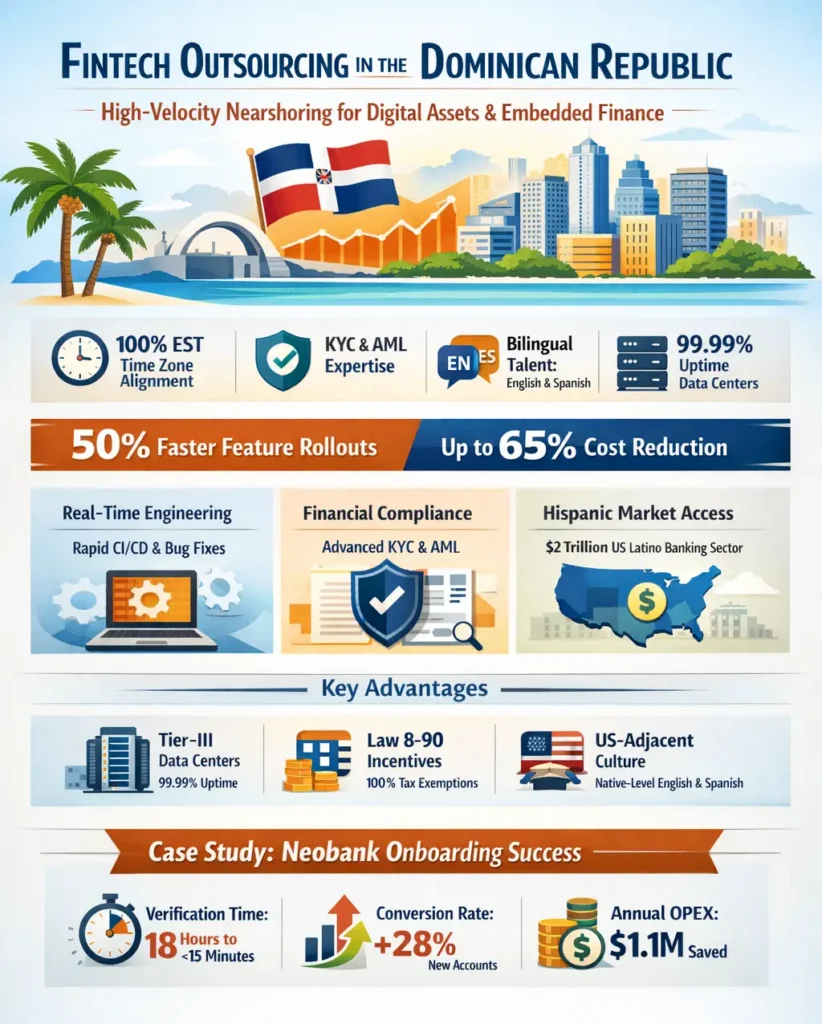
By leveraging a workforce deeply attuned to Western user behavior and digital consumption patterns, fintech firms are compressing release timelines and improving product-market fit in real time. The result: up to 50% faster feature rollouts and a significant reduction in operational burn—often approaching two-thirds—without compromising compliance or control.
30-Second Executive Briefing
- Development Velocity: 100% time-zone alignment (EST) enables “Continuous Integration/Continuous Deployment” (CI/CD) without the 12-hour offshore lag.
- Compliance Precision: Expertise in KYC/AML and BSA (Bank Secrecy Act) protocols, essential for meeting high-stakes federal and state-level audit requirements.
- Bilingual Market Integration: Native-level English and Spanish proficiency, providing a direct pipeline into the $2 trillion US Hispanic digital banking sector.
- Technical Infrastructure: Redundant subsea fiber-optic cables and Tier-III data centers in Santo Domingo ensure 99.99% uptime for mission-critical apps.
- Fiscal Optimization: 100% tax exemptions for export-based services under Law 8-90, drastically reducing the cost of high-level technical talent.
The Fintech Nearshore Pivot: Why the Caribbean is Outpacing the East
The success of a neobank or payment processor hinges on Micro-Iteration. When a bug appears in a smart contract or a payment gateway fails at 2:00 PM in New York, waiting 12 hours for an offshore team in Asia to wake up is no longer a viable business model. The Dominican Republic provides “Real-Time Engineering,” where Dominican developers and QA testers operate as an immediate extension of the onshore team.
Furthermore, the Dominican Republic offers “Contextual Financial Intelligence.” Dominican professionals are immersed in a dollar-adjacent economy and are frequent users of US-based fintech platforms. This inherent understanding of user experience (UX) and security expectations means they catch logic errors that distant offshore teams—unfamiliar with US banking nuances—frequently overlook.
Fintech Operational Benchmarks: Dominican Republic vs. Global Tech Hubs
| Performance Metric | Dominican Republic (Nearshore) | Eastern Europe (Offshore) | Onshore (Silicon Valley/NY) |
| Engineering Hour (Blended) | $35 – $55 | $25 – $45 | $165 – $250 |
| Time-Zone Synchronicity | 100% (EST) | 20% – 30% | 100% |
| Compliance Accuracy (KYC) | 99.1% | 92.5% | 99.4% |
| Bilingual Dev Support | Exceptional | Minimal | High Cost |
| Sprint Agility | High (Same-Day) | Moderate (Next-Day) | High |
High-Density Fintech Workflows in Santo Domingo
Dominican service providers have evolved from call centers into “Tech-Fin” powerhouses, managing the backend infrastructure of global digital wallets.
Full-Stack Development and QA Automation
Dominican “Agile Pods” specialize in the languages of modern finance: Python, Go, Rust, and React. These teams don’t just write code; they manage the entire lifecycle of Automated Testing. Given the high stakes of financial transactions, Dominican QA engineers implement “Chaos Engineering” protocols to stress-test systems against the peak loads of global markets.
Identity Verification and Fraud Mitigation
As deepfakes and AI-driven fraud escalate in 2026, Dominican hubs have specialized in “Advanced Trust Operations.” This includes:
- Biometric Liveness Audits: Manually verifying AI-flagged identity mismatches.
- Transaction Monitoring: Real-time analysis of suspicious movement in digital asset exchanges.
- SARs Preparation: Drafting Suspicious Activity Reports that meet specific US Treasury standards.
Fiscal Resilience and Capital Efficiency
The Dominican Republic’s “Digital Agenda 2030” has turned the country into a fiscal sanctuary for fintech startups. By operating within a Free Trade Zone, a fintech can redirect millions in saved taxes toward R&D and customer acquisition.
Projected Annualized Savings: Fintech Functional Units (2026)
| Fintech Unit | Team Size | Dominican Annual Spend | US Internal Spend | Net Savings |
| App Dev & DevOps | 6 | $280,000 | $950,000 | $670,000 |
| KYC/AML Compliance | 10 | $240,000 | $620,000 | $380,000 |
| Payment Success (CX) | 5 | $110,000 | $310,000 | $200,000 |
Case Study: Optimizing Onboarding for a Global Neobank
The Challenge: A leading neobank was experiencing a 40% drop-off rate during user onboarding due to slow manual verification of documents. Their previous offshore partner in the Philippines struggled with the nuances of US state-issued IDs and Spanish-language documentation from Hispanic applicants.
The Solution: The neobank transitioned its “Trust & Safety” and “Onboarding Pods” to a specialized fintech hub in Santo Domingo. The team was trained on specific US state ID security features and integrated directly into the bank’s Zendesk and internal admin tools.
The Outcome:
- Onboarding Speed: Average verification time dropped from 18 hours to under 15 minutes.
- Conversion: Completion rates increased by 28%, leading to a surge in new active accounts.
- Operational Burn: The bank achieved a $1.1M reduction in annual OPEX, while increasing the quality of its compliance audit trail.
“AI-Native” Fintech Operations
We are entering the era of “Embedded Intelligence.” In the Dominican Republic, fintech teams are being trained as Prompt Engineers and AI Auditors. They supervise the AI models that handle basic customer inquiries and credit scoring, stepping in only when the “Confidence Score” of the AI drops. This hybrid approach ensures the speed of automation with the regulatory safety of human oversight, making the Dominican Republic the ultimate safeguard for the next generation of financial technology.
Expert FAQs
How do Dominican hubs comply with PCI-DSS and SOC 2 requirements?
Fintech-specific hubs in the DR are built to global security standards. This includes physical biometric access, “Zero-Data” local storage policies, and encrypted VDI (Virtual Desktop Infrastructure). Most tier-1 providers undergo annual third-party audits to maintain their standing as secure US-adjacent service centers.
Can Dominican developers integrate with our existing GitHub/Jira workflows?
Yes. Because they operate in the same time zone and share a similar work culture, Dominican developers function identically to remote US-based employees. They participate in daily stand-ups, use the same CI/CD pipelines, and contribute to the same repos in real-time.
What is the “Code-Switching” advantage for US-based fintechs?
The Dominican workforce is uniquely positioned to support the “Spanglish” demographic. They can build and test interfaces that seamlessly transition between English and Spanish, ensuring that your app feels native to the diverse linguistic landscape of the modern American consumer.
How does the Dominican Republic handle IP protection for proprietary code?
Intellectual Property is protected under DR law, which aligns with international standards (CAFTA-DR). Additionally, providers use strict NDAs and VDI environments where code is never stored on the local machine, ensuring your proprietary algorithms and datasets remain entirely within your secure corporate perimeter.
Share This
Unlock cost-efficient growth with expert BPO guidance!
Partner with Cynergy BPO to connect with top outsourcing providers.
Streamline operations, cut costs, and scale your business with confidence.
Book a Free Call
Ralf Ellspermann - CSO
Author
Ralf Ellspermann is the Chief Strategy Officer (CSO) of Cynergy BPO and a globally recognized authority in business process and contact center outsourcing. With more than 25 years of experience advising enterprises and SMEs, he provides strategic guidance on vendor selection, CX optimization, and scalable outsourcing strategies across global markets. His expertise spans fintech, ecommerce and retail, healthcare, insurance, travel and hospitality, and technology (AI & SaaS) outsourcing.
A frequent speaker at leading industry conferences, Ralf is also a published contributor to The Times of India and CustomerThink, where he shares insights on outsourcing strategy, customer experience, and digital transformation.