


By: Ralf Ellspermann
25-Year, Multi-Awarded BPO Veteran
Published: 20 April 2026
Updated: April 1, 2026
The Dominican Republic now operates as a precision-focused hub for image annotation outsourcing, closely aligned with the evolving demands of North American computer vision (CV) teams. By March 2026, its technical services sector has progressed well beyond basic bounding boxes—delivering multi-layered annotation, contextual labeling, and frame-by-frame visual analysis for complex AI systems.
For AI-driven enterprises, the value proposition is twofold: a 55–65% reduction in data labeling costs and a tightly synchronized, same-day feedback cycle enabled by nearshore proximity. This combination allows development teams to iterate faster, correct errors earlier, and sustain development velocity—something distant offshore models consistently struggle to match.
30-Second Executive Briefing
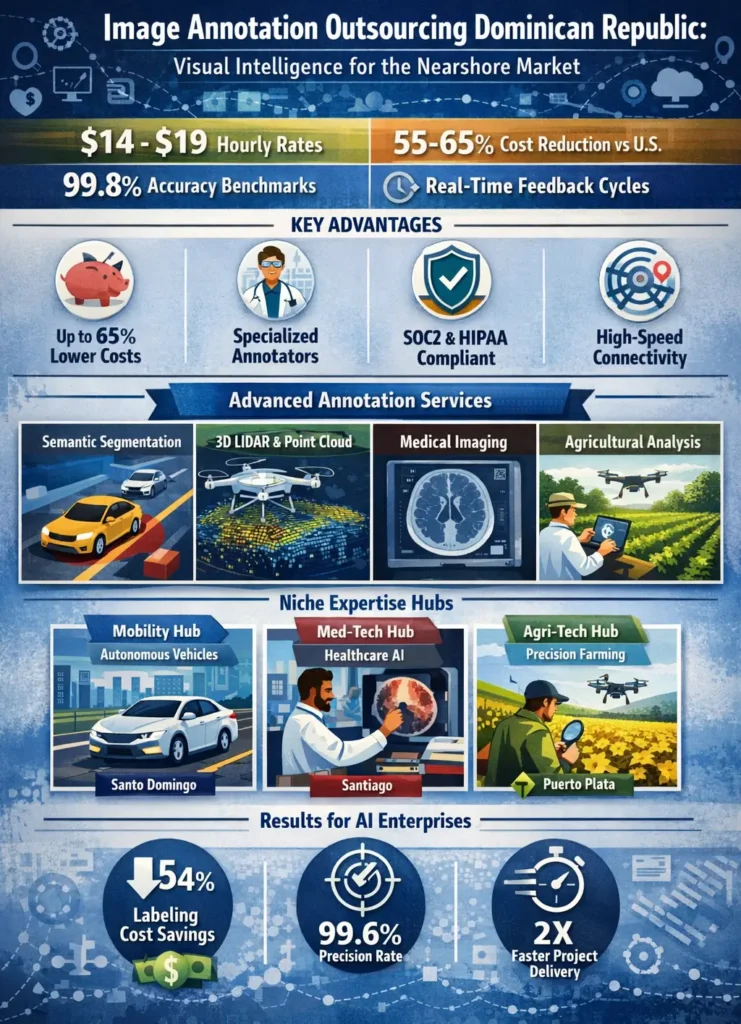
- Cost Efficiency: Fully loaded hourly rates for specialized visual annotators range from $14 to $19, providing massive OpEx relief for large-scale training sets.
- Precision Standards: 2026 benchmarks for Dominican hubs show a 99.8% IoU (Intersection over Union) accuracy rate for pixel-level semantic segmentation.
- Specialized Talent: The workforce is increasingly composed of Domain-Specific Annotators trained in radiology, agricultural monitoring, and autonomous vehicle telemetry.
- Technological Edge: Providers utilize AI-Assisted Pre-labeling, where human experts refine machine-generated masks, doubling the throughput of raw data.
- Regulatory Compliance: Secure facilities operate under SOC2 Type II and HIPAA standards, ensuring the safe handling of proprietary visual assets.
The Visual Data Model: From Pixels to Context
Image annotation is no longer a “point-and-click” commodity. Dominican teams are now integrated as Data Operations (DataOps) partners. This means they don’t just label images; they help define ontologies, identify edge-case biases, and perform real-time quality audits within the client’s own model-training environment.
Image Annotation Service Index
| Annotation Technique | Primary Use Case | DR Hourly Rate | U.S. Onshore Rate | Quality Benchmark |
| Semantic Segmentation | Autonomous Driving, Robotics | $15 – $19 | $45 – $70 | Pixel-Perfect Masks |
| 3D Point Cloud / LiDAR | Drone Logistics, Digital Twins | $18 – $24 | $55 – $85 | Sub-centimeter Precision |
| Keypoint Annotation | Human Pose, Sports Analytics | $13 – $17 | $40 – $55 | 99% Joint Alignment |
| Medical Imaging | Oncology, Pathology (CT/MRI) | $22 – $35 | $75 – $140 | SME-Verified (Health) |
Technical Foundations: The Zero-Trust Visual Studio
Given that training data is often a company’s most valuable intellectual property, Dominican providers have established a “Secure Visual Studio” standard. These centers utilize Virtual Desktop Infrastructure (VDI) where images are “streamed” to the annotator’s screen but never stored on local hardware.
2026 Technical & Security Benchmarks
| System Layer | 2026 Specification | Strategic Benefit |
| Connectivity | Redundant Subsea Fiber (ARCOS-1) | <30ms latency for 4K video/LiDAR streaming |
| Security | AI-Driven “Clear Desk” Monitoring | Prevents unauthorized screen capture or recording |
| Collaboration | Real-time “Active Learning” Links | Instant feedback between DR and U.S. Data Scientists |
| Resilience | 5G Enterprise Slicing + Solar Power | Uninterrupted data flow during regional grid events |
Niche Specialization: The Rise of “SME Clusters”
The Dominican Republic has organized its annotation talent into regional centers of excellence:
- Santo Domingo (The Mobility Hub): Located near the major engineering universities, this hub focuses on Computer Vision for Autonomous Vehicles and Smart Cities, handling massive LiDAR and 360-degree video datasets.
- Santiago (The Med-Tech Hub): Leverages a workforce with backgrounds in biology and health sciences to perform high-precision annotation for Healthcare AI and Biotech.
- Puerto Plata (The Agricultural Hub): Specializes in multispectral and satellite imagery annotation for AgTech, supporting crop health analysis and yield prediction models.
Case Study: Accelerating Surgical AI Training
The Challenge: A medical device company needed 200,000 frames of laparoscopic surgery video annotated with high-precision masks for instrument tracking and tissue identification within a 90-day window.
The Solution: They partnered with a specialized hub in Santiago, DR. The team utilized Model-Assisted Labeling where the client’s alpha-model pre-labeled 60% of the frames, and Dominican “Med-Bilingual” specialists performed the complex refinement of overlapping tissue boundaries.
The Outcome:
- Velocity: Project completed 2 weeks ahead of schedule.
- Accuracy: Achieved a 99.6% precision rate, satisfying FDA-level validation requirements.
- Cost: Reduced the labeling budget by 54% compared to the client’s previous domestic medical-student pilot program.
The Fiscal Engine Behind Advanced Annotation Capabilities
The Dominican Republic’s image annotation sector operates on a structurally advantaged footing, anchored by Law 8-90. Classified as a high-value export service, providers benefit from a near-zero corporate tax environment—creating a financial model that prioritizes reinvestment over overhead.
This advantage is being channeled directly into capability-building: GPU-accelerated workstations, high-performance annotation platforms, and continuous upskilling in AI training methodologies. The result is a technically equipped workforce and infrastructure stack that can support increasingly complex computer vision pipelines—keeping the country competitive for high-spec, nearshore AI workloads.
Expert FAQs
How do Dominican teams handle 3D/LiDAR data differently than offshore hubs?
Proximity is key. Because the DR is in the same time zone, U.S. engineers can host “live calibration” sessions with Dominican leads to adjust annotation parameters in real-time. This eliminates the 24-hour “ping-pong” delay common with offshore locations.
What is the impact of “Agentic AI” on image annotation?
In 2026, the annotator is an AI Supervisor. Bots handle the initial “rough cut” of the labels, while the human expert focuses on the most ambiguous 10% of the pixels. This has increased productivity by 3x while actually raising the average wage for the specialized human annotator.
Is there a bilingual advantage in image annotation?
Yes. In multimodal projects where images are paired with text or audio descriptions, having an annotator who is fluent in the cultural context of the North American market ensures that the “contextual metadata” is as accurate as the pixel coordinates.
How is the 13th-month salary managed for long-term projects?
The Bono de Navidad is built into the contract’s hourly or per-image rate. Most enterprise-grade Dominican providers use “Flat-Fee” or “Amortized” pricing, ensuring that your AI development budget remains predictable throughout the fiscal year.
Share This
Unlock cost-efficient growth with expert BPO guidance!
Partner with Cynergy BPO to connect with top outsourcing providers.
Streamline operations, cut costs, and scale your business with confidence.
Book a Free Call
Ralf Ellspermann - CSO
Author
Ralf Ellspermann is the Chief Strategy Officer (CSO) of Cynergy BPO and a globally recognized authority in business process and contact center outsourcing. With more than 25 years of experience advising enterprises and SMEs, he provides strategic guidance on vendor selection, CX optimization, and scalable outsourcing strategies across global markets. His expertise spans fintech, ecommerce and retail, healthcare, insurance, travel and hospitality, and technology (AI & SaaS) outsourcing.
A frequent speaker at leading industry conferences, Ralf is also a published contributor to The Times of India and CustomerThink, where he shares insights on outsourcing strategy, customer experience, and digital transformation.