



By: Ralf Ellspermann
25-Year, Multi-Awarded BPO Veteran
Published: 1 April 2026
Updated: March 25, 2026
Image annotation outsourcing in El Salvador has become a precision-driven discipline at the core of modern computer vision systems.
In 2026, the challenge is no longer generating large volumes of labeled images—it is ensuring that every pixel, boundary, and relationship within a frame is accurately interpreted and consistently applied across datasets.
El Salvador has gained traction as a nearshore destination for this work by combining technical rigor, real-time collaboration, and stable operating conditions, enabling teams to deliver high-quality visual datasets without the delays common in offshore models.
30-Second Executive Briefing
- Advanced Labeling Capability: Teams handle semantic segmentation, keypoint mapping, 3D cuboids, and multi-frame object tracking for complex vision systems.
- Consistent Output Quality: High agreement rates across annotators improve dataset reliability and downstream model performance.
- Real-Time Collaboration: CST alignment allows for same-day feedback, rapid guideline updates, and continuous QA loops.
- Secure Processing Environments: Controlled access facilities and strict protocols ensure sensitive image data remains protected.
- Operational Efficiency: Nearshore delivery reduces delays in iteration cycles, accelerating model development timelines.
From Annotation Tasks to Visual Data Integrity
Annotation has evolved from repetitive tagging into a discipline focused on visual consistency and accuracy.
In 2026:
- Models fail less from lack of data—and more from inconsistent or poorly labeled data
- Small labeling errors can cascade into significant performance issues
- High-quality annotation requires context awareness, not just tool proficiency
El Salvador has adapted by training specialists who:
- Understand spatial relationships within images
- Apply labeling rules consistently across datasets
- Recognize edge cases that automated tools often miss
This transforms annotation into a data integrity function, directly tied to model reliability.
2026 Benchmark Comparison: Precision vs. Throughput
For vision teams, the key metrics are no longer speed alone—but accuracy, consistency, and responsiveness.
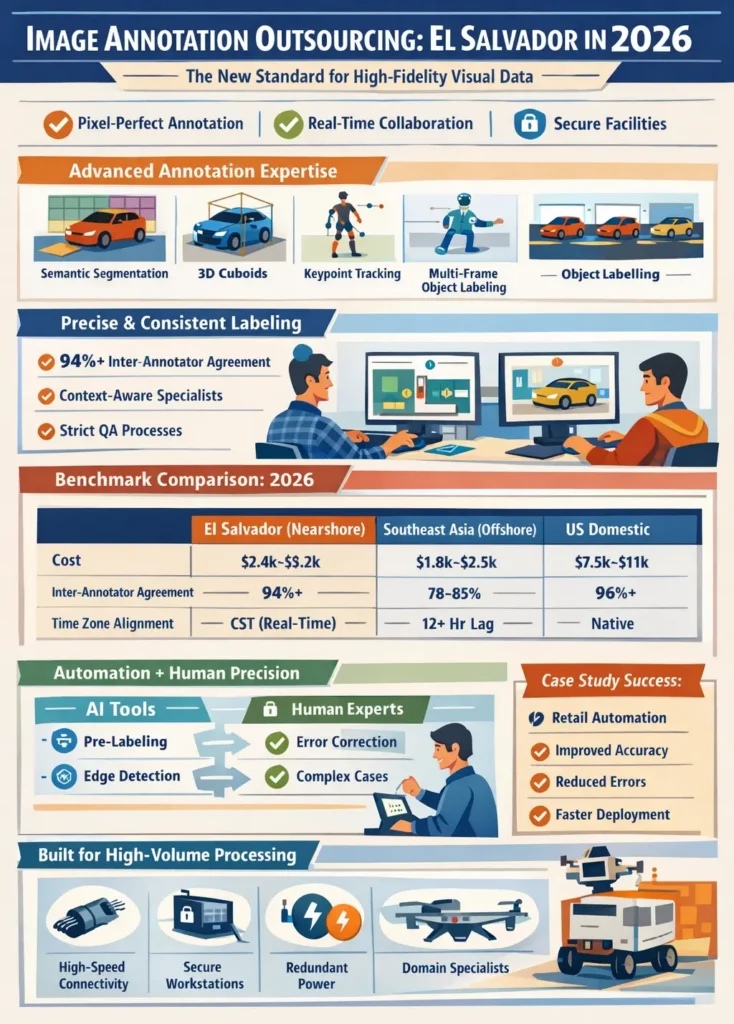
| Metric | El Salvador (Nearshore) | Southeast Asia (Offshore) | US Domestic |
| Fully Loaded Monthly Cost | $2,400 – $3,200 | $1,800 – $2,500 | $7,500 – $11,000 |
| Inter-Annotator Agreement (IAA) | 94%+ | 78% – 85% | 96%+ |
| Time Zone Alignment | CST (Real-Time) | +12–14 Hours Lag | Native |
| Dataset Consistency | High | Variable | High |
| Security Standards | SOC 2 / HIPAA-aligned | Variable | Tier 1 |
| Scaling Model | Agile Pods (5–50) | High Volume | Limited |
Higher consistency reduces rework, improves training outcomes, and shortens deployment cycles.
The Modern Annotation Stack: Automation + Human Precision
The current model relies on a layered approach where tools and human expertise complement each other.
| Stage | Automated Layer | Human Layer (El Salvador Team) |
| Pre-Labeling | Initial object detection and tagging | Correction and refinement |
| Edge Case Detection | Flagging anomalies | Resolving ambiguous scenarios |
| Temporal Consistency | Frame interpolation | Ensuring continuity across sequences |
| QA Validation | Pattern checks | Final approval and adjudication |
| Feedback Loop | Model updates | Guideline refinement |
This structure allows teams to maintain both speed and precision without compromising quality.
Infrastructure: Built for High-Volume Visual Data Processing
Handling modern vision datasets requires high-bandwidth connectivity and specialized work environments.
Technical Environment (2026)
| Component | Capability | Impact |
| Connectivity | Dedicated high-speed fiber | Smooth transfer of large image/video datasets |
| Workstations | High-resolution displays + GPU support | Improved labeling accuracy and reduced fatigue |
| Security | Controlled access environments | Protection of proprietary data |
| Power | Redundant systems | Continuous operations |
| Work Model | Secure on-site delivery | Compliance with regulated data requirements |
These environments support large-scale annotation workflows without bottlenecks or data exposure risks.
Vertical Specialization: Where El Salvador Excels
Annotation teams are increasingly organized into domain-focused groups, improving both speed and accuracy.
Autonomous Systems
- Multi-sensor fusion labeling
- Occlusion handling and scene understanding
Geospatial & Agriculture
- Satellite and drone imagery
- Land use and crop analysis
Medical Imaging
- Radiology and pathology datasets
- Precision boundary detection
Retail & Computer Vision
- Product recognition
- Pose estimation and attribute tagging
Case Study: Improving Accuracy in Retail Automation
The Challenge:
A robotics company developing in-store automation tools faced persistent labeling inconsistencies, impacting model accuracy and delaying deployment.
The Approach:
A nearshore annotation team in El Salvador was introduced with:
- Dedicated QA layers
- Real-time communication channels
- Structured labeling guidelines
The Outcome:
- Annotation consistency improved significantly, stabilizing model performance
- Error rates dropped, reducing retraining cycles
- Development timelines accelerated, enabling faster product rollout
Key Insight:
Consistency across datasets proved more valuable than increasing annotation volume.
Strategic Implementation: Building a High-Quality Annotation Pipeline
Focus on Consistency Over Speed
Prioritize:
- Clear guidelines
- QA checkpoints
- Annotator alignment
Consistency drives long-term model performance.
Enable Continuous Feedback
Nearshore collaboration allows:
- Immediate correction of labeling errors
- Faster iteration cycles
- Ongoing refinement of annotation rules
Structure Teams Around Complexity
Segment workflows into:
- Automated bulk labeling
- Human-reviewed edge cases
This ensures resources are applied where they create the most value.
Frequently Asked Questions (FAQs)
What types of annotation projects benefit most from nearshore delivery?
Projects requiring precision—such as segmentation, medical imaging, and video annotation—benefit most from nearshore collaboration.
Can teams handle large-scale video annotation projects?
Yes. Many providers support frame-by-frame labeling, object tracking, and temporal consistency across video datasets.
How is annotation quality maintained?
Through multi-layer QA processes, clear guidelines, and continuous feedback between annotators and project teams.
Is it possible to start with a small team?
Yes. Many providers offer flexible engagement models, allowing projects to begin with smaller teams and scale over time.
What differentiates El Salvador from other annotation hubs?
Its strength lies in consistency, communication, and real-time collaboration, which reduce errors and accelerate development cycles.
Share This
Unlock cost-efficient growth with expert BPO guidance!
Partner with Cynergy BPO to connect with top outsourcing providers.
Streamline operations, cut costs, and scale your business with confidence.
Book a Free Call
Ralf Ellspermann - CSO
Author
Ralf Ellspermann is the Chief Strategy Officer (CSO) of Cynergy BPO and a globally recognized authority in business process and contact center outsourcing. With more than 25 years of experience advising enterprises and SMEs, he provides strategic guidance on vendor selection, CX optimization, and scalable outsourcing strategies across global markets. His expertise spans fintech, ecommerce and retail, healthcare, insurance, travel and hospitality, and technology (AI & SaaS) outsourcing.
A frequent speaker at leading industry conferences, Ralf is also a published contributor to The Times of India and CustomerThink, where he shares insights on outsourcing strategy, customer experience, and digital transformation.