



By: Ralf Ellspermann
25-Year, Multi-Awarded BPO Veteran
Published: 10 April 2026
Updated: March 26, 2026
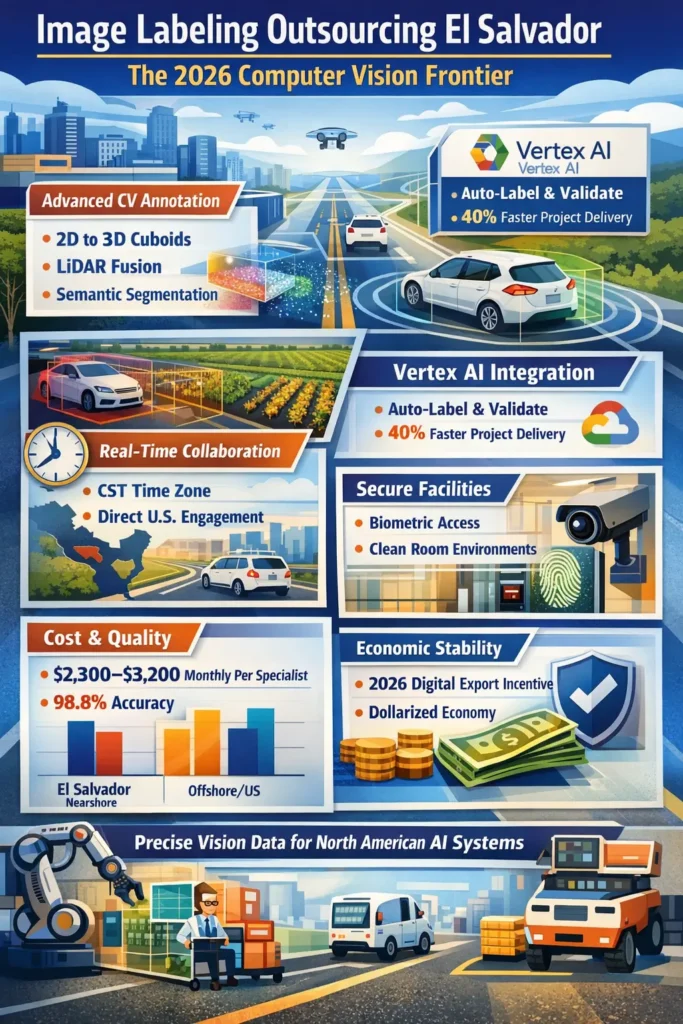
Image labeling in El Salvador has evolved into a discipline defined by precision and operational discipline in 2026. As autonomous systems and spatial computing shift from pilot programs to core infrastructure, the country has positioned itself as a specialized hub for high-accuracy Computer Vision (CV) training data. With a fully loaded monthly cost per specialist ranging from $2,300 to $3,200, Salvadoran teams deliver the responsiveness and contextual alignment required for performance-critical visual models deployed across North America.
30-Second Executive Briefing
- Spatial Intelligence Focus:
Salvadoran delivery centers have advanced from basic 2D annotation to complex 3D cuboids and LiDAR fusion, supporting the rapid expansion of autonomous logistics and warehouse robotics. - The “Vertex AI” Workflow:
Through the Google Cloud–El Salvador partnership (Year 3), labeling operations are embedded within Vertex AI pipelines, enabling “auto-label then validate” workflows that compress project timelines by up to 40%. - Zero-Lag Collaboration:
Operating in Central Standard Time (CST), Salvadoran teams engage directly with U.S.-based engineers in real-time edge-case reviews—critical for models where delays translate directly into performance risk. - Security-First Enclaves:
Facilities in San Salvador and Santa Tecla now operate with biometric-controlled clean-room environments, ensuring that sensitive visual assets—ranging from unreleased product prototypes to medical imagery—remain fully contained. - Economic Stability:
The 2026 Digital Export Incentive stabilizes tax exposure for AI service providers, giving U.S. clients long-term pricing clarity within a fully dollarized economy.
Why El Salvador Is Gaining Ground in Vision Data
What distinguishes El Salvador in 2026 is not scale—it’s control over quality at the edge of complexity. As Computer Vision systems are deployed into real-world environments—retail floors, factory lines, road networks—the margin for error narrows. Mislabeling is no longer a minor defect; it becomes a downstream liability that affects system behavior, operational safety, and financial outcomes.
Salvadoran teams operate closer to this threshold of precision. The combination of real-time collaboration, structured training pipelines, and exposure to Western commercial environments allows annotators to interpret visual ambiguity with greater consistency. This is particularly evident in edge-case scenarios—low-light imagery, occluded objects, or visually similar assets—where generic offshore models tend to degrade.
Equally important is the operational cadence. Working within U.S.-aligned time zones enables continuous iteration rather than delayed batch feedback. Engineers can recalibrate labeling logic, validate edge cases, and redeploy model updates within the same working cycle. This compresses the distance between data preparation and model performance, turning annotation from a passive input into an active component of system optimization.
El Salvador functions less as a volume-based outsourcing destination and more as a precision layer within the Computer Vision pipeline—where accuracy, speed, and interpretive judgment converge to support production-grade deployment.
Beyond Bounding Boxes: The 2026 Visual Tech Stack
In 2026, the complexity of visual datasets has surpassed what generic offshore models can reliably support. El Salvador’s edge is rooted in contextual judgment. Whether annotating construction environments for safety compliance or interpreting satellite imagery for environmental monitoring, teams apply practical, real-world reasoning that reduces model errors and misclassification.
Table 1: 2026 Image Labeling Efficiency & Cost Matrix
| Labeling Intensity | El Salvador (Nearshore) | India/Vietnam (Offshore) | US Domestic (In-house) |
| Loaded Monthly Cost | $2,300 – $3,200 | $1,600 – $2,400 | $6,500 – $10,500 |
| Accuracy (Complex Scenes) | 98.8% | 89% | 99.2% |
| Feedback Loop | Real-time (CST) | 12-Hour Delay | Instant |
| Infrastructure | GDC Edge (Low Latency) | Standard Web | Local Fiber |
| Specialization | Medical/Auto/Retail | High-Volume General | R&D Only |
Service Pillars: 2026 High-Fidelity Visual Units
3D Spatial & LiDAR Fusion
As spatial computing becomes operational standard, Salvadoran teams specialize in aligning 2D imagery with LiDAR point clouds—supporting navigation systems for autonomous vehicles and aerial inspection platforms.
Semantic & Instance Segmentation
Transitioning from bounding boxes to pixel-level precision, this capability is essential for agricultural analytics and medical imaging, where boundary accuracy directly impacts outcomes.
Keypoint & Pose Estimation
Providing structured data for virtual fitting applications and motion tracking systems, specialists annotate skeletal and facial landmarks with frame-level consistency for smooth visual rendering.
Visual Trust & Safety (Moderation)
Focused on distinguishing synthetic from authentic media, these teams support digital platforms by identifying manipulated imagery and deepfake content using forensic annotation techniques.
The 2026 Clean Room Infrastructure
In 2026, safeguarding visual datasets is a primary concern for enterprise AI leaders. El Salvador has responded with tightly controlled data environments.
Google Distributed Cloud (GDC):
Processing occurs on localized infrastructure synchronized with U.S. instances, ensuring sensitive data remains within controlled environments.
Biometric Accountability:
Personnel operate within zero-device zones, supported by biometric access controls and activity monitoring to prevent data leakage.
Audit Transparency:
Every interaction—from annotation to revision—is logged with immutable timestamps, creating a verifiable chain of custody for regulated industries such as healthcare and defense.
Table 2: 2026 Regulatory & Technical Readiness
| Feature | Salvadoran Standard | Business Benefit |
| Data Residency | GDC Sovereign Enclave | Meets strict U.S./EU data requirements |
| Security Law | 2025 Special Cybercrime Law | Legal protection for IP and data integrity |
| Connectivity | 5G Standalone (5G-SA) | Efficient handling of high-resolution datasets |
| Workforce | “Genius Act” Certified | Pre-trained talent in spatial and labeling logic |
| ESG Compliance | Geothermal Powered | Alignment with sustainability mandates |
Case Study: Retail Robotics & Real-Time Inventory
The Challenge:
A global retailer deployed autonomous inventory robots in 2025 but faced a 15% accuracy gap. Offshore teams struggled to distinguish subtle packaging differences between private-label and branded goods, leading to inventory discrepancies.
The Solution:
Operations shifted to a 40-person Computer Vision pod in Soyapango, El Salvador. Annotators were provided with physical product samples to ground visual interpretation.
The Results:
- Labeling Precision: Increased to 99.4% within three weeks
- Deployment Speed: Model updates moved from weekly to daily cycles (CST alignment)
- Financial Impact: Reduced inventory discrepancies by $4.2M annually while maintaining a 55% cost advantage over prior U.S.-based efforts
Frequently Asked Questions (FAQs)
How does El Salvador handle 4K video labeling without lag?
Leading providers deploy Google Distributed Cloud (GDC) infrastructure locally, allowing seamless navigation of high-resolution video without latency constraints.
Can teams work within proprietary labeling environments?
Yes. Delivery teams are tool-agnostic and integrate via secure virtual desktop environments across platforms such as Labelbox, Scale AI, or custom-built systems.
How is temporal consistency maintained in video annotation?
Dedicated sequence ownership ensures continuity, supported by assisted object tracking that suggests frame progression while allowing human validation for accuracy.
What is the impact of the 2026 “Genius Act”?
The initiative embeds spatial reasoning and coordinate-based thinking into early education, reducing onboarding time for advanced annotation tasks by up to 60%.
Is the $3,200 monthly rate fully loaded?
Yes. This includes compensation, statutory benefits (including Aguinaldo), social security contributions (ISSS), high-performance workstations, and secure facility overhead aligned with SOC2 standards.
Share This
Unlock cost-efficient growth with expert BPO guidance!
Partner with Cynergy BPO to connect with top outsourcing providers.
Streamline operations, cut costs, and scale your business with confidence.
Book a Free Call
Ralf Ellspermann - CSO
Author
Ralf Ellspermann is the Chief Strategy Officer (CSO) of Cynergy BPO and a globally recognized authority in business process and contact center outsourcing. With more than 25 years of experience advising enterprises and SMEs, he provides strategic guidance on vendor selection, CX optimization, and scalable outsourcing strategies across global markets. His expertise spans fintech, ecommerce and retail, healthcare, insurance, travel and hospitality, and technology (AI & SaaS) outsourcing.
A frequent speaker at leading industry conferences, Ralf is also a published contributor to The Times of India and CustomerThink, where he shares insights on outsourcing strategy, customer experience, and digital transformation.