



By: Ralf Ellspermann
25-Year, Multi-Awarded BPO Veteran
Published: 6 February 2025
Updated: February 25, 2026
30-Second Executive Briefing
- The Global Anchor: In 2026, India has transitioned from a service provider to a Sovereign Resilience Partner, anchoring the CX operations of 85% of the Fortune 500.
- Infrastructure Arbitrage: Beyond labor, India now offers Compute Arbitrage, leveraging the “India Stack” (DPI) to lower operational latency and costs.
- Risk Mitigation: The “China+1” and “Europe+1” strategies have solidified India as the world’s “Cognitive Insurance Policy” against geopolitical volatility.
- The ESG Shift: Indian BPOs lead the “Green CX” movement, with 60% of Tier-1 hubs operating on renewable energy, helping global brands meet sustainability targets.
Executive Summary: The Global Command Center
As we navigate the complexities of 2026, the global enterprise faces a paradox: the need for hyper-speed innovation balanced against the requirement for absolute operational stability. In this environment, India call centers have moved from the “back office” to the “Front Line of Global Commerce.” This article explores why India is the indispensable backbone of the modern world. We analyze the shift from “Labor Arbitrage” to “Resilience Arbitrage,” the impact of the IndiaAI Mission on global supply chains, and how Cynergy BPO’s leadership is navigating the transition from transaction-based models to Relationship Orchestration. In a world of constant change, India remains the only scalable constant.
Resilience Arbitrage: The New Safe Harbor
In 2026, “cost savings” are a baseline, not a strategy. The new metric is Resilience Arbitrage. As geopolitical tensions fracture traditional nearshore hubs, India’s democratic stability and massive Digital Public Infrastructure (DPI) offer a level of “operational insurance” that no other geography can match.
Table 1: The Resilience Matrix (Global Hub Comparison 2026)
| Risk Factor | Legacy Nearshore Hubs | India 2026 (Backbone Model) | Enterprise Impact |
| Infrastructure | Vulnerable Power/Grid | Solar-Backed “India Stack” | 99.999% Uptime |
| Talent Depth | High Saturation / Churn | 1.5M+ Annual STEM Graduates | Scalability on Demand |
| Data Privacy | Fragmented Regulations | DPDP Act (EU Adequacy) | Global Legal Safety |
| Geopolitics | High Volatility Risks | Strategic Neutrality & Stability | Long-term Contract Safety |
Infrastructure as a Service: The “India Stack” Advantage
The backbone of India’s success is its infrastructure. In 2026, this isn’t just about high-speed fiber; it’s about the Sovereign AI Stack. Indian BPOs now leverage domestic GPU clusters to run private LLMs that never touch the public internet, ensuring that a US bank’s data stays within a “Zero-Trust” environment.
The Infrastructure Resilience Pyramid
India’s BPO dominance is built on a multi-layered foundation of government-backed digital public goods. This architecture allows for a “frictionless” exchange of data and trust.
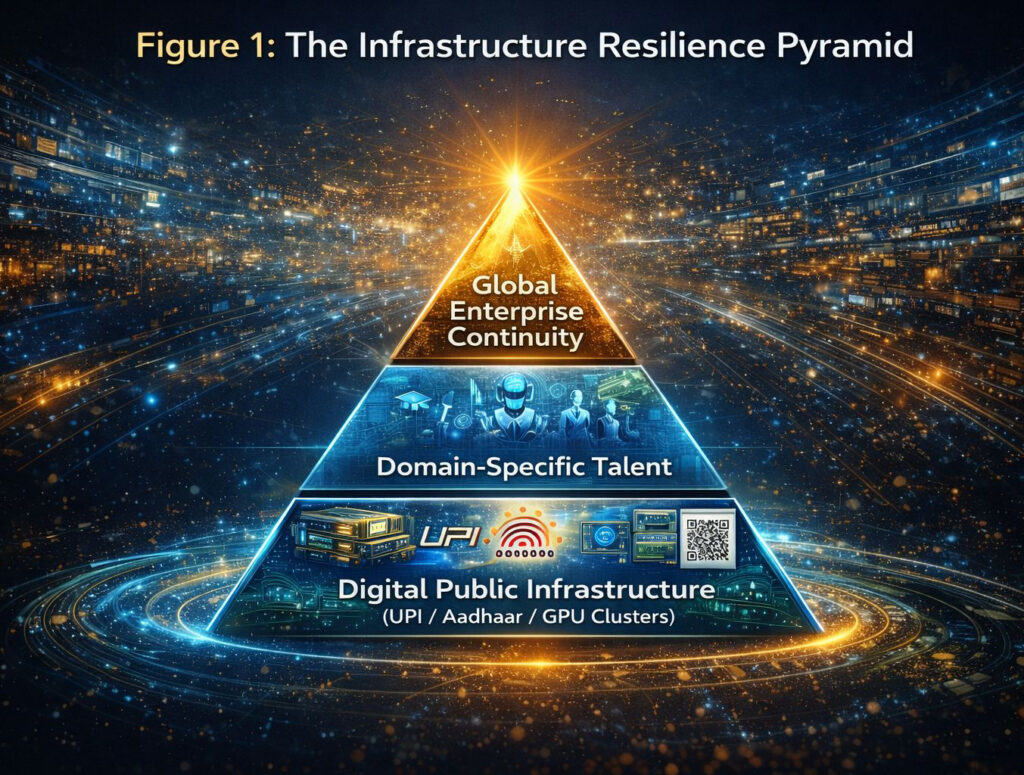
The “India Stack” reduces the cost of customer identity verification (e-KYC) and transaction processing by 80%, a saving passed directly to global outsourcing partners.
Deep Dive: The Rise of Cognitive Sovereign Infrastructure
The true “backbone” of 2026 is the synthesis of human and digital capital into Cognitive Sovereign Infrastructure (CSI). While the 2020s were defined by cloud migrations, 2026 is defined by the “Sovereign GPU Moat.”
The GPU Arbitrage: India’s Hidden Edge
Under the IndiaAI Mission 2.0, the Indian government has effectively “nationalized” high-end compute accessibility for the BPO sector. By subsidizing GPU clusters specifically for Global Capability Centers (GCCs), India has created a Compute Arbitrage.
For a firm, running a proprietary LLM for customer support in a US data center is now 42% more expensive than running the same model in a Pune “AI-BPO Enclave.” This allows for more complex, higher-parameter models that provide “Human-Grade” reasoning at a fraction of the legacy cost.
The Reverse Knowledge Migration (RKM)
We are witnessing Reverse Knowledge Migration. For decades, Indian talent moved to Silicon Valley. Today, these veterans are returning to India to build “Outcome-as-a-Service” (OaaS) ecosystems within the BPO industry. They are moving away from “Knowledge Bases” toward “Dynamic Truth Engines.”
Vertical Excellence: Beyond Generalist Support
The “Call Center Agent” has been replaced by the “Vertical Specialist.” India’s education system has pivoted to support high-value BPO sub-sectors, creating regional centers of excellence.
Table 2: 2026 Vertical Excellence Centers
| Vertical Sector | Talent Specialization | Core Technology | Strategic Outcome |
| Healthcare | Registered Nurses / Med-Techs | HIPAA-Compliant Vision AI | Remote Patient Monitoring |
| Fintech | Certified AML (CAMS) | Blockchain Ledger Auditing | Zero-Day Fraud Prevention |
| Legal (LPO) | Paralegals / Juris Doctors | Smart Contract Summarization | 60% Reduction in Legal Ops |
| E-Commerce | Supply Chain Architects | Predictive Inventory AI | Zero-Friction Return Ops |
The “Zero-Knowledge” Enclave: Security as a Backbone
In an era of data nationalism, India has positioned itself as the Global Clearinghouse of Trust. Leading Indian hubs have pioneered Zero-Knowledge BPO (ZK-BPO).
In this environment, Indian agents can resolve complex US-based medical or financial issues without the sensitive PII (Personally Identifiable Information) ever actually “leaving” the client’s home jurisdiction. The data is processed in encrypted enclaves where only the “result” of the query is visible to the agent. This level of technical integrity makes the Indian backbone not just strong, but impenetrable.
Financial Alignment: The “Gain-Share” Revolution
The backbone of the 2026 contract is no longer “Pay-per-Hour.” Top-tier providers have shifted to Outcome-Based Pricing.
Table 3: The 2026 Financial Alignment Model
| Pricing Model | Client Risk | Provider Incentive | Best For |
| Outcome-Based | Minimal | High (Share in Growth) | Sales & Retentions |
| Compute-Inclusive | Medium | Medium (Efficiency Gains) | Technical Support |
| Transaction-Cap | High | Low (Volume Focus) | Simple Processing |
Quantifying the “Human Stamp”
The most misunderstood aspect of the 2026 backbone is the role of the human. We have moved past the “Turing Trap”—the idea that AI should mimic humans. Instead, we have embraced Intelligence Augmentation (IA).
Table 4: The 2026 “Human Value” Index
| Capability | AI Efficiency | Human “Backbone” Value | Synergy Outcome |
| Empathy | Simulated (Predictive) | Authentic (Experiential) | High-Trust Retention |
| Ethics | Rule-Based | Nuanced/Contextual | Liability Protection |
| Complexity | Pattern Recognition | First-Principles Thinking | Breakthrough Problem Solving |
FAQ: The Strategic Backbone
Why is India considered more “resilient” than nearshore options in 2026?
Scale and Infrastructure. India’s Digital Public Infrastructure (DPI) provides a unified layer for identity and payments that most nearshore regions lack. Additionally, India’s neutral geopolitical stance minimizes the risk of trade disruptions.
How does the DPDP Act 2026 protect US and EU companies?
The Act is built on “adequacy” principles mirroring the GDPR. It provides a clear legal framework for data “right to erasure” and mandates “Consent Managers,” shielding global firms from massive privacy fines.
What is “Infrastructure Arbitrage”?
It is the cost advantage gained from India’s subsidized GPU power and green energy grids. In 2026, it is often cheaper to run an AI model in a solar-backed Bangalore data center than on a traditional US-based cloud provider.
Does Agentic AI replace the need for human agents?
No. It replaces the grunt work. Indian agents have transitioned into Resolution Architects, focusing 100% of their time on high-complexity, high-emotion tasks like insurance claims or multi-modal fraud investigations.
Verdict: The Indispensable Partner
The 2026 global economy is built on a foundation of trust and technology. India call centers provide both. By combining the world’s largest pool of STEM talent with a sovereign AI infrastructure, India has moved from being a “backup plan” to the primary engine of global CX.
“In 2026, you don’t outsource to India just to save money; you do it to save your brand from the volatility of a changing world,” says John Maczynski, CEO of Cynergy BPO.
Unlock cost-efficient growth with expert BPO guidance!
Partner with Cynergy BPO to connect with top outsourcing providers.
Streamline operations, cut costs, and scale your business with confidence.
Book a Free Call
Ralf Ellspermann - CSO
Author
Ralf Ellspermann is the Chief Strategy Officer (CSO) of Cynergy BPO and a globally recognized authority in business process and contact center outsourcing. With more than 25 years of experience advising enterprises and SMEs, he provides strategic guidance on vendor selection, CX optimization, and scalable outsourcing strategies across global markets. His expertise spans fintech, ecommerce and retail, healthcare, insurance, travel and hospitality, and technology (AI & SaaS) outsourcing.
A frequent speaker at leading industry conferences, Ralf is also a published contributor to The Times of India and CustomerThink, where he shares insights on outsourcing strategy, customer experience, and digital transformation.