



By: Ralf Ellspermann
25-Year, Multi-Awarded BPO Veteran
Published: 4 April 2026
Updated: March 23, 2026
Labeling Services to Colombia gives enterprises a nearshore way to turn raw, unstructured data into dependable training assets for modern AI. In 2026, Colombia has become more than a support location for basic annotation. It is increasingly used as a precision delivery hub for multimodal data alignment, expert-in-the-loop review, RLHF, and audit-ready human oversight for high-stakes AI systems.
- Colombia has evolved into a nearshore center for high-precision labeling across text, audio, video, and sensor-rich AI workflows.
- The work now extends beyond tagging into multimodal synchronization, bias review, expert validation, and reinforcement learning support.
- Time-zone alignment with North America allows same-day calibration between engineering teams and annotation operations.
- Colombian providers are increasingly used for regulated and high-risk use cases where traceability and human oversight matter.
- Secure zero-possession environments support sensitive datasets in healthcare, finance, legal, and enterprise AI programs.
- The main business gain is better model reliability, faster iteration, and stronger compliance readiness.
Why Labeling Has Become a Strategic AI Function
The quality of an AI system is still determined, to a large extent, by the quality of the human judgment embedded in its training data. That truth has become sharper in 2026 as enterprises move from narrow models toward multimodal and agentic systems that must interpret language, sound, images, movement, and context at the same time.
This change has altered the role of labeling. It is no longer enough to identify an object in an image or assign a sentiment score to a sentence. Modern AI requires structured human input that can connect events across multiple data streams, resolve ambiguity, document rationale, and create the kind of ground truth that holds up under real-world pressure.
That is why Colombia is drawing more attention. The country’s labeling ecosystem is increasingly aligned with what enterprise buyers now need: technical maturity, linguistic and cultural fluency, real-time collaboration, and secure delivery models that support sensitive, high-value data.
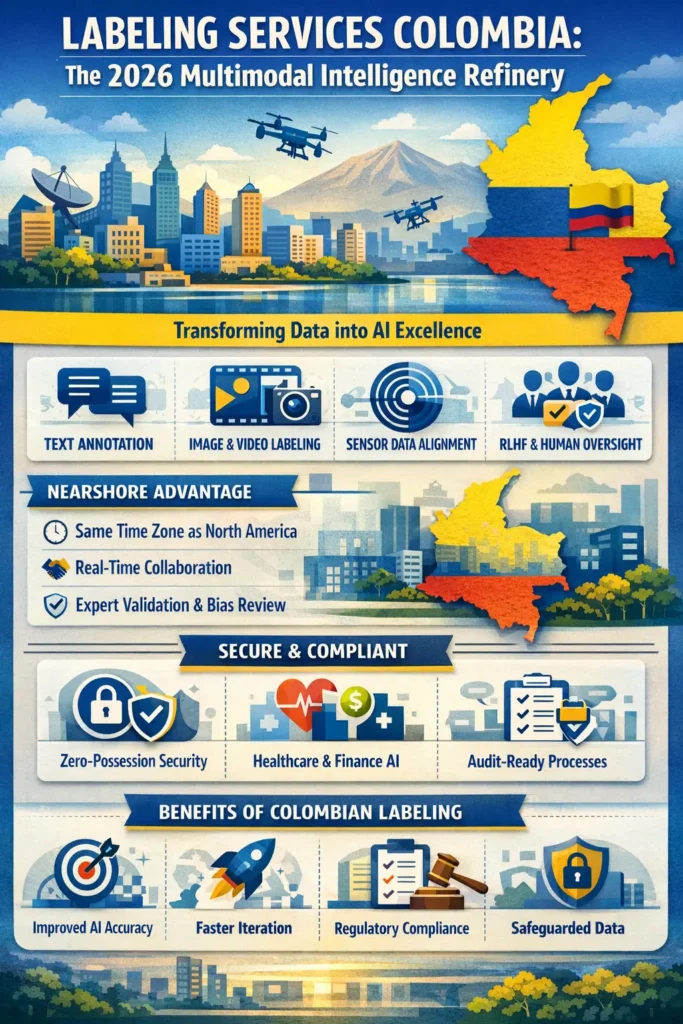
Colombia’s Rise as a Nearshore Intelligence Refinery
Colombia’s relevance in AI operations comes from more than labor availability. Its appeal lies in its ability to function as a synchronized extension of North American model teams.
For fast-moving AI programs, delay is costly. A 12-hour feedback lag between data scientists and annotation teams can slow retraining cycles, delay model corrections, and compound quality errors. Colombian operations reduce that friction by working in compatible time zones, allowing live guideline updates, immediate exception reviews, and faster relaunch of production batches.
That operating model is especially valuable in multimodal environments. When a team is labeling video, aligning audio transcripts, validating sensor cues, and refining model outputs at once, the work becomes highly iterative. Colombia’s nearshore advantage supports that pace.
There is also a talent dimension. Colombian specialists are increasingly used not just for general-purpose annotation, but for work that requires contextual interpretation. In sectors such as healthcare, legal analysis, customer experience, and industrial AI, the difference between a useful label and a misleading one often comes down to nuance. Strong providers in Colombia are building around that requirement.
From Simple Tagging to Human Oversight
The most important shift in 2026 is that labeling has become inseparable from human oversight. Regulatory pressure is part of the reason. High-risk AI systems increasingly require documented human involvement in validation, especially when outputs affect safety, rights, financial outcomes, or regulated decisions.
That has pushed labeling operations into a more strategic role. Enterprises now need providers that can support bias checks, review weak labels created by automated systems, maintain traceable annotation logs, and escalate uncertain cases instead of forcing false confidence into the dataset.
Colombia fits this model well because many of its leading providers operate with structured human-in-the-loop frameworks. The value is not merely that humans touch the data. The value is that their judgment is governed, reviewable, and operationally integrated into the model-development cycle.
John Maczynski, CEO of Cynergy BPO, has framed this evolution in practical terms: the market no longer rewards raw data volume alone. It rewards traceable integrity—the ability to show how training data was created, verified, and aligned with both performance and compliance expectations.
Table 1: Strategic Benefits of Colombian Labeling Services in 2026
| Advantage | Technical Focus | Strategic Outcome |
| Multimodal Synchronization | Aligning text, audio, video, and sensor streams with temporal accuracy | Better performance for multimodal and agentic AI |
| Domain-Specific Validation | Labels reviewed by specialists in areas such as medicine, law, and engineering | Higher accuracy for regulated and high-risk use cases |
| RLHF Support | Human ranking and feedback on model outputs | Safer, smarter, and more aligned AI behavior |
| Audit-Ready Traceability | Immutable logging of label origin, reviewer actions, and methods | Stronger transparency and compliance posture |
| Zero-Possession Security | Encrypted VDI with no local saving or external access | Better protection for sensitive enterprise data |
The Modern Labeling Lifecycle
High-quality labeling programs now begin well before annotation itself. Enterprises first need dataset curation to remove noise, duplication, and low-value records. They then need pre-label validation, often involving human correction of AI-generated weak labels, followed by layered QA, fairness review, and benchmark creation.
Colombian providers are increasingly active across that full lifecycle. Rather than acting as isolated task processors, they support the broader data engineering function that keeps model pipelines reliable over time.
That includes active learning loops, where human effort is concentrated on the model’s most uncertain predictions, and golden set management, where static high-accuracy benchmark data is maintained to measure progress and detect drift. In more sensitive environments, it also includes PII redaction and controlled handling of confidential information before training even begins.
Table 2: The 2026 Labeling Lifecycle in Colombia
| Phase | Colombian Contribution | Enterprise Value |
| Dataset Curation | Removing duplicates, noise, and low-quality samples | Lower compute waste and cleaner training sets |
| Pre-Label Validation | Correcting automated weak labels | Faster throughput without sacrificing accuracy |
| Bias and Fairness Review | Auditing for skew and cultural misinterpretation | More reliable model behavior across populations |
| Active Learning Support | Directing reviewers to uncertain or high-value cases | Lower total labeling cost over time |
| PII Redaction | Masking sensitive personal information before use | Stronger privacy compliance and safer AI workflows |
| Golden Set Management | Building benchmark datasets for evaluation | Better drift monitoring and model measurement |
Why Colombia Matters in the Next Phase of AI
As enterprises deploy AI into customer interaction, diagnostics, autonomous systems, and reasoning-heavy workflows, the human training layer becomes a competitive differentiator. Models improve when the data behind them is not only abundant, but logically structured, ethically reviewed, and operationally traceable.
That is the case for Colombia in 2026. Its labeling sector is increasingly valuable because it supports the difficult parts of AI development: multimodal logic, synchronized feedback, expert review, and secure, documented human oversight. For companies building AI that must perform reliably in production, that combination makes Colombia more than an outsourcing destination. It makes it part of the intelligence infrastructure itself.
Expert FAQs
What makes labeling services in Colombia different in 2026?
The strongest providers now support multimodal annotation, expert validation, RLHF, bias review, and secure human-in-the-loop operations rather than only basic tagging.
Why is nearshore delivery important for labeling?
It allows engineering teams and annotation teams to refine guidelines, review errors, and restart production within the same business day.
Can Colombian teams support regulated industries?
Yes. Many providers increasingly handle healthcare, legal, financial, and other high-sensitivity datasets through controlled environments and traceable workflows.
What is the role of RLHF in labeling services?
RLHF uses human feedback to rank and refine model outputs, helping improve reasoning quality, safety, and alignment.
How is sensitive data protected?
Leading providers use zero-possession environments, encrypted virtual desktops, and access controls that prevent local storage or unauthorized transfer of data.
Share This
Unlock cost-efficient growth with expert BPO guidance!
Partner with Cynergy BPO to connect with top outsourcing providers.
Streamline operations, cut costs, and scale your business with confidence.
Book a Free Call
Ralf Ellspermann - CSO
Author
Ralf Ellspermann is the Chief Strategy Officer (CSO) of Cynergy BPO and a globally recognized authority in business process and contact center outsourcing. With more than 25 years of experience advising enterprises and SMEs, he provides strategic guidance on vendor selection, CX optimization, and scalable outsourcing strategies across global markets. His expertise spans fintech, ecommerce and retail, healthcare, insurance, travel and hospitality, and technology (AI & SaaS) outsourcing.
A frequent speaker at leading industry conferences, Ralf is also a published contributor to The Times of India and CustomerThink, where he shares insights on outsourcing strategy, customer experience, and digital transformation.