


By: Ralf Ellspermann
25-Year, Multi-Awarded BPO Veteran
Published: 21 March 2026
Updated: March 18, 2026
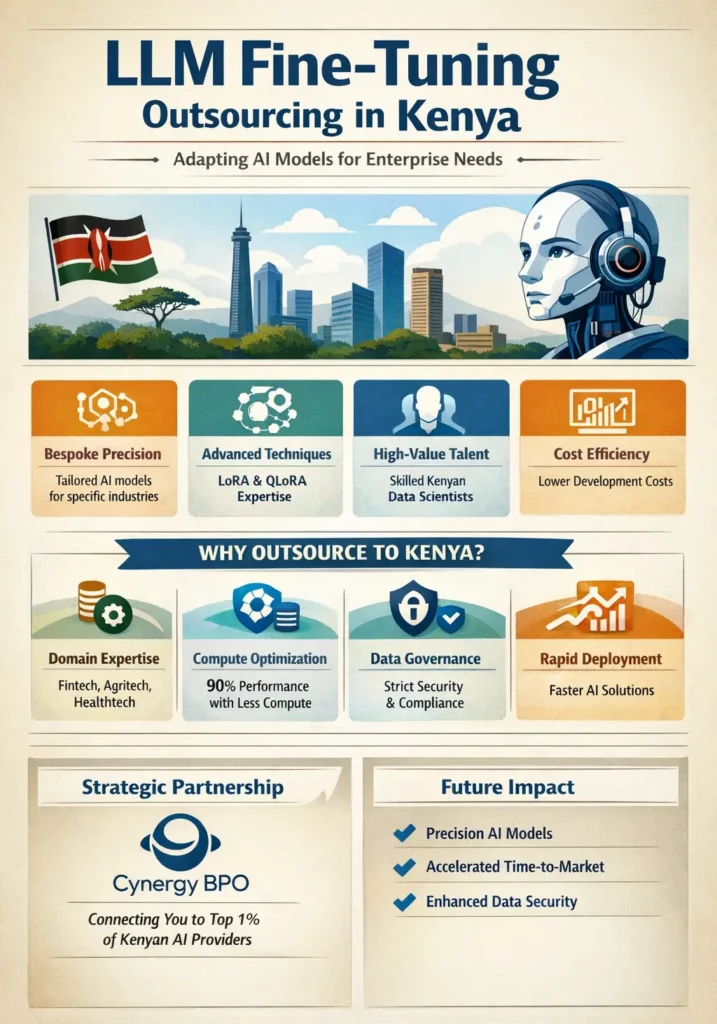
Kenya has emerged as a premier destination for Large Language Model (LLM) fine-tuning, offering the technical depth required to transform generic AI into specialized enterprise assets. By leveraging local expertise in Parameter-Efficient Fine-Tuning (PEFT) and Low-Rank Adaptation (LoRA), global organizations can develop bespoke, high-accuracy models that master industry-specific jargon and proprietary workflows at a fraction of Western development costs.
Executive Briefing:
- Bespoke Precision: Kenyan AI engineers specialize in adapting base models (like Llama 3 or Gemini) to mirror specific corporate voices and technical domains.
- Technological Mastery: Local firms utilize advanced LoRA and QLoRA techniques to provide 90% of full-precision performance with significantly reduced compute overhead.
- High-Value Talent: The “Silicon Savannah” offers a deep pool of data scientists and ML engineers focused on solving complex data governance and “catastrophic forgetting” challenges.
- Cost-Benefit Leadership: Outsourcing fine-tuning to Kenya enables mid-market firms to deploy private, sovereign AI models that were previously cost-prohibitive.
- Governance Assurance: Cynergy BPO acts as a strategic architect, connecting enterprises with the top 1% of vetted Kenyan AI-ops providers to ensure data security and ROI.
The Strategic Imperative of LLM Fine-Tuning in the Enterprise
Generic large language models, while impressive, often stumble when faced with the granular demands of specialized industries. For a foundational model to truly drive value, it must move beyond general conversation and master the specific vocabulary, regulatory requirements, and strategic nuances of an organization. Fine-tuning is the process that bridges this gap, evolving broad AI capabilities into precision-engineered instruments.
In the 2026 landscape, sophisticated fine-tuning is no longer a luxury—it is a competitive necessity. By updating a model’s weights with proprietary datasets, businesses can achieve higher accuracy, eliminate common hallucinations, and maintain strict data sovereignty. Choosing to outsource these complex operations to Kenya allows enterprises to access elite technical skills while accelerating their time-to-market for specialized AI applications.
Kenya’s Ascent as an AI Fine-Tuning Powerhouse
Kenya is rapidly solidifying its reputation as a global center for advanced AI operations. This rise is underpinned by the National AI Strategy (2025–2030) and massive investments in digital infrastructure, including the expansion of regional data centers and high-performance compute access. Nairobi has become a magnet for “sovereign talent”—specialists who are adept at localizing and refining global AI architectures.
Outsourcing to this East African tech hub provides more than just cost savings; it offers a partnership with a dynamic ecosystem that understands the complexities of the “Intelligence Economy.” Kenyan firms are at the forefront of AI research, often collaborating on international summits to define the future of ethical and scalable machine learning. This environment ensures that enterprise models are refined by professionals who are as versed in global best practices as they are in technical execution.
Navigating the Fine-Tuning Landscape: A Partnership Approach
Successfully adapting an LLM requires a delicate balance of technical prowess, data ethics, and business alignment. It is not enough to simply feed data into a model; one must manage the risks of overfitting and ensure the model remains robust across various edge cases. This is where the role of Cynergy BPO becomes critical for global firms.
As a governance architect, Cynergy BPO meticulously vets the Kenyan AI-ops market to identify the top 1% of providers. These elite firms are selected for their mastery of diverse fine-tuning methodologies and their commitment to stringent data privacy standards. By facilitating these high-level partnerships, Cynergy BPO ensures that global enterprises can integrate Kenyan talent into their workflows with zero friction and maximum strategic impact.
“The shift toward specialized AI outsourcing is about more than just efficiency—it’s about accessing a level of expertise that can fundamentally transform a company’s intellectual property into a digital advantage,” notes John Maczynski, a leading expert in global outsourcing strategy. “Kenya is currently setting the pace, offering a rare blend of deep technical proficiency and an agile approach to complex data challenges. Enterprises that embrace this model will be the ones defining the next decade of AI innovation.”
Table 1: Strategic Advantages of Fine-Tuning in Kenya
| Advantage | Enterprise Impact |
| Domain-Specific Talent | Access to ML engineers who specialize in niche industries like Fintech, Agritech, and Healthtech. |
| Compute Efficiency | Mastery of PEFT and QLoRA techniques that lower GPU requirements and inference costs. |
| Rapid Iteration | Agile development cycles that bring customized AI products to market 40% faster. |
| Scale & Flexibility | Ability to spin up dedicated “Model Teams” to handle massive proprietary datasets. |
| Security & Ethics | Partnerships with firms that prioritize local data residency and quantum-resistant encryption. |
The Future of Enterprise AI: Precision and Performance
The era of the “generalist” AI is fading as businesses demand systems that perform mission-critical tasks with surgical precision. The true impact of foundational models will be realized through these “adaptation layers” that align AI behavior with unique corporate goals. Kenya is perfectly positioned to serve as the engine for this transition.
By 2027, the ability to fine-tune and maintain private LLMs will be the hallmark of an industry leader. Outsourcing these functions to Kenya offers a sustainable path to this future, combining specialized human capital with an infrastructure optimized for high-performance AI. For the forward-thinking organization, this talent corridor is not just a source of labor—it is the gateway to the next frontier of intelligent business.
Table 2: Comparing LLM Adaptation Methodologies
| Approach | Technical Execution | Best Use Case |
| Full Fine-Tuning | Adjusts all neural parameters; resource-intensive. | Creating entirely new “expert” models for deep technical domains. |
| LoRA / QLoRA | Trains small “adapter” layers while freezing the base model. | Cost-effective adaptation for specific brand voices or dialects. |
| RLHF | Uses human feedback to optimize for preference and safety. | Aligning customer-facing bots with corporate ethical guidelines. |
| RAG Integration | Connects the LLM to real-time external knowledge bases. | Applications requiring up-to-the-minute data without retraining. |
Expert FAQ
Why is fine-tuning better than just using a better prompt?
While prompt engineering is effective for guidance, fine-tuning permanently changes the model’s “behavioral DNA.” This leads to much higher consistency in complex tasks and reduces the token cost of long, repetitive prompts.
How does Kenya handle the high compute power required for AI?
Through initiatives like the Nairobi AI Forum, Kenyan innovators now have access to millions of GPU hours via partnerships with global cloud providers and sovereign compute hubs, ensuring they can handle enterprise-scale training.
Is my data safe during the fine-tuning process?
Yes. Vetted Kenyan partners adhere to international standards (like GDPR and Kenya’s Data Protection Act) and often utilize “Clean Room” environments where your data is used for training but never leaves a secured, encrypted perimeter.
Can fine-tuning reduce my ongoing AI costs?
Significantly. A smaller, fine-tuned model (e.g., a 7B or 13B parameter model) often outperforms a massive, generic model (like GPT-4) on specific tasks while being 10x–15x cheaper to run per query.
Unlock cost-efficient growth with expert BPO guidance!
Partner with Cynergy BPO to connect with top outsourcing providers.
Streamline operations, cut costs, and scale your business with confidence.
Book a Free Call
Ralf Ellspermann - CSO
Author
Ralf Ellspermann is the Chief Strategy Officer (CSO) of Cynergy BPO and a globally recognized authority in business process and contact center outsourcing. With more than 25 years of experience advising enterprises and SMEs, he provides strategic guidance on vendor selection, CX optimization, and scalable outsourcing strategies across global markets. His expertise spans fintech, ecommerce and retail, healthcare, insurance, travel and hospitality, and technology (AI & SaaS) outsourcing.
A frequent speaker at leading industry conferences, Ralf is also a published contributor to The Times of India and CustomerThink, where he shares insights on outsourcing strategy, customer experience, and digital transformation.